Event submissions
Published

This submission belongs to the session B. Posters of the event 5th International Electronic Conference on Medicinal Chemistry
Published date
08 Nov, 2019
Citation
Cláudia de Almeida Pinto, Bruno M. Fonseca, Susana I. Sá, Effects of chronic Tamoxifen treatment in the hypothalamic circuitry that regulates female sexual behaviour, in Proceedings of 5th International Electronic Conference on Medicinal Chemistry, 1 November–30 November 2019, MDPI: Basel, Switzerland, doi: 10.3390/ECMC2019-06404
Share
Email
Facebook
Twitter
LinkedIn
Effects of chronic Tamoxifen treatment in the hypothalamic circuitry that regulates female sexual behaviour
'%3e%3cpath%20d='M12.6647%2010.9104C12.4176%2010.325%2012.0589%209.7933%2011.6088%209.34485C11.16%208.89511%2010.6283%208.53653%2010.0432%208.28891C10.038%208.28629%2010.0327%208.28498%2010.0275%208.28236C10.8437%207.69282%2011.3743%206.73252%2011.3743%205.64907C11.3743%203.85423%209.92005%202.40002%208.12522%202.40002C6.33038%202.40002%204.87618%203.85423%204.87618%205.64907C4.87618%206.73252%205.40677%207.69282%206.22296%208.28367C6.21772%208.28629%206.21248%208.2876%206.20724%208.29022C5.62031%208.53783%205.09365%208.89287%204.64167%209.34616C4.19192%209.79496%203.83334%2010.3266%203.58573%2010.9117C3.34247%2011.4846%203.21128%2012.0987%203.19925%2012.721C3.1989%2012.735%203.20135%2012.7489%203.20646%2012.7619C3.21157%2012.7749%203.21924%2012.7868%203.22901%2012.7968C3.23877%2012.8068%203.25045%2012.8148%203.26334%2012.8202C3.27623%2012.8256%203.29007%2012.8284%203.30406%2012.8284H4.09012C4.14776%2012.8284%204.19362%2012.7825%204.19493%2012.7262C4.22113%2011.7148%204.62726%2010.7676%205.34519%2010.0497C6.08802%209.30686%207.07452%208.89811%208.12522%208.89811C9.17592%208.89811%2010.1624%209.30686%2010.9052%2010.0497C11.6232%2010.7676%2012.0293%2011.7148%2012.0555%2012.7262C12.0568%2012.7839%2012.1027%2012.8284%2012.1603%2012.8284H12.9464C12.9604%2012.8284%2012.9742%2012.8256%2012.9871%2012.8202C13%2012.8148%2013.0117%2012.8068%2013.0214%2012.7968C13.0312%2012.7868%2013.0389%2012.7749%2013.044%2012.7619C13.0491%2012.7489%2013.0515%2012.735%2013.0512%2012.721C13.0381%2012.0947%2012.9084%2011.4856%2012.6647%2010.9104ZM8.12522%207.90243C7.52388%207.90243%206.95792%207.66793%206.53214%207.24215C6.10636%206.81636%205.87185%206.2504%205.87185%205.64907C5.87185%205.04773%206.10636%204.48177%206.53214%204.05599C6.95792%203.63021%207.52388%203.3957%208.12522%203.3957C8.72655%203.3957%209.29252%203.63021%209.7183%204.05599C10.1441%204.48177%2010.3786%205.04773%2010.3786%205.64907C10.3786%206.2504%2010.1441%206.81636%209.7183%207.24215C9.29252%207.66793%208.72655%207.90243%208.12522%207.90243Z'%20fill='%235D1EE1'/%3e%3c/g%3e%3c/svg%3e)
Cláudia de Almeida Pinto 1
Bruno M. Fonseca 2
Susana I. Sá 1,3
1. Department of Biomedicine, Unit of Anatomy, Faculty of Medicine, University of Porto, Portugal
2. UCIBIO, REQUIMTE, Laboratory of Biochemistry, Department of Biological Sciences, Faculty of Pharmacy, University of Porto, Portugal
3. Center for Health Technology and Services Research (CINTESIS), Faculty of Medicine, University of Porto, Portugal
Abstract
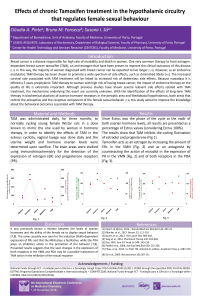
Breast cancer (BC) is a disease responsible for high rate of morbidity and death in women. Tamoxifen (TAM) has been used for decades as an anti-estrogen in estrogen-dependent BC treatment while endocrine therapies have improved the clinical outcomes in this disease.
Nevertheless, TAM therapy is still accompanied by a wide spectrum of side effects. By expanding the indications for endocrine therapy, the majority of women diagnosed with BC can be expected to live longer. The increased survival rate leads to increased risk of deleterious side effects associated with TAM treatment. Because nowadays it is offered a 5 years prophylactic TAM therapy to woman with high risk of having BC, the impact of endocrine therapy on the quality of life is extremely important.
Previous studies have shown that TAM inhibits female rodent sexual behavior and women taking TAM complain about diminished libido; however, the mechanisms underlying this event are currently unknown. With the identification of the effects of long-term TAM therapy in the structural and biochemical plasticity of the medial preoptic (MPN) and the ventromedial hypothalamic nuclei (VMN), hypothalamic areas that control the proceptive and the receptive component, respectively, of the female sexual behavior, this study aimed to improve the knowledge about the behavioral outcomes associated with TAM therapy.
TAM was administrated daily, for three months, to normally cycling young female Wistar rats in a dose known to mimic the one used by woman in hormone therapy. In order to identify the effects of TAM in the estrous cyclicity, vaginal lavage was done daily and the uterine weight and estradiol levels were determined upon sacrifice. The brain areas were studied using immunohistochemistry for the detection of the expression of estrogen and progesterone receptors. The results show that TAM inhibits the cycling fluctuation of estradiol and progesterone inducing changes in the expression and co-expression of both receptors in the VMN and MPN suggesting a possible mechanism of action in the inhibition of the sexual response.
Keywords
Female rat
Tamoxifen
Ovarian hormone levels
Estrogen receptors
Progesterone receptors
Hypothalamus
Manuscript
2.ecmc-5_ecmc-5_Poster pdf.pdf
Poster
sciforum-028021.pdf
Tryptophanol-derived oxazoloisoindolinones: Novel small molecule p53 activators with promising antitumor activity
Abietane Diterpenoids from Plectranthus spp. as a potential new class of Protein Kinase C Modulators