Event submissions
Published

This submission belongs to the session B. Posters of the event 5th International Electronic Conference on Medicinal Chemistry
Published date
11 Nov, 2019
Citation
Soraia Pedro, Mafalda Laranjo, António Aguiar, Maria Filomena Botelho, Abilio J.F.N. Sobral, Photodynamic therapy on a human lung cancer cell line a549 with new bodipy photosensitizers, in Proceedings of 5th International Electronic Conference on Medicinal Chemistry, 1 November–30 November 2019, MDPI: Basel, Switzerland, doi: 10.3390/ECMC2019-06412
Share
Email
Facebook
Twitter
LinkedIn
Photodynamic therapy on a human lung cancer cell line a549 with new bodipy photosensitizers
'%3e%3cpath%20d='M12.6647%2010.9104C12.4176%2010.325%2012.0589%209.7933%2011.6088%209.34485C11.16%208.89511%2010.6283%208.53653%2010.0432%208.28891C10.038%208.28629%2010.0327%208.28498%2010.0275%208.28236C10.8437%207.69282%2011.3743%206.73252%2011.3743%205.64907C11.3743%203.85423%209.92005%202.40002%208.12522%202.40002C6.33038%202.40002%204.87618%203.85423%204.87618%205.64907C4.87618%206.73252%205.40677%207.69282%206.22296%208.28367C6.21772%208.28629%206.21248%208.2876%206.20724%208.29022C5.62031%208.53783%205.09365%208.89287%204.64167%209.34616C4.19192%209.79496%203.83334%2010.3266%203.58573%2010.9117C3.34247%2011.4846%203.21128%2012.0987%203.19925%2012.721C3.1989%2012.735%203.20135%2012.7489%203.20646%2012.7619C3.21157%2012.7749%203.21924%2012.7868%203.22901%2012.7968C3.23877%2012.8068%203.25045%2012.8148%203.26334%2012.8202C3.27623%2012.8256%203.29007%2012.8284%203.30406%2012.8284H4.09012C4.14776%2012.8284%204.19362%2012.7825%204.19493%2012.7262C4.22113%2011.7148%204.62726%2010.7676%205.34519%2010.0497C6.08802%209.30686%207.07452%208.89811%208.12522%208.89811C9.17592%208.89811%2010.1624%209.30686%2010.9052%2010.0497C11.6232%2010.7676%2012.0293%2011.7148%2012.0555%2012.7262C12.0568%2012.7839%2012.1027%2012.8284%2012.1603%2012.8284H12.9464C12.9604%2012.8284%2012.9742%2012.8256%2012.9871%2012.8202C13%2012.8148%2013.0117%2012.8068%2013.0214%2012.7968C13.0312%2012.7868%2013.0389%2012.7749%2013.044%2012.7619C13.0491%2012.7489%2013.0515%2012.735%2013.0512%2012.721C13.0381%2012.0947%2012.9084%2011.4856%2012.6647%2010.9104ZM8.12522%207.90243C7.52388%207.90243%206.95792%207.66793%206.53214%207.24215C6.10636%206.81636%205.87185%206.2504%205.87185%205.64907C5.87185%205.04773%206.10636%204.48177%206.53214%204.05599C6.95792%203.63021%207.52388%203.3957%208.12522%203.3957C8.72655%203.3957%209.29252%203.63021%209.7183%204.05599C10.1441%204.48177%2010.3786%205.04773%2010.3786%205.64907C10.3786%206.2504%2010.1441%206.81636%209.7183%207.24215C9.29252%207.66793%208.72655%207.90243%208.12522%207.90243Z'%20fill='%235D1EE1'/%3e%3c/g%3e%3c/svg%3e)
Soraia Pedro 1,2

Mafalda Laranjo 1,3,4
António Aguiar 2

Maria Filomena Botelho 1,3,4
Abilio J.F.N. Sobral 2
1. Biophysics Institute, Faculty of Medicine, University of Coimbra, Portugal.;
2. Faculty of Science and Technology, University of Coimbra, Portugal;
3. CNC.IBILI, University of Coimbra, Portugal.
4. Institute for Clinical and Biomedical Research (iCBR) area of Environment Genetics and Oncobiology (CIMAGO), Faculty of Medicine, University of Coimbra, Portugal;
Abstract
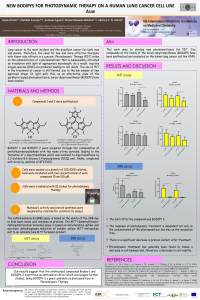
Lung cancer is the most incident and the deadliest cancer for both men and women. Therefore, the need for new and more effective therapies with fewer side effects is a concern. Photodynamic Therapy (PDT) relies on the administration of a photosensitizer that is subsequently activated by irradiation with light of appropriate wavelength. As a result, reactive oxygen species (ROS) are produced leading to cell death. PDT use in the treatment of cancer is still limited, due to the low number of new approved drugs. In light with this, this work aims to develop new photosensitizers for PDT. As an alternative class of the porphyrin-based photosensitizers, two compounds of the family of the boron−dipyrromethenes (BODIPY) have been synthesized and evaluated on the human lung cancer cell line A549. In this study, we used the MTT and SRB assays to assess the cytotoxicity of the compounds with concentrations ranging from 0,1 to 50 μM. Both compounds are photocytotoxics at the higher concentration studied. The most effective compound in the photocytotoxicity studies was the BODIPY 2 when used in a concentration of 10 and 50 µM. These promising results uphold further studies.
Keywords
bodipy
photodinamic therapy
biomaterials
Manuscript
Poster_CongressoElec1.pdf
Poster
sciforum-027445.pdf
Synthesis, antibacterial and antifungal studies of cobalt(II) complexes of (2E)-2-(2-hydroxy-3-methoxybenzalidene)hydrazinecarbo(thio)amides
Repurposing Common Food Additives (Benzo Derivatives) As New Anti-parasitic Agents