Event submissions
Published

This submission belongs to the session A. Chemo- and Biosensors of the event 6th International Electronic Conference on Sensors and Applications
Published date
14 Nov, 2019
Citation
João Pedro Jenson de Oliveira, Marta Bonet San Emeterio, Acelino Cardoso de Sá, Leonardo Lataro Paim, Manel del Valle, Methanol, Ethanol and Glycerol oxidation study by graphite-epoxy composite electrodes with graphene-anchored nickel oxyhydroxide nanoparticles. , in Proceedings of 6th International Electronic Conference on Sensors and Applications, 15 November–30 November 2019, MDPI: Basel, Switzerland, doi: 10.3390/ecsa-6-06544
Share
Email
Facebook
Twitter
LinkedIn
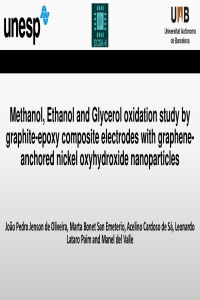
Methanol, Ethanol and Glycerol oxidation study by graphite-epoxy composite electrodes with graphene-anchored nickel oxyhydroxide nanoparticles.
'%3e%3cpath%20d='M12.6647%2010.9104C12.4176%2010.325%2012.0589%209.7933%2011.6088%209.34485C11.16%208.89511%2010.6283%208.53653%2010.0432%208.28891C10.038%208.28629%2010.0327%208.28498%2010.0275%208.28236C10.8437%207.69282%2011.3743%206.73252%2011.3743%205.64907C11.3743%203.85423%209.92005%202.40002%208.12522%202.40002C6.33038%202.40002%204.87618%203.85423%204.87618%205.64907C4.87618%206.73252%205.40677%207.69282%206.22296%208.28367C6.21772%208.28629%206.21248%208.2876%206.20724%208.29022C5.62031%208.53783%205.09365%208.89287%204.64167%209.34616C4.19192%209.79496%203.83334%2010.3266%203.58573%2010.9117C3.34247%2011.4846%203.21128%2012.0987%203.19925%2012.721C3.1989%2012.735%203.20135%2012.7489%203.20646%2012.7619C3.21157%2012.7749%203.21924%2012.7868%203.22901%2012.7968C3.23877%2012.8068%203.25045%2012.8148%203.26334%2012.8202C3.27623%2012.8256%203.29007%2012.8284%203.30406%2012.8284H4.09012C4.14776%2012.8284%204.19362%2012.7825%204.19493%2012.7262C4.22113%2011.7148%204.62726%2010.7676%205.34519%2010.0497C6.08802%209.30686%207.07452%208.89811%208.12522%208.89811C9.17592%208.89811%2010.1624%209.30686%2010.9052%2010.0497C11.6232%2010.7676%2012.0293%2011.7148%2012.0555%2012.7262C12.0568%2012.7839%2012.1027%2012.8284%2012.1603%2012.8284H12.9464C12.9604%2012.8284%2012.9742%2012.8256%2012.9871%2012.8202C13%2012.8148%2013.0117%2012.8068%2013.0214%2012.7968C13.0312%2012.7868%2013.0389%2012.7749%2013.044%2012.7619C13.0491%2012.7489%2013.0515%2012.735%2013.0512%2012.721C13.0381%2012.0947%2012.9084%2011.4856%2012.6647%2010.9104ZM8.12522%207.90243C7.52388%207.90243%206.95792%207.66793%206.53214%207.24215C6.10636%206.81636%205.87185%206.2504%205.87185%205.64907C5.87185%205.04773%206.10636%204.48177%206.53214%204.05599C6.95792%203.63021%207.52388%203.3957%208.12522%203.3957C8.72655%203.3957%209.29252%203.63021%209.7183%204.05599C10.1441%204.48177%2010.3786%205.04773%2010.3786%205.64907C10.3786%206.2504%2010.1441%206.81636%209.7183%207.24215C9.29252%207.66793%208.72655%207.90243%208.12522%207.90243Z'%20fill='%235D1EE1'/%3e%3c/g%3e%3c/svg%3e)
João Pedro Jenson de Oliveira 1,2
Marta Bonet San Emeterio 2
Acelino Cardoso de Sá 3
Leonardo Lataro Paim 4

Manel del Valle 2
1. Engineering of Energy, Campus of Rosana, São Paulo State University (UNESP), 192740-000 Rosana, São Paulo, Brazil.
2. Sensors and Biosensors Group, Department of Chemistry, Universitat Autònoma de Barcelona, Edifici Cn, 08193 Bellaterra, Barcelona, Spain.
3. Department of Physics and Materials Science, University of São Paulo, 13566-590 São Carlos, São Paulo, Brazil.
4. 2RE – Research for Renewable Energy, Department of Energy Engineering, São Paulo State University, 192740-000 Rosana, São Paulo, Brazil.
Abstract
Alcohols have been widely employed in different applications from solvents to fuels but today the main concern is their energy value as fuel. This work reports a graphite-epoxy composite electrode with nickel oxyhydroxide nanoparticles anchored in reduced graphene oxide for the electrooxidation of methanol, ethanol and glycerol, aiming for future application in electronic tongues for biofuel quality control. The electrode was formed by a graphite-epoxy graphite compound with cyclic voltammetry electrodeposited reduced graphene oxide and nickel oxyhydroxide nanoparticles formed by the decomposition in NaOH alkaline solution of cyclic voltammetry electrodeposited nickel hexacyanoferrate. FE-SEM studies were performed to confirm NiOOH nanoparticle morphology; EDX was applied to analyze chemical composition and ImageJ software was applied to size nanoparticles: the average size of the NiOOH nanoparticles was 61±16 nm. To verify the performance of the prepared electrode, it was applied in the electrooxidation of alcohols in alkaline medium by cyclic voltammetry. By performing different calibration experiments of methanol, ethanol and glycerol it was possible to extract some information about the electrode in the presence of alcohols. The LOD for methanol, ethanol and glycerol were 2.16 mM, 2.73 mM and 0.09 mM, respectively, with sensitivity values of 1.32 µA mM-1, 1.80 µA mM-1 and 24.60 µA mM-1, also for methanol, ethanol and glycerol. Multivariate inspection of the data using Principal Component Analysis (performed with use of the ClustVis online tool) demonstrated the potential ability to discriminate between the different alcohols, whereas the explained variance with the first two components was as high as 89.7%.
Keywords
Composite electrode
Glycerol
Electro-oxidation
Manuscript
sciforum-026826-done.pdf
Poster
Presentation ECSA6_JOAOJENSON_BRAZIL.pdf
An IoT-Based Smart Framework for Human Heartbeat Rate Monitoring and Control System
IoT Based Monitoring System for White Button Mushroom Farming