Event submissions
Published

This submission belongs to the session D. Applications of the event 6th International Electronic Conference on Sensors and Applications
Published date
14 Nov, 2019
Citation
Juan Pablo Garcia Vazquez, Isabel Lebasi Ambriz, Indoor Localization through Mobile Participatory Sensing and Magnetic Field, in Proceedings of 6th International Electronic Conference on Sensors and Applications, 15 November–30 November 2019, MDPI: Basel, Switzerland, doi: 10.3390/ecsa-6-06560
Share
Email
Facebook
Twitter
LinkedIn
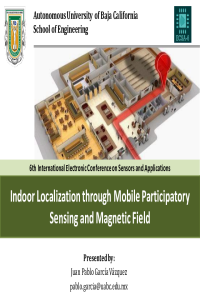
Indoor Localization through Mobile Participatory Sensing and Magnetic Field

Juan Pablo Garcia Vazquez 1
'%3e%3cpath%20d='M12.6647%2010.9104C12.4176%2010.325%2012.0589%209.7933%2011.6088%209.34485C11.16%208.89511%2010.6283%208.53653%2010.0432%208.28891C10.038%208.28629%2010.0327%208.28498%2010.0275%208.28236C10.8437%207.69282%2011.3743%206.73252%2011.3743%205.64907C11.3743%203.85423%209.92005%202.40002%208.12522%202.40002C6.33038%202.40002%204.87618%203.85423%204.87618%205.64907C4.87618%206.73252%205.40677%207.69282%206.22296%208.28367C6.21772%208.28629%206.21248%208.2876%206.20724%208.29022C5.62031%208.53783%205.09365%208.89287%204.64167%209.34616C4.19192%209.79496%203.83334%2010.3266%203.58573%2010.9117C3.34247%2011.4846%203.21128%2012.0987%203.19925%2012.721C3.1989%2012.735%203.20135%2012.7489%203.20646%2012.7619C3.21157%2012.7749%203.21924%2012.7868%203.22901%2012.7968C3.23877%2012.8068%203.25045%2012.8148%203.26334%2012.8202C3.27623%2012.8256%203.29007%2012.8284%203.30406%2012.8284H4.09012C4.14776%2012.8284%204.19362%2012.7825%204.19493%2012.7262C4.22113%2011.7148%204.62726%2010.7676%205.34519%2010.0497C6.08802%209.30686%207.07452%208.89811%208.12522%208.89811C9.17592%208.89811%2010.1624%209.30686%2010.9052%2010.0497C11.6232%2010.7676%2012.0293%2011.7148%2012.0555%2012.7262C12.0568%2012.7839%2012.1027%2012.8284%2012.1603%2012.8284H12.9464C12.9604%2012.8284%2012.9742%2012.8256%2012.9871%2012.8202C13%2012.8148%2013.0117%2012.8068%2013.0214%2012.7968C13.0312%2012.7868%2013.0389%2012.7749%2013.044%2012.7619C13.0491%2012.7489%2013.0515%2012.735%2013.0512%2012.721C13.0381%2012.0947%2012.9084%2011.4856%2012.6647%2010.9104ZM8.12522%207.90243C7.52388%207.90243%206.95792%207.66793%206.53214%207.24215C6.10636%206.81636%205.87185%206.2504%205.87185%205.64907C5.87185%205.04773%206.10636%204.48177%206.53214%204.05599C6.95792%203.63021%207.52388%203.3957%208.12522%203.3957C8.72655%203.3957%209.29252%203.63021%209.7183%204.05599C10.1441%204.48177%2010.3786%205.04773%2010.3786%205.64907C10.3786%206.2504%2010.1441%206.81636%209.7183%207.24215C9.29252%207.66793%208.72655%207.90243%208.12522%207.90243Z'%20fill='%235D1EE1'/%3e%3c/g%3e%3c/svg%3e)
Isabel Lebasi Ambriz 1
1. Universidad Autonoma de Baja California
Abstract
Developing location systems that use mobile device sensors has been a topic of interest to industry and the academy. In this paper, we describe an experiment that was performed for evaluating the feasibility to create a mobile indoor localization model at room level based on data from participatory sensing. In order to achieve it, seven subjects that had a smartphone with magnetometer collected magnetic field information in a building composed by five rooms with different dimensions. The information collected was used to train three machine learning algorithms: k Nearest Neighbors (kNN), decision trees (J48) and Naïve Bayes. The performance of the algorithms was measured through the accuracy and the kappa statistics. Our results show that it is possible to create a mobile indoor localization model at room level using data from participatory sensing. The model with the highest performance was obtained with the kNN algorithm with a value of k = 3, since this offer an accuracy of 97.12% with a concordance level (kappa) of 0.9639 to estimate the localization of individual inside a room at the indoor environment. While the model with the lowest performance was Naïve Bayes, it offers an accuracy of 50.79% with a concordance level of 0.3834.
Keywords
indoor localization
mobile phones
magnetic field
sensors
Manuscript
sciforum-027342_done.pdf
Poster
Garciaetal_ECSA-6Presentation1.pdf
Wireless Channel Characterization and System Analysis of Complex Utility Tunnel Environments
A Novel Crosslayering Power Control Mechanism for AODV