Event submissions
Published

This submission belongs to the session B. Bioorganic, Medicinal and Natural Products Chemistry of the event The 23rd International Electronic Conference on Synthetic Organic Chemistry
Published date
14 Nov, 2019
Citation
Mabrouk Mohamed Salama, Rania N. Shallan, Safaa s. Hassan, Antibacterial and Molecular Study of Thiourea Derivative Ligand and its Dimethyltin(IV) Complex with the Superior of its Copper(II) Complex as a Hepatocellular Antitumor Drug, in Proceedings of The 23rd International Electronic Conference on Synthetic Organic Chemistry, 15 November–15 December 2019, MDPI: Basel, Switzerland, doi: 10.3390/ecsoc-23-06621
Share
Email
Facebook
Twitter
LinkedIn
Antibacterial and Molecular Study of Thiourea Derivative Ligand and its Dimethyltin(IV) Complex with the Superior of its Copper(II) Complex as a Hepatocellular Antitumor Drug
'%3e%3cpath%20d='M12.6647%2010.9104C12.4176%2010.325%2012.0589%209.7933%2011.6088%209.34485C11.16%208.89511%2010.6283%208.53653%2010.0432%208.28891C10.038%208.28629%2010.0327%208.28498%2010.0275%208.28236C10.8437%207.69282%2011.3743%206.73252%2011.3743%205.64907C11.3743%203.85423%209.92005%202.40002%208.12522%202.40002C6.33038%202.40002%204.87618%203.85423%204.87618%205.64907C4.87618%206.73252%205.40677%207.69282%206.22296%208.28367C6.21772%208.28629%206.21248%208.2876%206.20724%208.29022C5.62031%208.53783%205.09365%208.89287%204.64167%209.34616C4.19192%209.79496%203.83334%2010.3266%203.58573%2010.9117C3.34247%2011.4846%203.21128%2012.0987%203.19925%2012.721C3.1989%2012.735%203.20135%2012.7489%203.20646%2012.7619C3.21157%2012.7749%203.21924%2012.7868%203.22901%2012.7968C3.23877%2012.8068%203.25045%2012.8148%203.26334%2012.8202C3.27623%2012.8256%203.29007%2012.8284%203.30406%2012.8284H4.09012C4.14776%2012.8284%204.19362%2012.7825%204.19493%2012.7262C4.22113%2011.7148%204.62726%2010.7676%205.34519%2010.0497C6.08802%209.30686%207.07452%208.89811%208.12522%208.89811C9.17592%208.89811%2010.1624%209.30686%2010.9052%2010.0497C11.6232%2010.7676%2012.0293%2011.7148%2012.0555%2012.7262C12.0568%2012.7839%2012.1027%2012.8284%2012.1603%2012.8284H12.9464C12.9604%2012.8284%2012.9742%2012.8256%2012.9871%2012.8202C13%2012.8148%2013.0117%2012.8068%2013.0214%2012.7968C13.0312%2012.7868%2013.0389%2012.7749%2013.044%2012.7619C13.0491%2012.7489%2013.0515%2012.735%2013.0512%2012.721C13.0381%2012.0947%2012.9084%2011.4856%2012.6647%2010.9104ZM8.12522%207.90243C7.52388%207.90243%206.95792%207.66793%206.53214%207.24215C6.10636%206.81636%205.87185%206.2504%205.87185%205.64907C5.87185%205.04773%206.10636%204.48177%206.53214%204.05599C6.95792%203.63021%207.52388%203.3957%208.12522%203.3957C8.72655%203.3957%209.29252%203.63021%209.7183%204.05599C10.1441%204.48177%2010.3786%205.04773%2010.3786%205.64907C10.3786%206.2504%2010.1441%206.81636%209.7183%207.24215C9.29252%207.66793%208.72655%207.90243%208.12522%207.90243Z'%20fill='%235D1EE1'/%3e%3c/g%3e%3c/svg%3e)
Mabrouk Mohamed Salama 1
Rania N. Shallan 2
Safaa s. Hassan 2
1. Department of Chemistry, faculty of Science, University of Benghazi
2. Department of chemistry, faculty of Science, Cairo University, Egypt
Abstract
1-benzoyl(1,2,4-triazol-3-yl)thiourea [BTThU] ligand and its [dimethyltin(IV), Pd(II) and Cu(II)] complexes are synthesized. The complexes are formed in molar ratio Cu(BTThU)2, DMT(BTThU)2 and Pd(BTThU)2. The characterization has been done by using different physicochemical methods as elemental analyses, IR, 1H NMR DMSO-d6 and molar conductance measurements. The stability constants of the formed species that produced from the interaction of [BTThU] with dimethyltin(IV) [DMT], dibutyltin(IV) [DBT] and diphenyltin(IV) [DPT] were determined potentiometrically using the non-linear least-square program MINIQUAD-75 in 50% ethanol–water mixture and 0.1M ionic strength at 25oC. Concentration distribution diagrams for these system were evaluated. The theoretical conformational structure analyses were performed using density functional theory for thiol and thione tautomeric forms of [BTThU] ligand and its complex at B3LYP functional with 6-311G basis set for ligand and LANL2DZ basis set for complex. The theoretical vibrational frequency values of the optimized structures were calculated. The charge distribution within the ligand and its dimethyltin(IV) complex was calculated using Mulliken population analysis of [MPA] and natural population analysis [NPA]. The biological activity of BTThU ligand and its dimethyltin(IV) complex were tested in vitro against some selected species of fungi and bacteria. The hepatocellular antitumor effect of all compounds was investigated.
Keywords
dimethyltin(IV)
dibutyltin(IV)
diphenyltin(IV)
HepG2
HOMO - LUMO
equilibrium studies
antitumor drug.
Manuscript
manuscript of cupper thiouria complex sciforum-027845.pdf
Poster
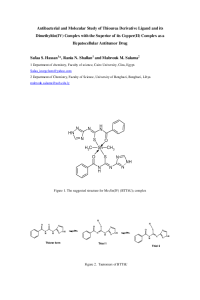
all figures of thiourea derivative sciforum-027845.pdf
Applying benzenetetracaboxylic acid as a linker in the synthesis of a porous Ba(II)-based MOF by ultrasonic method
Metal-doped copper indium disulfide heterostructure: Environment-friendly Hole-transporting material toward photovoltaic application in organic-inorganic perovskite solar cell