Event submissions
EventsMOL2NET'19, Conference on Molecular, Biomed., Comput. & Network Science and Engineering, 5th ed.
Published

This submission belongs to the session 08. MODEC-04: Nat. Prod. & Agro-Indust. Proc. in Amazon, UEA, Puyo, Ecuador, 2019 of the event MOL2NET'19, Conference on Molecular, Biomed., Comput. & Network Science and Engineering, 5th ed.
Published date
14 Nov, 2019
Citation
Ricardo Burgos-Morán, Jason Shaw, Janeth Sánchez-Campuzano, Simply low-cost recirculation aquaculture system for Amazonian native fish hatchery under controlled conditions, in Proceedings of MOL2NET'19, Conference on Molecular, Biomed., Comput. & Network Science and Engineering, 5th ed., 20 March–20 December 2019, MDPI: Basel, Switzerland, doi: 10.3390/mol2net-05-06623
Share
Email
Facebook
Twitter
LinkedIn
Simply low-cost recirculation aquaculture system for Amazonian native fish hatchery under controlled conditions
'%3e%3cpath%20d='M12.6647%2010.9104C12.4176%2010.325%2012.0589%209.7933%2011.6088%209.34485C11.16%208.89511%2010.6283%208.53653%2010.0432%208.28891C10.038%208.28629%2010.0327%208.28498%2010.0275%208.28236C10.8437%207.69282%2011.3743%206.73252%2011.3743%205.64907C11.3743%203.85423%209.92005%202.40002%208.12522%202.40002C6.33038%202.40002%204.87618%203.85423%204.87618%205.64907C4.87618%206.73252%205.40677%207.69282%206.22296%208.28367C6.21772%208.28629%206.21248%208.2876%206.20724%208.29022C5.62031%208.53783%205.09365%208.89287%204.64167%209.34616C4.19192%209.79496%203.83334%2010.3266%203.58573%2010.9117C3.34247%2011.4846%203.21128%2012.0987%203.19925%2012.721C3.1989%2012.735%203.20135%2012.7489%203.20646%2012.7619C3.21157%2012.7749%203.21924%2012.7868%203.22901%2012.7968C3.23877%2012.8068%203.25045%2012.8148%203.26334%2012.8202C3.27623%2012.8256%203.29007%2012.8284%203.30406%2012.8284H4.09012C4.14776%2012.8284%204.19362%2012.7825%204.19493%2012.7262C4.22113%2011.7148%204.62726%2010.7676%205.34519%2010.0497C6.08802%209.30686%207.07452%208.89811%208.12522%208.89811C9.17592%208.89811%2010.1624%209.30686%2010.9052%2010.0497C11.6232%2010.7676%2012.0293%2011.7148%2012.0555%2012.7262C12.0568%2012.7839%2012.1027%2012.8284%2012.1603%2012.8284H12.9464C12.9604%2012.8284%2012.9742%2012.8256%2012.9871%2012.8202C13%2012.8148%2013.0117%2012.8068%2013.0214%2012.7968C13.0312%2012.7868%2013.0389%2012.7749%2013.044%2012.7619C13.0491%2012.7489%2013.0515%2012.735%2013.0512%2012.721C13.0381%2012.0947%2012.9084%2011.4856%2012.6647%2010.9104ZM8.12522%207.90243C7.52388%207.90243%206.95792%207.66793%206.53214%207.24215C6.10636%206.81636%205.87185%206.2504%205.87185%205.64907C5.87185%205.04773%206.10636%204.48177%206.53214%204.05599C6.95792%203.63021%207.52388%203.3957%208.12522%203.3957C8.72655%203.3957%209.29252%203.63021%209.7183%204.05599C10.1441%204.48177%2010.3786%205.04773%2010.3786%205.64907C10.3786%206.2504%2010.1441%206.81636%209.7183%207.24215C9.29252%207.66793%208.72655%207.90243%208.12522%207.90243Z'%20fill='%235D1EE1'/%3e%3c/g%3e%3c/svg%3e)
Ricardo Burgos-Morán 1
Jason Shaw 2
Janeth Sánchez-Campuzano 1
1. Universidad Estatal Amazónica: Puyo, Pastaza, EC
2. Miracle Springs Inc
Abstract
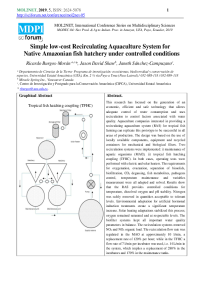
This research has focused on the generation of an economic, efficient and safe technology that allows adequate control of inlet flow and recirculation as well as factors associated with water quality. It is hoped that medium-sized aquaculture companies interested in providing fry for tropical fish farming can replicate this prototype. The design was based on the use of locally available components, considering recycled containers for mechanical and biological filters manufacture. Two recirculation lines were implemented: i) maintenance of aquatic organisms (MAO); ii) tropical fish hatching coupling (TFHC). In both cases, operating tests were performed with electric and solar heaters. The requirements for oxygenation, evacuation and separation of biosolids, excretion products biofiltration, CO2 degassing and fish metabolites, pathogens control, temperature maintenance and variables measurement were adapted and solved. Results show that the recirculation systems provide handling conditions with temperature, dissolved oxygen and pH stability, while nitrogen was safely removal in quantities and forms. As environmental adaptation for artificial hormonal induction treatments, there is a significant temperature increase, which is stable with the solar heating adaptations; oxygen remains in saturation concentration; and the biofilter systems remains below concentrations that could affect organisms in the recirculation systems removed NO2 and NO3 organic load. The recirculation flow rate is regulated in the MAO at approximately 10 l/min, a replacement rate of 120% per hour; while in the TFHC a flow rate of 7 l/min per incubator was used, i.e. 14 L/min in the system, which implies a replacement of 280% in the incubators and 170% in the maintenance tanks.
Keywords
RAS
tropical hatchery
low cost biofilter,
Manuscript
RAS_hacker MOL2Net_ok12-11-2019.pdf
Poster
RAS_hacker MOL2Net_ok12-11-2019.pdf
A QSPR model for the prediction of the partition coefficient of organic compounds of pharmaceutical interest
Invisible training: how to improve your sports performance