Event submissions
EventsMOL2NET'19, Conference on Molecular, Biomed., Comput. & Network Science and Engineering, 5th ed.
Published

This submission belongs to the session 07. CHEMBIOMOL-05: Chem. Biol. & Med. Chem. Workshop, Bilbao-Lisboa, Portugal-Rostock, Germany, Galveston, Texas, USA, 2019 of the event MOL2NET'19, Conference on Molecular, Biomed., Comput. & Network Science and Engineering, 5th ed.
Published date
04 Feb, 2020
Citation
Bernardo Henriques, Paulo Jorge Costa, Targeting acetylcholinesterase with halogenated ligands: finding halogen bonding hotspots, in Proceedings of MOL2NET'19, Conference on Molecular, Biomed., Comput. & Network Science and Engineering, 5th ed., 20 March–20 December 2019, MDPI: Basel, Switzerland, doi: 10.3390/mol2net-05-06777
Share
Email
Facebook
Twitter
LinkedIn
Targeting acetylcholinesterase with halogenated ligands: finding halogen bonding hotspots
'%3e%3cpath%20d='M12.6647%2010.9104C12.4176%2010.325%2012.0589%209.7933%2011.6088%209.34485C11.16%208.89511%2010.6283%208.53653%2010.0432%208.28891C10.038%208.28629%2010.0327%208.28498%2010.0275%208.28236C10.8437%207.69282%2011.3743%206.73252%2011.3743%205.64907C11.3743%203.85423%209.92005%202.40002%208.12522%202.40002C6.33038%202.40002%204.87618%203.85423%204.87618%205.64907C4.87618%206.73252%205.40677%207.69282%206.22296%208.28367C6.21772%208.28629%206.21248%208.2876%206.20724%208.29022C5.62031%208.53783%205.09365%208.89287%204.64167%209.34616C4.19192%209.79496%203.83334%2010.3266%203.58573%2010.9117C3.34247%2011.4846%203.21128%2012.0987%203.19925%2012.721C3.1989%2012.735%203.20135%2012.7489%203.20646%2012.7619C3.21157%2012.7749%203.21924%2012.7868%203.22901%2012.7968C3.23877%2012.8068%203.25045%2012.8148%203.26334%2012.8202C3.27623%2012.8256%203.29007%2012.8284%203.30406%2012.8284H4.09012C4.14776%2012.8284%204.19362%2012.7825%204.19493%2012.7262C4.22113%2011.7148%204.62726%2010.7676%205.34519%2010.0497C6.08802%209.30686%207.07452%208.89811%208.12522%208.89811C9.17592%208.89811%2010.1624%209.30686%2010.9052%2010.0497C11.6232%2010.7676%2012.0293%2011.7148%2012.0555%2012.7262C12.0568%2012.7839%2012.1027%2012.8284%2012.1603%2012.8284H12.9464C12.9604%2012.8284%2012.9742%2012.8256%2012.9871%2012.8202C13%2012.8148%2013.0117%2012.8068%2013.0214%2012.7968C13.0312%2012.7868%2013.0389%2012.7749%2013.044%2012.7619C13.0491%2012.7489%2013.0515%2012.735%2013.0512%2012.721C13.0381%2012.0947%2012.9084%2011.4856%2012.6647%2010.9104ZM8.12522%207.90243C7.52388%207.90243%206.95792%207.66793%206.53214%207.24215C6.10636%206.81636%205.87185%206.2504%205.87185%205.64907C5.87185%205.04773%206.10636%204.48177%206.53214%204.05599C6.95792%203.63021%207.52388%203.3957%208.12522%203.3957C8.72655%203.3957%209.29252%203.63021%209.7183%204.05599C10.1441%204.48177%2010.3786%205.04773%2010.3786%205.64907C10.3786%206.2504%2010.1441%206.81636%209.7183%207.24215C9.29252%207.66793%208.72655%207.90243%208.12522%207.90243Z'%20fill='%235D1EE1'/%3e%3c/g%3e%3c/svg%3e)
Bernardo Henriques 1

Paulo Jorge Costa 1
1. BioISI - Biosystems & Integrative Sciences Institute
Abstract
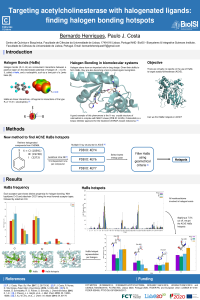
Acetylcholinesterase (AChE) is one of the most relevant therapeutic targets for the symptomatic treatment of Alzheimer’s disease. Hence, the development of new molecules capable of inhibiting AChE activity is an effective therapeutic strategy. The incorporation of halogens (X) in drug molecules is a common way to enhance drug ADME (absorption, distribution, metabolism, and excretion) properties, often leading to increased potency. However, halogenation can also improve drug-target binding affinity due to the existence of halogen bonds (HaBs) established with the receptor. Halogen bonds (R-X...B) are noncovalent interactions between a positive region on the electrostatic potential of X, called sigma-hole, and a nucleophile, such as a lone pair of a Lewis base (B).
Since there were virtually no reports on the use of HaBs to target AChE, in this work, we searched for amino acids frequently targeted by halogen bonding (called hotspots) in the AChE binding site. For that purpose, all the compounds containing a moiety capable of halogen bonding (Ph-X, Ph = phenyl, and X=Cl, Br, I) were retrieved from the ChEMBL database and docked into the AChE binding site using AutoDock Vina XB whose scoring function takes into account the sigma-hole. Multiple X-ray structures and molecular dynamics snapshots from the target were used to account for conformational variability. By applying a geometrical criteria, we selected all halogens atoms engaged in HaBs, thus being able to identify halogen bonding hotspots on the binding pocket. These preliminary results will be the starting point for obtaining new halogenated scaffolds to target AChE, hopefully helping in the design of new and more effective AChE inhibitors.
Keywords
Halogen bonds
Acetylcholinesterase
Hotspots
AutoDock Vina XB
Manuscript
Targeting acetylcholinesterase with halogenated ligands: finding halogen bonding hotspots (Abstract).pdf
Poster
Targeting acetylcholinesterase with halogenated ligands: finding halogen bonding hotspots.pdf
Carbon nanofibers: alternative weapons against multidrug-resistant pathogens
Plant microbiomes and their benefit towards a more sustainable agriculture