Event submissions
Published

This submission belongs to the session I. Posters of the event 2nd Coatings and Interfaces Web Conference
Published date
29 Apr, 2020
Citation
Helena P. Felgueiras, Marta A. Teixeira, Tânia D. Tavares, Natália C. Homem, Marta S. Teixeira, Andrea Zille, Joana C. Antunes, M. Teresa P. Amorim, Flexible, biodegradable LL37-anchored poly(vinyl alcohol)/cellulose acetate films for enhanced infection control, in Proceedings of 2nd Coatings and Interfaces Web Conference, 15 May–31 May 2020, MDPI: Basel, Switzerland, doi: 10.3390/CIWC2020-06807
Share
Email
Facebook
Twitter
LinkedIn
Flexible, biodegradable LL37-anchored poly(vinyl alcohol)/cellulose acetate films for enhanced infection control

Helena P. Felgueiras 1
'%3e%3cpath%20d='M12.6647%2010.9104C12.4176%2010.325%2012.0589%209.7933%2011.6088%209.34485C11.16%208.89511%2010.6283%208.53653%2010.0432%208.28891C10.038%208.28629%2010.0327%208.28498%2010.0275%208.28236C10.8437%207.69282%2011.3743%206.73252%2011.3743%205.64907C11.3743%203.85423%209.92005%202.40002%208.12522%202.40002C6.33038%202.40002%204.87618%203.85423%204.87618%205.64907C4.87618%206.73252%205.40677%207.69282%206.22296%208.28367C6.21772%208.28629%206.21248%208.2876%206.20724%208.29022C5.62031%208.53783%205.09365%208.89287%204.64167%209.34616C4.19192%209.79496%203.83334%2010.3266%203.58573%2010.9117C3.34247%2011.4846%203.21128%2012.0987%203.19925%2012.721C3.1989%2012.735%203.20135%2012.7489%203.20646%2012.7619C3.21157%2012.7749%203.21924%2012.7868%203.22901%2012.7968C3.23877%2012.8068%203.25045%2012.8148%203.26334%2012.8202C3.27623%2012.8256%203.29007%2012.8284%203.30406%2012.8284H4.09012C4.14776%2012.8284%204.19362%2012.7825%204.19493%2012.7262C4.22113%2011.7148%204.62726%2010.7676%205.34519%2010.0497C6.08802%209.30686%207.07452%208.89811%208.12522%208.89811C9.17592%208.89811%2010.1624%209.30686%2010.9052%2010.0497C11.6232%2010.7676%2012.0293%2011.7148%2012.0555%2012.7262C12.0568%2012.7839%2012.1027%2012.8284%2012.1603%2012.8284H12.9464C12.9604%2012.8284%2012.9742%2012.8256%2012.9871%2012.8202C13%2012.8148%2013.0117%2012.8068%2013.0214%2012.7968C13.0312%2012.7868%2013.0389%2012.7749%2013.044%2012.7619C13.0491%2012.7489%2013.0515%2012.735%2013.0512%2012.721C13.0381%2012.0947%2012.9084%2011.4856%2012.6647%2010.9104ZM8.12522%207.90243C7.52388%207.90243%206.95792%207.66793%206.53214%207.24215C6.10636%206.81636%205.87185%206.2504%205.87185%205.64907C5.87185%205.04773%206.10636%204.48177%206.53214%204.05599C6.95792%203.63021%207.52388%203.3957%208.12522%203.3957C8.72655%203.3957%209.29252%203.63021%209.7183%204.05599C10.1441%204.48177%2010.3786%205.04773%2010.3786%205.64907C10.3786%206.2504%2010.1441%206.81636%209.7183%207.24215C9.29252%207.66793%208.72655%207.90243%208.12522%207.90243Z'%20fill='%235D1EE1'/%3e%3c/g%3e%3c/svg%3e)
Marta A. Teixeira 2
Tânia D. Tavares 3

Natália C. Homem 3
Marta S. Teixeira 3

Andrea Zille 3

Joana C. Antunes 3
M. Teresa P. Amorim 3
1. Centre for Textile Science and Technology, University of Minho, Portugal
2. Centre for Textile Science and Technology, University of Minho, Guimarães, Portugal
3. Centre for Textile Science and Technology, University of Minho
Abstract
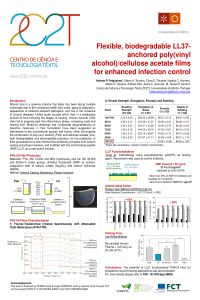
Wound care is a growing industry that lately has been facing multiple challenges due to the increasing health care costs, aging of population, appearance of antibiotic-resistant pathogens, and rise in the incidence of chronic diseases. Unlike acute wounds which heal in a predictable amount of time following the stages of healing, chronic wounds (CW) often fail to progress past the inflammatory phase, increasing costs and healing time. Bioactive dressings that incorporate drugs/antibiotics or bioactive molecules in their formulation have been suggested as alternatives to the conventional gauzes and foams. Here, we propose the combination of poly(vinyl alcohol) (PVA) and cellulose acetate (CA), both biodegradable and biocompatible polymers, for the production of films processed via a new method that combines principles from solvent casting and phase inversion, and modified with the antimicrobial peptide (AMP) LL37, as a new active solution.
To guarantee some degree of flexibility, films were produced with a higher percentage of PVA compared to CA, from 90/10 to 50/50. LL37 was then anchored using dopamine as a binding agent. Films were characterized in terms of functional groups, thermal stability, tensile strength, porosity, swelling and degradation rate. The antimicrobial performance of LL37 surface-modified films was tested against Staphylococcus aureus, Staphylococcus epidermidis and Escherichia coli in dynamic environment. LL37-modified films demonstrated great antibacterial efficacy against the three bacteria, ≈ 75% inhibition for S. aureus, ≈ 85% for S. epidermidis and ≈ 60% for E. coli, regardless of PVA/CA ratio. Films treated with LL37 accelerated clotting time (≈ 10 min) above vancomycin and bare surfaces, demonstrating great capacity to activate the intrinsic coagulation cascade. In the end, the potential of LL37 functionalized PVA/CA films for prospective wound-healing applications was demonstrated.
Keywords
biodegradable films
peptide LL37
antibacterial action
accelerated clotting
wound-healing
Manuscript
2020.04.20_Poster_2nd Coatings and Interfaces Web Conference.pdf
Poster
2020.04.20_Poster_2nd Coatings and Interfaces Web Conference.pdf
Structure and Properties of Coatings Made of High-Entropy Alloy with Martensitic Transformations Obtained by HVOF Method in a Protective Atmosphere
Essential Oils Loading onto Cellulose Acetate/Polycaprolactone Fibers via Coagulation Bath for an Improved Antimicrobial Action