Event submissions
Published

This submission belongs to the session A. Biocoating and Biomaterial Surfaces and Interfaces of the event 2nd Coatings and Interfaces Web Conference
Published date
08 May, 2020
Citation
Miruna S. Stan, Ionela Cristina Nica, Anca Dinischiotu, Valentina Grumezescu, Alexandra Elena Stoica, Alina Maria Holban, Alexandru Grumezescu, Novel Coatings Based on Nanostructured Cefepime-Functionalized Magnetite for Implantable Devices, in Proceedings of 2nd Coatings and Interfaces Web Conference, 15 May–31 May 2020, MDPI: Basel, Switzerland, doi: 10.3390/CIWC2020-06817
Share
Email
Facebook
Twitter
LinkedIn
Novel Coatings Based on Nanostructured Cefepime-Functionalized Magnetite for Implantable Devices

Miruna S. Stan 1

Ionela Cristina Nica 2

Anca Dinischiotu 2
'%3e%3cpath%20d='M12.6647%2010.9104C12.4176%2010.325%2012.0589%209.7933%2011.6088%209.34485C11.16%208.89511%2010.6283%208.53653%2010.0432%208.28891C10.038%208.28629%2010.0327%208.28498%2010.0275%208.28236C10.8437%207.69282%2011.3743%206.73252%2011.3743%205.64907C11.3743%203.85423%209.92005%202.40002%208.12522%202.40002C6.33038%202.40002%204.87618%203.85423%204.87618%205.64907C4.87618%206.73252%205.40677%207.69282%206.22296%208.28367C6.21772%208.28629%206.21248%208.2876%206.20724%208.29022C5.62031%208.53783%205.09365%208.89287%204.64167%209.34616C4.19192%209.79496%203.83334%2010.3266%203.58573%2010.9117C3.34247%2011.4846%203.21128%2012.0987%203.19925%2012.721C3.1989%2012.735%203.20135%2012.7489%203.20646%2012.7619C3.21157%2012.7749%203.21924%2012.7868%203.22901%2012.7968C3.23877%2012.8068%203.25045%2012.8148%203.26334%2012.8202C3.27623%2012.8256%203.29007%2012.8284%203.30406%2012.8284H4.09012C4.14776%2012.8284%204.19362%2012.7825%204.19493%2012.7262C4.22113%2011.7148%204.62726%2010.7676%205.34519%2010.0497C6.08802%209.30686%207.07452%208.89811%208.12522%208.89811C9.17592%208.89811%2010.1624%209.30686%2010.9052%2010.0497C11.6232%2010.7676%2012.0293%2011.7148%2012.0555%2012.7262C12.0568%2012.7839%2012.1027%2012.8284%2012.1603%2012.8284H12.9464C12.9604%2012.8284%2012.9742%2012.8256%2012.9871%2012.8202C13%2012.8148%2013.0117%2012.8068%2013.0214%2012.7968C13.0312%2012.7868%2013.0389%2012.7749%2013.044%2012.7619C13.0491%2012.7489%2013.0515%2012.735%2013.0512%2012.721C13.0381%2012.0947%2012.9084%2011.4856%2012.6647%2010.9104ZM8.12522%207.90243C7.52388%207.90243%206.95792%207.66793%206.53214%207.24215C6.10636%206.81636%205.87185%206.2504%205.87185%205.64907C5.87185%205.04773%206.10636%204.48177%206.53214%204.05599C6.95792%203.63021%207.52388%203.3957%208.12522%203.3957C8.72655%203.3957%209.29252%203.63021%209.7183%204.05599C10.1441%204.48177%2010.3786%205.04773%2010.3786%205.64907C10.3786%206.2504%2010.1441%206.81636%209.7183%207.24215C9.29252%207.66793%208.72655%207.90243%208.12522%207.90243Z'%20fill='%235D1EE1'/%3e%3c/g%3e%3c/svg%3e)
Valentina Grumezescu 3
Alexandra Elena Stoica 4

Alina Maria Holban 5,6

Alexandru Grumezescu 4
1. Departament of Biochemistry and Molecular Biology, Faculty of Biology, University of Bucharest, 91-95 Splaiul Independentei, 050095 Bucharest, Romania
2. Department of Biochemistry and Molecular Biology, Faculty of Biology, University of Bucharest, 91-95 Splaiul Independentei, 050095 Bucharest, Romania
3. National Institute for Lasers, Plasma and Radiation Physics, Măgurele 077125, Romania
4. Department of Science and Engineering of Oxide Materials and Nanomaterials, Faculty of Applied Chemistry and Materials Science, University Politehnica of Bucharest, 1–7 Polizu Street, 011061 Bucharest, Romania
5. Research Institute of the University of Bucharest –ICUB, 91-95 Splaiul Independentei, 050095 Bucharest, Romania
6. Microbiology Immunology Department, Faculty of Biology, University of Bucharest, 1–3 Portocalelor Lane, Sector 5, 77206 Bucharest, Romania
Abstract
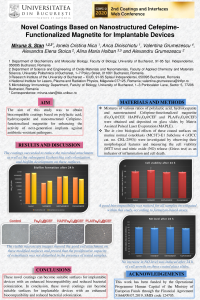
The aim of this study was to obtain biocompatible coatings based on polylactic acid, hydroxyapatite and nanostructured Cefepime-functionalized magnetite for enhancing the activity of next-generation implants against antibiotic-resistant pathogens. Mixtures of various ratios of polylactic acid, hydroxyapatite and nanostructured Cefepime-functionalized magnetite (Fe3O4@CEF, HAP/Fe3O4@CEF and PLA/Fe3O4@CEF) were obtained and deposited on glass slides by Matrix Assisted Pulsed Laser Evaporation (MAPLE). The in vitro biological effects of these coated surfaces on murine normal osteoblasts (MC3T3-E1 Subclone 4 (ATCC cat. no. CRL-2593)) were investigated by observing their morphological features and measuring the cell viability and nitric oxide (NO) release as an indicator of inflammation and cell death. A good biocompatibility was noticed for all samples investigated within this study, according to formazan-based assay. Also, no increase in NO level was induced after 24 h of cell growth on these coated glass slides. Moreover, the visible microscopy images showed the good cell attachment on these modified surfaces and proved that the proliferative capacity of osteoblasts was not disturbed in the presence of tested samples. The coatings succeeded to reduce the microbial attachment as well as the subsequent Escherichia coli colonization and biofilm development on these surfaces. In conclusion, these novel coatings can become suitable surfaces for implantable devices with an enhanced biocompatibility and reduced bacterial colonization. In conclusion, these novel coatings can become suitable surfaces for implantable devices with an enhanced biocompatibility and reduced bacterial colonization. Acknowledgements. This work has been funded by the Operational Programme Human Capital of the Ministry of European Funds through the Financial Agreement 51668/09.07.2019, SMIS code 124705, and through the project no. 77PD/2018 NANO-BIO-INT (PN-III-P1-1.1-PD-2016-1562).
Keywords
coatings
polylactic acid
hydroxyapatite
Cefepime
magnetite
osteoblasts
Manuscript
CIWC2020-Manuscript.pdf
Poster
Poster 2020.pdf
Synthesis and Characterizations of 2D Platinum Diselenide
Development of biodegradable electrospun dressing based on PVA/CA with antimicrobial potential for chronic wounds