Event submissions
Published

This submission belongs to the session I. Posters of the event 2nd Coatings and Interfaces Web Conference
Published date
09 May, 2020
Citation
Marta A. Teixeira, Tânia D. Tavares, Ana R. M. Ribeiro, M. Teresa P. Amorim, Helena P. Felgueiras, Development of biodegradable electrospun dressing based on PVA/CA with antimicrobial potential for chronic wounds, in Proceedings of 2nd Coatings and Interfaces Web Conference, 15 May–31 May 2020, MDPI: Basel, Switzerland, doi: 10.3390/CIWC2020-06821
Share
Email
Facebook
Twitter
LinkedIn
Development of biodegradable electrospun dressing based on PVA/CA with antimicrobial potential for chronic wounds
'%3e%3cpath%20d='M12.6647%2010.9104C12.4176%2010.325%2012.0589%209.7933%2011.6088%209.34485C11.16%208.89511%2010.6283%208.53653%2010.0432%208.28891C10.038%208.28629%2010.0327%208.28498%2010.0275%208.28236C10.8437%207.69282%2011.3743%206.73252%2011.3743%205.64907C11.3743%203.85423%209.92005%202.40002%208.12522%202.40002C6.33038%202.40002%204.87618%203.85423%204.87618%205.64907C4.87618%206.73252%205.40677%207.69282%206.22296%208.28367C6.21772%208.28629%206.21248%208.2876%206.20724%208.29022C5.62031%208.53783%205.09365%208.89287%204.64167%209.34616C4.19192%209.79496%203.83334%2010.3266%203.58573%2010.9117C3.34247%2011.4846%203.21128%2012.0987%203.19925%2012.721C3.1989%2012.735%203.20135%2012.7489%203.20646%2012.7619C3.21157%2012.7749%203.21924%2012.7868%203.22901%2012.7968C3.23877%2012.8068%203.25045%2012.8148%203.26334%2012.8202C3.27623%2012.8256%203.29007%2012.8284%203.30406%2012.8284H4.09012C4.14776%2012.8284%204.19362%2012.7825%204.19493%2012.7262C4.22113%2011.7148%204.62726%2010.7676%205.34519%2010.0497C6.08802%209.30686%207.07452%208.89811%208.12522%208.89811C9.17592%208.89811%2010.1624%209.30686%2010.9052%2010.0497C11.6232%2010.7676%2012.0293%2011.7148%2012.0555%2012.7262C12.0568%2012.7839%2012.1027%2012.8284%2012.1603%2012.8284H12.9464C12.9604%2012.8284%2012.9742%2012.8256%2012.9871%2012.8202C13%2012.8148%2013.0117%2012.8068%2013.0214%2012.7968C13.0312%2012.7868%2013.0389%2012.7749%2013.044%2012.7619C13.0491%2012.7489%2013.0515%2012.735%2013.0512%2012.721C13.0381%2012.0947%2012.9084%2011.4856%2012.6647%2010.9104ZM8.12522%207.90243C7.52388%207.90243%206.95792%207.66793%206.53214%207.24215C6.10636%206.81636%205.87185%206.2504%205.87185%205.64907C5.87185%205.04773%206.10636%204.48177%206.53214%204.05599C6.95792%203.63021%207.52388%203.3957%208.12522%203.3957C8.72655%203.3957%209.29252%203.63021%209.7183%204.05599C10.1441%204.48177%2010.3786%205.04773%2010.3786%205.64907C10.3786%206.2504%2010.1441%206.81636%209.7183%207.24215C9.29252%207.66793%208.72655%207.90243%208.12522%207.90243Z'%20fill='%235D1EE1'/%3e%3c/g%3e%3c/svg%3e)
Marta A. Teixeira 1
Tânia D. Tavares 2

Ana R. M. Ribeiro 2
M. Teresa P. Amorim 2

Helena P. Felgueiras 2
1. Centre for Textile Science and Technology (2C2T), University of Minho, Campus ed Azurém 4800-058 Guimarães, Portugal
2. Centre for Textile Science and Technology, University of Minho
Abstract
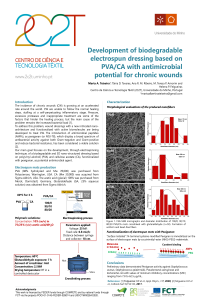
The incidence of chronic wounds (CW) is growing at an accelerated rate around the world. CW are characterized for failing to progress through the orderly phases of the healing process, stalling at the inflammatory stage. This disorder is often triggered by infections. To address this problem, wound dressings with a nano-architecture and functionalized with active biomolecules are being engineered. The introduction of antimicrobial peptides (AMPs), as pexiganan (or MSI-78), which display broad spectrum of antibacterial activity and reduce bacterial resistance, has been considered a viable solution. Here, nanofibrous mats were electrospun with an architecture resembling the extracellular-matrix. To this effect, poly(vinyl alcohol) (PVA) and cellulose acetate (CA)-based meshes were prepared at different ratios from 100/0 to 70/30% (v/v) and characterized. The process was kept as green as possible by resorting to acetic acid/distilled water as solvents and low temperatures. Optimal conditions for PVA/CA processing were established at 29 kV, feeding rate of 0.8 mL/h and distance between needle and collector of 17 cm. To increase PVA stability in aqueous medium, a crosslinking process was carried out with glutaraldehyde (GA) vapor, a less toxic approach than GA immersion or GA addition to the polymer solution. Highly stable films were obtained. Their degradation profile was mapped after 28 days of incubation in distilled water, revealed that only less than 20% of their overall mass was lost after that period. Pexiganan was examined for its antibacterial action against Staphylococcus aureus, Staphylococcus epidermidis, Pseudomonas aeruginosa and Escherichia coli demonstrating minimum inhibitory concentrations (MIC) ranging from 7.8 to 62.5 µg/mL. Surface anchoring at MIC value (62.5 µg/mL) was performed using a poly(ethylene glycol)-spacer, the succinimidyl-ester (NHS)-PEG2-Maleimide, as a binding agent which allowed for covalent and electrostatic bonding to take place by means of the N-terminal cysteine-modified pexignan. Preliminary antimicrobial results are very promising.
Keywords
Chronic wounds
biodegradable
electrospinning
poly(vinyl alcohol)
cellulose acetate
antimicrobial effects
Manuscript
2020.04.24_Poster Conf_Marta Teixeira (2).pdf
Poster
2020.04.24_Poster Conf_Marta Teixeira (2).pdf
Novel Coatings Based on Nanostructured Cefepime-Functionalized Magnetite for Implantable Devices
Surface Topography and Grain Morphology of Nanolayer TiAlN/TiSIN Coating Governed by Substrate Material and Rotation during Deposition