Event submissions
Published

This submission belongs to the session I. Posters of the event 2nd Coatings and Interfaces Web Conference
Published date
13 May, 2020
Citation
S. Machado, E. M. F. Vieira, A. M. Rocha, A. J. Paleo, N-Type Thermoelectric Textile Fabrics Based on Vapor Grown Carbon Nanofibers, in Proceedings of 2nd Coatings and Interfaces Web Conference, 15 May–31 May 2020, MDPI: Basel, Switzerland, doi: 10.3390/CIWC2020-06828
Share
Email
Facebook
Twitter
LinkedIn
N-Type Thermoelectric Textile Fabrics Based on Vapor Grown Carbon Nanofibers
'%3e%3cpath%20d='M12.6647%2010.9104C12.4176%2010.325%2012.0589%209.7933%2011.6088%209.34485C11.16%208.89511%2010.6283%208.53653%2010.0432%208.28891C10.038%208.28629%2010.0327%208.28498%2010.0275%208.28236C10.8437%207.69282%2011.3743%206.73252%2011.3743%205.64907C11.3743%203.85423%209.92005%202.40002%208.12522%202.40002C6.33038%202.40002%204.87618%203.85423%204.87618%205.64907C4.87618%206.73252%205.40677%207.69282%206.22296%208.28367C6.21772%208.28629%206.21248%208.2876%206.20724%208.29022C5.62031%208.53783%205.09365%208.89287%204.64167%209.34616C4.19192%209.79496%203.83334%2010.3266%203.58573%2010.9117C3.34247%2011.4846%203.21128%2012.0987%203.19925%2012.721C3.1989%2012.735%203.20135%2012.7489%203.20646%2012.7619C3.21157%2012.7749%203.21924%2012.7868%203.22901%2012.7968C3.23877%2012.8068%203.25045%2012.8148%203.26334%2012.8202C3.27623%2012.8256%203.29007%2012.8284%203.30406%2012.8284H4.09012C4.14776%2012.8284%204.19362%2012.7825%204.19493%2012.7262C4.22113%2011.7148%204.62726%2010.7676%205.34519%2010.0497C6.08802%209.30686%207.07452%208.89811%208.12522%208.89811C9.17592%208.89811%2010.1624%209.30686%2010.9052%2010.0497C11.6232%2010.7676%2012.0293%2011.7148%2012.0555%2012.7262C12.0568%2012.7839%2012.1027%2012.8284%2012.1603%2012.8284H12.9464C12.9604%2012.8284%2012.9742%2012.8256%2012.9871%2012.8202C13%2012.8148%2013.0117%2012.8068%2013.0214%2012.7968C13.0312%2012.7868%2013.0389%2012.7749%2013.044%2012.7619C13.0491%2012.7489%2013.0515%2012.735%2013.0512%2012.721C13.0381%2012.0947%2012.9084%2011.4856%2012.6647%2010.9104ZM8.12522%207.90243C7.52388%207.90243%206.95792%207.66793%206.53214%207.24215C6.10636%206.81636%205.87185%206.2504%205.87185%205.64907C5.87185%205.04773%206.10636%204.48177%206.53214%204.05599C6.95792%203.63021%207.52388%203.3957%208.12522%203.3957C8.72655%203.3957%209.29252%203.63021%209.7183%204.05599C10.1441%204.48177%2010.3786%205.04773%2010.3786%205.64907C10.3786%206.2504%2010.1441%206.81636%209.7183%207.24215C9.29252%207.66793%208.72655%207.90243%208.12522%207.90243Z'%20fill='%235D1EE1'/%3e%3c/g%3e%3c/svg%3e)
S. Machado 1
E. M. F. Vieira 2
A. M. Rocha 1
A. J. Paleo 1
1. 2C2T-Centre for Textile Science and Technology, University of Minho, Campus de Azurém, 4800-058 Guimarães, Portugal
2. CMEMS-UMinho-Center for MicroElectromechanical Systems, University of Minho, Campus de Azurém, 4800-058 Guimarães, Portugal
Abstract
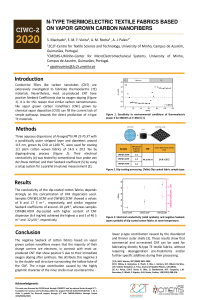
Thermoelectric (TE) devices that convert a heat gradient directly to electricity are considered as a clean technology for energy harvesting. Both hole-transporting (p-type) and electron-transporting (n-type) materials are required in order to fabricate a thermoelectric module. Carbon nanotube (CNT) based textile fabrics are relevant in this context for the production of wearable TE modules due to the combination of the high electrical conductivity and thermopower (Seebeck coefficient) from the CNT and the low thermal conductivity and flexibility provided by the textile fabric [1]. Nevertheless, most as-produced CNT are p-type materials due to their inherent oxygen doping, and therefore the production of air- and thermally stable n-type CNT based textile fabrics remains a challenge nowadays [2]. On the other hand, vapor grown carbon nanofibers (VGCNF), produced by chemical vapor deposition (CVD), have similar structures to multiwall carbon nanotubes (MWCNT), which make them valuable for electronic applications. For instance, by adjusting process variables during their CVD and post growth heat treatment, VGCNF can be tailored to have a wide range of thermal conductivity and electrical conductivity at room temperature. In particular, the unexpected n-type character at room temperature that they supply to dip-coated cotton fabrics will be the issue of this presentation [3].
[1] R. Torah, J. Lawrie-Ashton, Y. Li, S. Arumugam, H.A. Sodano, S. Beeby, Energy-harvesting materials for smart fabrics and textiles, MRS Bulletin 43(3) (2018) 214-219.
[2] L. Brownlie, J. Shapter, Advances in carbon nanotube n-type doping: Methods, analysis and applications, Carbon 126 (2018) 257-270.
[3] A.J. Paleo, E.M.F. Vieira, K. Wan, O. Bondarchuk, M.F. Cerqueira, L.M. Goncalves, E. Bilotti, P. Alpuim, A.M. Rocha, Negative thermoelectric power of melt mixed vapor grown carbon nanofiber polypropylene composites, Carbon 150 (2019) 408-416.
Keywords
Cotton fabrics
carbon nanofibers
negative thermoelectric power
Manuscript
ajpv_et_al_poster.pdf
Poster
ajpv_et_al_poster.pdf
Surface Modification of Implants by Sol-Gel Coating Technology: Advantages and Applications
Influence of the Size of Coal Ash FAU Zeolites Used as Dopants on the Sensing Properties of Nb2O5 Thin Films