Event submissions
Published

This submission belongs to the session B. Coatings and Surfaces for Mitigating Wear, Erosion and Corrosion of the event 2nd Coatings and Interfaces Web Conference
Published date
13 May, 2020
Citation
Jesús Abraham Pérez, Juan Jacobo Ruíz, Antonio Zaldivar, Anabel Álvarez, Salomé de la Parra, Astrid Sánchez, Synthesis of Silica Particles from Sugarcane Bagasse ash for its Application in Hydrophobic Coatings, in Proceedings of 2nd Coatings and Interfaces Web Conference, 15 May–31 May 2020, MDPI: Basel, Switzerland, doi: 10.3390/CIWC2020-06830
Share
Email
Facebook
Twitter
LinkedIn
Synthesis of Silica Particles from Sugarcane Bagasse ash for its Application in Hydrophobic Coatings
'%3e%3cpath%20d='M12.6647%2010.9104C12.4176%2010.325%2012.0589%209.7933%2011.6088%209.34485C11.16%208.89511%2010.6283%208.53653%2010.0432%208.28891C10.038%208.28629%2010.0327%208.28498%2010.0275%208.28236C10.8437%207.69282%2011.3743%206.73252%2011.3743%205.64907C11.3743%203.85423%209.92005%202.40002%208.12522%202.40002C6.33038%202.40002%204.87618%203.85423%204.87618%205.64907C4.87618%206.73252%205.40677%207.69282%206.22296%208.28367C6.21772%208.28629%206.21248%208.2876%206.20724%208.29022C5.62031%208.53783%205.09365%208.89287%204.64167%209.34616C4.19192%209.79496%203.83334%2010.3266%203.58573%2010.9117C3.34247%2011.4846%203.21128%2012.0987%203.19925%2012.721C3.1989%2012.735%203.20135%2012.7489%203.20646%2012.7619C3.21157%2012.7749%203.21924%2012.7868%203.22901%2012.7968C3.23877%2012.8068%203.25045%2012.8148%203.26334%2012.8202C3.27623%2012.8256%203.29007%2012.8284%203.30406%2012.8284H4.09012C4.14776%2012.8284%204.19362%2012.7825%204.19493%2012.7262C4.22113%2011.7148%204.62726%2010.7676%205.34519%2010.0497C6.08802%209.30686%207.07452%208.89811%208.12522%208.89811C9.17592%208.89811%2010.1624%209.30686%2010.9052%2010.0497C11.6232%2010.7676%2012.0293%2011.7148%2012.0555%2012.7262C12.0568%2012.7839%2012.1027%2012.8284%2012.1603%2012.8284H12.9464C12.9604%2012.8284%2012.9742%2012.8256%2012.9871%2012.8202C13%2012.8148%2013.0117%2012.8068%2013.0214%2012.7968C13.0312%2012.7868%2013.0389%2012.7749%2013.044%2012.7619C13.0491%2012.7489%2013.0515%2012.735%2013.0512%2012.721C13.0381%2012.0947%2012.9084%2011.4856%2012.6647%2010.9104ZM8.12522%207.90243C7.52388%207.90243%206.95792%207.66793%206.53214%207.24215C6.10636%206.81636%205.87185%206.2504%205.87185%205.64907C5.87185%205.04773%206.10636%204.48177%206.53214%204.05599C6.95792%203.63021%207.52388%203.3957%208.12522%203.3957C8.72655%203.3957%209.29252%203.63021%209.7183%204.05599C10.1441%204.48177%2010.3786%205.04773%2010.3786%205.64907C10.3786%206.2504%2010.1441%206.81636%209.7183%207.24215C9.29252%207.66793%208.72655%207.90243%208.12522%207.90243Z'%20fill='%235D1EE1'/%3e%3c/g%3e%3c/svg%3e)
Jesús Abraham Pérez 1
Juan Jacobo Ruíz 1
Antonio Zaldivar 1
Anabel Álvarez 1
Salomé de la Parra 1
Astrid Sánchez 1
1. Universidad Autónoma de Nuevo León
Abstract
Wastes like sugarcane bagasse ash (SCBA) can be used as raw material in the ceramics, by the elaboration of bricks and tiles, and glass industry due its high amount of silica in its composition (>70 %). Another application for the SCBA is the synthesis of metallic silicates. In this work is studied the synthesis of sodium silicate with SCBA as main raw material and the future application of the sodium silicate for the preparation of silica particles to create hydrophobic surfaces for ceramic materials to prevent its erosion. The sodium silicate synthesis was carried out by the thermochemical method with batches of ash and sodium carbonate in a 1:1 sodium oxide-silicon oxide molar ratio. The thermal treatment was in a electric furnace at 800 °C for 8 hours, then for the synthesis of the silica particles, the sodium silicate was dissolved in water and there was added methanol in a 3:2 water methanol volume ratio, the solution was aging for an hour to create the bond Si-OH, finally TEOS was added and the solution was stirred for 2 hours to originate a hydrophobic and hydrolytically resistant siloxane by the displacement of the H in the Si-OH bond. The application of the solution was by the spray-coating method over substrates of concrete and red clay with an application of 10, 15 and 20 layers. The hydrophobicity was evaluated with the water contact angle test, with results of contact angles above the 110°, thus demonstrating the capacity of a waste for the generation of coatings to prolong the useful life of building materials.
Keywords
Sugarcane bagasse ash
Sodium silicate
Hydrophobic coatings
Manuscript
CIWC2020-sciforum-030668 .pdf
Poster
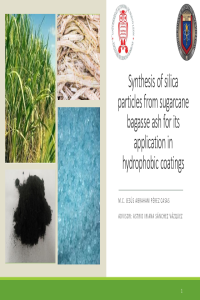
Synthesis silica.pdf
Influence of the Size of Coal Ash FAU Zeolites Used as Dopants on the Sensing Properties of Nb2O5 Thin Films
Fabrication of Transparent ITO/Ga-Doped ZnO Coating as a Front Panel Electrode toward Efficient Thin Film Solar Cells