Event submissions
Published

This submission belongs to the session A. Biocoating and Biomaterial Surfaces and Interfaces of the event 2nd Coatings and Interfaces Web Conference
Published date
15 May, 2020
Citation
Ionela Cristina Nica, Miruna S. Stan, Anca Dinischiotu, Valentina Grumezescu, Alexandra Elena Stoica, Alina Maria Holban, Alexandru Grumezescu, New Advances on Fibroblast Growth Factor-Based Coatings for Hip Replacement Implants, in Proceedings of 2nd Coatings and Interfaces Web Conference, 15 May–31 May 2020, MDPI: Basel, Switzerland, doi: 10.3390/CIWC2020-06844
Share
Email
Facebook
Twitter
LinkedIn
New Advances on Fibroblast Growth Factor-Based Coatings for Hip Replacement Implants

Ionela Cristina Nica 1

Miruna S. Stan 1,2

Anca Dinischiotu 1
'%3e%3cpath%20d='M12.6647%2010.9104C12.4176%2010.325%2012.0589%209.7933%2011.6088%209.34485C11.16%208.89511%2010.6283%208.53653%2010.0432%208.28891C10.038%208.28629%2010.0327%208.28498%2010.0275%208.28236C10.8437%207.69282%2011.3743%206.73252%2011.3743%205.64907C11.3743%203.85423%209.92005%202.40002%208.12522%202.40002C6.33038%202.40002%204.87618%203.85423%204.87618%205.64907C4.87618%206.73252%205.40677%207.69282%206.22296%208.28367C6.21772%208.28629%206.21248%208.2876%206.20724%208.29022C5.62031%208.53783%205.09365%208.89287%204.64167%209.34616C4.19192%209.79496%203.83334%2010.3266%203.58573%2010.9117C3.34247%2011.4846%203.21128%2012.0987%203.19925%2012.721C3.1989%2012.735%203.20135%2012.7489%203.20646%2012.7619C3.21157%2012.7749%203.21924%2012.7868%203.22901%2012.7968C3.23877%2012.8068%203.25045%2012.8148%203.26334%2012.8202C3.27623%2012.8256%203.29007%2012.8284%203.30406%2012.8284H4.09012C4.14776%2012.8284%204.19362%2012.7825%204.19493%2012.7262C4.22113%2011.7148%204.62726%2010.7676%205.34519%2010.0497C6.08802%209.30686%207.07452%208.89811%208.12522%208.89811C9.17592%208.89811%2010.1624%209.30686%2010.9052%2010.0497C11.6232%2010.7676%2012.0293%2011.7148%2012.0555%2012.7262C12.0568%2012.7839%2012.1027%2012.8284%2012.1603%2012.8284H12.9464C12.9604%2012.8284%2012.9742%2012.8256%2012.9871%2012.8202C13%2012.8148%2013.0117%2012.8068%2013.0214%2012.7968C13.0312%2012.7868%2013.0389%2012.7749%2013.044%2012.7619C13.0491%2012.7489%2013.0515%2012.735%2013.0512%2012.721C13.0381%2012.0947%2012.9084%2011.4856%2012.6647%2010.9104ZM8.12522%207.90243C7.52388%207.90243%206.95792%207.66793%206.53214%207.24215C6.10636%206.81636%205.87185%206.2504%205.87185%205.64907C5.87185%205.04773%206.10636%204.48177%206.53214%204.05599C6.95792%203.63021%207.52388%203.3957%208.12522%203.3957C8.72655%203.3957%209.29252%203.63021%209.7183%204.05599C10.1441%204.48177%2010.3786%205.04773%2010.3786%205.64907C10.3786%206.2504%2010.1441%206.81636%209.7183%207.24215C9.29252%207.66793%208.72655%207.90243%208.12522%207.90243Z'%20fill='%235D1EE1'/%3e%3c/g%3e%3c/svg%3e)
Valentina Grumezescu 3
Alexandra Elena Stoica 2

Alina Maria Holban 4,5

Alexandru Grumezescu 2
1. Department of Biochemistry and Molecular Biology, Faculty of Biology, University of Bucharest, 91-95 Splaiul Independentei, 050095 Bucharest, Romania
2. Department of Science and Engineering of Oxide Materials and Nanomaterials, Faculty of Applied Chemistry and Materials Science, University Politehnica of Bucharest, 1–7 Polizu Street, 011061 Bucharest, Romania
3. National Institute for Lasers, Plasma and Radiation Physics, Măgurele 077125, Romania
4. Research Institute of the University of Bucharest –ICUB, 91-95 Splaiul Independentei, 050095 Bucharest, Romania
5. Department of Microbiology and Immunology, Faculty of Biology, University of Bucharest, 1-3 Aleea Portocalelor, 060101 Bucharest, Romania
Abstract
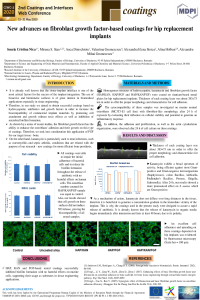
It is already well known that the tissue-implant interface is one of the most critical factors for the success of the implant integration. The use of bioactive and biomimetic surfaces is of great interest in biomedical applications especially in tissue engineering. Therefore, in our study we aimed to obtain successful coatings based on hydroxyapatite, antibiotics and growth factors in order to increase the biocompatibility of commercial implant materials by promoting cell attachment and growth without toxic effects as well as inhibition of microbial biofilm formation. In this way, homogenous mixtures of hydroxyapatite, kanamycin and fibroblast growth factor (HAP/KAN, HAP/FGF and HAP/KAN/FGF) were coated on titanium-based metal plates for hip replacement implants. The coatings were able to impair the initial adherence of bacterial cells and to reduce the biofilm formation throughout the release of antibiotic. The cytocompatibility of these samples was investigated on murine normal osteoblasts (MC3T3-E1 cell line) with fibroblast-like morphology by evaluating their influence on cellular viability and potential to generate an inflammatory response. In addition, the adhesion and proliferation, as well as the actin cytoskeleton organization, were observed after 24 h of cell culture on these coatings. The results confirmed the biocompatibility of all coatings, the cell number counted for HAP/KAN/FGF sample being equal to control. Since it is well known that NO is a marker of inflammation with an essential role in regulating apoptotic death and cell viability, our study showed that cell growth on these surfaces did not induce nitric oxide (NO) release, NO level being maintained close to control values for all tested samples. Also, an excellent cell adherence and spreading on these coatings deposited on hip implants was evidenced by fluorescence microscopy, supporting their usage as substrates in tissue engineering applications. Acknowledgements. This work has been funded by the Operational Programme Human Capital of the Ministry of European Funds through the Financial Agreement 51668/09.07.2019, SMIS code 124705, and through the project no. 77PD/2018 NANO-BIO-INT (PN-III-P1-1.1-PD-2016-1562).
Keywords
hydroxyapatite
kanamycin
fibroblast growth factor
coatings
osteoblasts
Manuscript
sciforum-031655.pdf
Poster
presentation.pdf
2D and 3D Electrospun Silk Fibroin Gelatin Coatings to Improve Scaffold Performances in Cardiovascular Applications
Hybrid Oxidation of Titanium Substrates for Biomedical Applications