Event submissions
EventsMOL2NET'20, Conference on Molecular, Biomed., Comput. & Network Science and Engineering, 6th ed.
Published
 10.3390/mol2net-06-06850 (registering DOI)
 This submission belongs to the session 02. USINEWS-04: US-IN-EU Worldwide Science Workshop Series, Duluth, USA, 2020 of the event MOL2NET'20, Conference on Molecular, Biomed., Comput. & Network Science and Engineering, 6th ed.
Published date
24 May, 2020
Citation
Noureddine Chaachouay, Lahcen Zidane, Diabetic treatement with herbal medecine in the Rif, Morocco, in Proceedings of MOL2NET'20, Conference on Molecular, Biomed., Comput. & Network Science and Engineering, 6th ed., 30 January 2020–30 January 2021, MDPI: Basel, Switzerland, doi: 10.3390/mol2net-06-06850
Share
Email
Facebook
Twitter
LinkedIn
Diabetic treatement with herbal medecine in the Rif, Morocco

Noureddine Chaachouay 1
'%3e%3cpath%20d='M12.6647%2010.9104C12.4176%2010.325%2012.0589%209.7933%2011.6088%209.34485C11.16%208.89511%2010.6283%208.53653%2010.0432%208.28891C10.038%208.28629%2010.0327%208.28498%2010.0275%208.28236C10.8437%207.69282%2011.3743%206.73252%2011.3743%205.64907C11.3743%203.85423%209.92005%202.40002%208.12522%202.40002C6.33038%202.40002%204.87618%203.85423%204.87618%205.64907C4.87618%206.73252%205.40677%207.69282%206.22296%208.28367C6.21772%208.28629%206.21248%208.2876%206.20724%208.29022C5.62031%208.53783%205.09365%208.89287%204.64167%209.34616C4.19192%209.79496%203.83334%2010.3266%203.58573%2010.9117C3.34247%2011.4846%203.21128%2012.0987%203.19925%2012.721C3.1989%2012.735%203.20135%2012.7489%203.20646%2012.7619C3.21157%2012.7749%203.21924%2012.7868%203.22901%2012.7968C3.23877%2012.8068%203.25045%2012.8148%203.26334%2012.8202C3.27623%2012.8256%203.29007%2012.8284%203.30406%2012.8284H4.09012C4.14776%2012.8284%204.19362%2012.7825%204.19493%2012.7262C4.22113%2011.7148%204.62726%2010.7676%205.34519%2010.0497C6.08802%209.30686%207.07452%208.89811%208.12522%208.89811C9.17592%208.89811%2010.1624%209.30686%2010.9052%2010.0497C11.6232%2010.7676%2012.0293%2011.7148%2012.0555%2012.7262C12.0568%2012.7839%2012.1027%2012.8284%2012.1603%2012.8284H12.9464C12.9604%2012.8284%2012.9742%2012.8256%2012.9871%2012.8202C13%2012.8148%2013.0117%2012.8068%2013.0214%2012.7968C13.0312%2012.7868%2013.0389%2012.7749%2013.044%2012.7619C13.0491%2012.7489%2013.0515%2012.735%2013.0512%2012.721C13.0381%2012.0947%2012.9084%2011.4856%2012.6647%2010.9104ZM8.12522%207.90243C7.52388%207.90243%206.95792%207.66793%206.53214%207.24215C6.10636%206.81636%205.87185%206.2504%205.87185%205.64907C5.87185%205.04773%206.10636%204.48177%206.53214%204.05599C6.95792%203.63021%207.52388%203.3957%208.12522%203.3957C8.72655%203.3957%209.29252%203.63021%209.7183%204.05599C10.1441%204.48177%2010.3786%205.04773%2010.3786%205.64907C10.3786%206.2504%2010.1441%206.81636%209.7183%207.24215C9.29252%207.66793%208.72655%207.90243%208.12522%207.90243Z'%20fill='%235D1EE1'/%3e%3c/g%3e%3c/svg%3e)
Lahcen Zidane 2
1. Agri-Food and Health Laboratory (AFHL), Faculty of Sciences and Techniques of Settat; Hassan First University; Address: Po Box 382, 26000 Settat, Morocco.
2. FSK IBN TOFAIL
Abstract
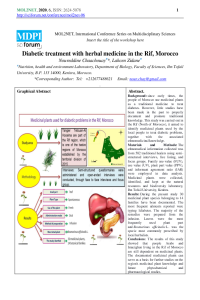
Background: since early times, the people of Morocco use medicinal plants as traditional medicine to treat diabetes. However, little studies have been made in the past to properly document and promote the traditional knowledge. This study was carried out in the Rif (North of Morocco), it aimed to identify medicinal plant used by the local people to treat diabetic problems, together with the associated ethnomedicinal knowledge.
Materials and Methods: The ethnomedical information collected was from 582 traditional healers using semi-structured interviews, free listing and focus group. Family use value (FUV), use value (UV), plant part value (PPV) and informant agreement ratio (IAR) were employed in data analysis. medicinal plant were collected, identified and kept at the natural resources and biodiversity laboratory, Ibn Tofail University, Kenitra.
Results: During the present study 30 medicinal plant species belonging to 14 families has been documented. The most frequent ailments reported were type 1 diabetes. The majority of the remedies were prepared from infusion. Leaves were the most frequently used plant part and Rosmarinus officinalis L. was the specie most commonly prescribed by local herbalists.
Conclusions: The results of this study showed that people Arabs and Imazighen living in the Rif of Morocco are still dependent on medicinal plants. The documented medicinal plants can serve as a basis for further studies on the regions medicinal plants knowledge and for future phytochemical and pharmacological studies.
Keywords
Rif
Ethnomedicinal
Medicinal plants
Diabetic problems.
Manuscript
ABSTRAT.pdf
Poster
ABSTRAT.pdf
Artificial Neural Network and Intelligent Attendance System
Combining Single-Walled Carbon Nanocones with Antioxidant Vitamins C and E Towards Neurotherapy-Based Nanomedicine