Event submissions
EventsMOL2NET'20, Conference on Molecular, Biomed., Comput. & Network Science and Engineering, 6th ed.
Published
 10.3390/mol2net-06-06857 (registering DOI)
 This submission belongs to the session 02. USINEWS-04: US-IN-EU Worldwide Science Workshop Series, Duluth, USA, 2020 of the event MOL2NET'20, Conference on Molecular, Biomed., Comput. & Network Science and Engineering, 6th ed.
Published date
05 Jun, 2020
Citation
Sondes MECHRI, Imen Sellem, Khelifa Bouacem, Fadoua Jabeur, Lotfi Mellouli, Hocine Hacene, Amel Bouanane-Darenfed, Bassem Jaouadi, Valorization of shrimp Metapenaeus monoceros bio-waste as a source of bioactive protein hydrolysate, in Proceedings of MOL2NET'20, Conference on Molecular, Biomed., Comput. & Network Science and Engineering, 6th ed., 30 January 2020–30 January 2021, MDPI: Basel, Switzerland, doi: 10.3390/mol2net-06-06857
Share
Email
Facebook
Twitter
LinkedIn
Valorization of shrimp Metapenaeus monoceros bio-waste as a source of bioactive protein hydrolysate
'%3e%3cpath%20d='M12.6647%2010.9104C12.4176%2010.325%2012.0589%209.7933%2011.6088%209.34485C11.16%208.89511%2010.6283%208.53653%2010.0432%208.28891C10.038%208.28629%2010.0327%208.28498%2010.0275%208.28236C10.8437%207.69282%2011.3743%206.73252%2011.3743%205.64907C11.3743%203.85423%209.92005%202.40002%208.12522%202.40002C6.33038%202.40002%204.87618%203.85423%204.87618%205.64907C4.87618%206.73252%205.40677%207.69282%206.22296%208.28367C6.21772%208.28629%206.21248%208.2876%206.20724%208.29022C5.62031%208.53783%205.09365%208.89287%204.64167%209.34616C4.19192%209.79496%203.83334%2010.3266%203.58573%2010.9117C3.34247%2011.4846%203.21128%2012.0987%203.19925%2012.721C3.1989%2012.735%203.20135%2012.7489%203.20646%2012.7619C3.21157%2012.7749%203.21924%2012.7868%203.22901%2012.7968C3.23877%2012.8068%203.25045%2012.8148%203.26334%2012.8202C3.27623%2012.8256%203.29007%2012.8284%203.30406%2012.8284H4.09012C4.14776%2012.8284%204.19362%2012.7825%204.19493%2012.7262C4.22113%2011.7148%204.62726%2010.7676%205.34519%2010.0497C6.08802%209.30686%207.07452%208.89811%208.12522%208.89811C9.17592%208.89811%2010.1624%209.30686%2010.9052%2010.0497C11.6232%2010.7676%2012.0293%2011.7148%2012.0555%2012.7262C12.0568%2012.7839%2012.1027%2012.8284%2012.1603%2012.8284H12.9464C12.9604%2012.8284%2012.9742%2012.8256%2012.9871%2012.8202C13%2012.8148%2013.0117%2012.8068%2013.0214%2012.7968C13.0312%2012.7868%2013.0389%2012.7749%2013.044%2012.7619C13.0491%2012.7489%2013.0515%2012.735%2013.0512%2012.721C13.0381%2012.0947%2012.9084%2011.4856%2012.6647%2010.9104ZM8.12522%207.90243C7.52388%207.90243%206.95792%207.66793%206.53214%207.24215C6.10636%206.81636%205.87185%206.2504%205.87185%205.64907C5.87185%205.04773%206.10636%204.48177%206.53214%204.05599C6.95792%203.63021%207.52388%203.3957%208.12522%203.3957C8.72655%203.3957%209.29252%203.63021%209.7183%204.05599C10.1441%204.48177%2010.3786%205.04773%2010.3786%205.64907C10.3786%206.2504%2010.1441%206.81636%209.7183%207.24215C9.29252%207.66793%208.72655%207.90243%208.12522%207.90243Z'%20fill='%235D1EE1'/%3e%3c/g%3e%3c/svg%3e)
Sondes MECHRI 1
Imen Sellem 1
Khelifa Bouacem 1,2
Fadoua Jabeur 1
Lotfi Mellouli 1
Hocine Hacene 2
Amel Bouanane-Darenfed 2
Bassem Jaouadi 1
1. Laboratory of Microbial Biotechnology, Enzymatic, and Biomolecules (LMBEB), Centre of Biotechnology of Sfax (CBS), University of Sfax, P.O. Box 1177, Sfax 3018, Tunisia
2. Laboratory of Cellular and Molecular Biology (LCMB), Microbiology Team, Faculty of Biological Sciences, University of Sciences and Technology of Houari Boumediene (USTHB), PO Box 32, El Alia, Bab Ezzouar, 16111 Algiers, Algeria
Abstract
Mediterranean sea is threatened by a large number of factors such as habitat alteration, urbanization, climate change, pollution and more specifically by the introduction of autochton and non-native species. Shrimps are caught all along the Tunisian coasts. They are found in the Gulf of Gabes area, wherein the largest concentrations of these species are located, especially the king shrimp Penaeus kerathurus. In addition, fishing with both trawlers and inshore fishing units have been recorded as relatively large quantities of another shrimp species, commonly known as white or speckled shrimp, Metapenaeus monoceros. The efficiency of the proteolytic strain Anoxybacillus kamchatkensis M1V in the fermentation of speckled shrimp by-product was investigated for the recovery of a deproteinized bioactive hydrolysate. The biological activities of the resulting hydrolysate were also examined by applying several antioxidant and enzyme inhibitory assays. The strain M1V was found to produce high level of protease activity (2,000 U/mL) when grown in media containing only shrimp powder at 25 g/L. The obtained hydrolysate showed a significant enzymatic inhibitory potential against acetylcholinesterase, tyrosinase, amylase, and angiotensin I convertase, and a strong antioxidant activity.
Keywords
Shrimp by-product
Anoxybacillus kamchatkensis
Protease
Chitin
Hydrolysate
Biological activities.
Manuscript
Manuscript_MOL2NET_2_2020.pdf
Poster
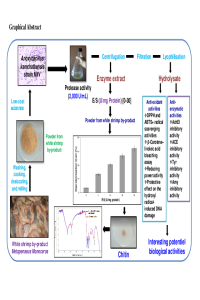
Graphical Abstract_MOL2NET_2_2020.pdf
Purification, biochemical characterization, and molecular elucidation of a new biotechnologically compatible serine peptidase from Virgibacillus natechei strain FarDT
Modeling and simulation on hydrogen-rich syngas production via gasification of palm kernel shell