Event submissions
EventsMOL2NET'20, Conference on Molecular, Biomed., Comput. & Network Science and Engineering, 6th ed.
Published
 10.3390/mol2net-06-06886 (registering DOI)
 This submission belongs to the session 01. CHEMBIOMOL-06: Chem. Biol. & Med. Chem. Workshop, Bilbao-Rostock, Germany-Galveston, Texas, USA, 2020 of the event MOL2NET'20, Conference on Molecular, Biomed., Comput. & Network Science and Engineering, 6th ed.
Published date
27 Jul, 2020
Citation
Katia-Louiza Asmani, Khelifa Bouacem, Akli Ouelhadj, Merzouk Yahiaoui, Sondes Mechri, Fadoua Jabeur, Bassem Jaouadi, Identification of a novel acido-thermostable chitinase from Bacillus altitudinis strain KA15, in Proceedings of MOL2NET'20, Conference on Molecular, Biomed., Comput. & Network Science and Engineering, 6th ed., 30 January 2020–30 January 2021, MDPI: Basel, Switzerland, doi: 10.3390/mol2net-06-06886
Share
Email
Facebook
Twitter
LinkedIn
Identification of a novel acido-thermostable chitinase from Bacillus altitudinis strain KA15
'%3e%3cpath%20d='M12.6647%2010.9104C12.4176%2010.325%2012.0589%209.7933%2011.6088%209.34485C11.16%208.89511%2010.6283%208.53653%2010.0432%208.28891C10.038%208.28629%2010.0327%208.28498%2010.0275%208.28236C10.8437%207.69282%2011.3743%206.73252%2011.3743%205.64907C11.3743%203.85423%209.92005%202.40002%208.12522%202.40002C6.33038%202.40002%204.87618%203.85423%204.87618%205.64907C4.87618%206.73252%205.40677%207.69282%206.22296%208.28367C6.21772%208.28629%206.21248%208.2876%206.20724%208.29022C5.62031%208.53783%205.09365%208.89287%204.64167%209.34616C4.19192%209.79496%203.83334%2010.3266%203.58573%2010.9117C3.34247%2011.4846%203.21128%2012.0987%203.19925%2012.721C3.1989%2012.735%203.20135%2012.7489%203.20646%2012.7619C3.21157%2012.7749%203.21924%2012.7868%203.22901%2012.7968C3.23877%2012.8068%203.25045%2012.8148%203.26334%2012.8202C3.27623%2012.8256%203.29007%2012.8284%203.30406%2012.8284H4.09012C4.14776%2012.8284%204.19362%2012.7825%204.19493%2012.7262C4.22113%2011.7148%204.62726%2010.7676%205.34519%2010.0497C6.08802%209.30686%207.07452%208.89811%208.12522%208.89811C9.17592%208.89811%2010.1624%209.30686%2010.9052%2010.0497C11.6232%2010.7676%2012.0293%2011.7148%2012.0555%2012.7262C12.0568%2012.7839%2012.1027%2012.8284%2012.1603%2012.8284H12.9464C12.9604%2012.8284%2012.9742%2012.8256%2012.9871%2012.8202C13%2012.8148%2013.0117%2012.8068%2013.0214%2012.7968C13.0312%2012.7868%2013.0389%2012.7749%2013.044%2012.7619C13.0491%2012.7489%2013.0515%2012.735%2013.0512%2012.721C13.0381%2012.0947%2012.9084%2011.4856%2012.6647%2010.9104ZM8.12522%207.90243C7.52388%207.90243%206.95792%207.66793%206.53214%207.24215C6.10636%206.81636%205.87185%206.2504%205.87185%205.64907C5.87185%205.04773%206.10636%204.48177%206.53214%204.05599C6.95792%203.63021%207.52388%203.3957%208.12522%203.3957C8.72655%203.3957%209.29252%203.63021%209.7183%204.05599C10.1441%204.48177%2010.3786%205.04773%2010.3786%205.64907C10.3786%206.2504%2010.1441%206.81636%209.7183%207.24215C9.29252%207.66793%208.72655%207.90243%208.12522%207.90243Z'%20fill='%235D1EE1'/%3e%3c/g%3e%3c/svg%3e)
Katia-Louiza Asmani 1
Khelifa Bouacem 1,2
Akli Ouelhadj 3,4
Merzouk Yahiaoui 5
Sondes Mechri 6
Fadoua Jabeur 7
Bassem Jaouadi 6
1. Department of Biochemistry & Microbiology, Faculty of Biological and Agricultural Sciences (FBAS), University of Mouloud Mammeri of Tizi-Ouzou (UMMTO), P.O. Box 17, Tizi-Ouzou 15000, Algeria
2. Laboratory of Cellular and Molecular Biology (LCMB), Microbiology Team, Faculty of Biological Sciences, University of Sciences and Technology Houari Boumediene (USTHB), P.O. Box 32, El Alia, Bab Ezzouar, 16111 Algiers, Algeria
3. Department of Biochemistry and Microbiology, Faculty of Biological and Agricultural Sciences (FBAS), University of Mouloud Mammeri of Tizi-Ouzou (UMMTO), P.O. Box 17, Tizi-Ouzou 15000, Algeria
4. Laboratory of Food Quality and Food Safety (LFQFS), FBAS, UMMTO, P.O. Box 17, Tizi-Ouzou 15000, Algeria
5. Department of Natural and Life Sciences, Faculty of Sciences (FS), University of M’Sila, P.O. Box 166, M’Sila 28000, Algeria
6. Laboratory of Microbial Biotechnology, Enzymatic, and Biomolecules (LMBEB), Centre of Biotechnology of Sfax, University of Sfax, P.O. Box 1177, Sfax 3018, Tunisia
7. Laboratory of Microbial Biotechnology, Enzymatic, and Biomolecules (LMBEM), Centre of Biotechnology of Sfax, University of Sfax, P.O. Box 1177, Sfax 3018, Tunisia
Abstract
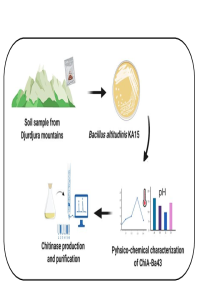
An extracellular acido-thermostable chitinase (called ChiA-Ba43) was hyper-produced and purified to homogeneity from a newly isolated Bacillus altitudinis strain KA15. This strain exhibited the highest chitinase activity (about 10,000 U/mL) after 46 h of incubation in an optimized meduim. Pure enzyme was obtained after ammonium sulphate precipitation (30-60%), followed by sequential column chromatographies on Sephacryl S-200 HR and Mono Q-Sepharose. The purified enzyme is a monomer with a molecular mass of 43,190.05 Da as determined by matrix assisted laser desorption ionization time-of-flight/mass spectrometry (MALDI-TOF/MS). The sequence of the 27 NH2-terminal residues of ChiA-Ba43 showed high homology with other Bacillus species. Optimal activity was recorded at pH 4.0-5.5 and 85°C. The pure enzyme was inhibited by p-chloromercuribenzoic acid (p-CMB) and N-ethylmaleimide (NEM). Interstingly, ChiA-Ba43 showed higher activity towards colloidal chitin, chitin azure, glycol chitin, glycol chitosane, chitotriose, and chito-oligosaccharide, while it did not hydrolyse chitibiose and amylose. Moreover, ChiA-Ba43 acted as an endo-splitting enzyme as showed by thin-layer chromatography (TLC) from enzymatic catalyzed hydrolysis of chitin-oligosaccharides and colloidal chitin. More interstingly, ChiA-Ba43 showed a high level of catalytic efficiency compared to chitinases ChiA-Mt45, ChiA-Hh59, Chitodextrinase®, N-acetyl-β-glucosaminidase®, and ChiA-65. Thanks to its biochemical properties, ChiA-Ba43 may be used for the bioconversion of chitinous waste on an industrial scale.
Keywords
Chitinase
Bacillus altitudinis
Endo-splitting enzyme.
Manuscript
Asmani et al., 2020b.pdf
Poster
Asmani et al., 2020.pdf
Rosemary (Rosmarinus officinalis) against Streptococcus mutans adhesins
The RNase III substrate specificity from that the E. coli’s to the Humans’.