Event submissions
Published
 10.3390/WEF-06918 (registering DOI)
 This submission belongs to the session S5. Energy Conversion Systems of the event The First World Energies Forum
Published date
11 Sep, 2020
Citation
Beaud Muriel, Amarasinghage Tharindu Dasun Perera, Cai Hanmin, Andrew Bollinger, Kristina Orehounig, Improving Energy Sustainability of Suburban Areas by Using Distributed Energy Systems: A Case Study, in Proceedings of The First World Energies Forum, 14 September–5 October 2020, MDPI: Basel, Switzerland, doi: 10.3390/WEF-06918
Share
Email
Facebook
Twitter
LinkedIn
Improving Energy Sustainability of Suburban Areas by Using Distributed Energy Systems: A Case Study
'%3e%3cpath%20d='M12.6647%2010.9104C12.4176%2010.325%2012.0589%209.7933%2011.6088%209.34485C11.16%208.89511%2010.6283%208.53653%2010.0432%208.28891C10.038%208.28629%2010.0327%208.28498%2010.0275%208.28236C10.8437%207.69282%2011.3743%206.73252%2011.3743%205.64907C11.3743%203.85423%209.92005%202.40002%208.12522%202.40002C6.33038%202.40002%204.87618%203.85423%204.87618%205.64907C4.87618%206.73252%205.40677%207.69282%206.22296%208.28367C6.21772%208.28629%206.21248%208.2876%206.20724%208.29022C5.62031%208.53783%205.09365%208.89287%204.64167%209.34616C4.19192%209.79496%203.83334%2010.3266%203.58573%2010.9117C3.34247%2011.4846%203.21128%2012.0987%203.19925%2012.721C3.1989%2012.735%203.20135%2012.7489%203.20646%2012.7619C3.21157%2012.7749%203.21924%2012.7868%203.22901%2012.7968C3.23877%2012.8068%203.25045%2012.8148%203.26334%2012.8202C3.27623%2012.8256%203.29007%2012.8284%203.30406%2012.8284H4.09012C4.14776%2012.8284%204.19362%2012.7825%204.19493%2012.7262C4.22113%2011.7148%204.62726%2010.7676%205.34519%2010.0497C6.08802%209.30686%207.07452%208.89811%208.12522%208.89811C9.17592%208.89811%2010.1624%209.30686%2010.9052%2010.0497C11.6232%2010.7676%2012.0293%2011.7148%2012.0555%2012.7262C12.0568%2012.7839%2012.1027%2012.8284%2012.1603%2012.8284H12.9464C12.9604%2012.8284%2012.9742%2012.8256%2012.9871%2012.8202C13%2012.8148%2013.0117%2012.8068%2013.0214%2012.7968C13.0312%2012.7868%2013.0389%2012.7749%2013.044%2012.7619C13.0491%2012.7489%2013.0515%2012.735%2013.0512%2012.721C13.0381%2012.0947%2012.9084%2011.4856%2012.6647%2010.9104ZM8.12522%207.90243C7.52388%207.90243%206.95792%207.66793%206.53214%207.24215C6.10636%206.81636%205.87185%206.2504%205.87185%205.64907C5.87185%205.04773%206.10636%204.48177%206.53214%204.05599C6.95792%203.63021%207.52388%203.3957%208.12522%203.3957C8.72655%203.3957%209.29252%203.63021%209.7183%204.05599C10.1441%204.48177%2010.3786%205.04773%2010.3786%205.64907C10.3786%206.2504%2010.1441%206.81636%209.7183%207.24215C9.29252%207.66793%208.72655%207.90243%208.12522%207.90243Z'%20fill='%235D1EE1'/%3e%3c/g%3e%3c/svg%3e)
Beaud Muriel 1,2
Amarasinghage Tharindu Dasun Perera 1
Cai Hanmin 1
Andrew Bollinger 1
Kristina Orehounig 1
1. Urban Energy Systems Laboratory, Swiss Federal Laboratories for Materials Science and Technology, Empa, 8600 Dübendorf, Switzerland
2. Automatic Control Laboratory,D-ITET, Swiss Federal Institute of Technology, ETHZ, 8092 Zürich, Switzerland
Abstract
The building sector plays a vital role in Switzerland’s climate policy. In order to support the energy transition in the building sector, Rolle, a suburban area located along the shore of Lake Geneva is considered in this study to understand the promising future scenarios for integration of renewable energy technologies. The area is clustered into 12 clusters and distributed energy system is designed for each cluster. Subsequently, three energy systems having contrasting densities are taken for further comparison to understand the impact of urban density on the design of the distributed energy system. The study reveals that urban density will influence the peak as well as the annual energy demand of the energy hubs. The study reveal that the energy technologies used in the energy hubs are strongly influenced by the capacity of the system (peak and annual energy demand). Energy systems having higher capacities are less sensitive to the market changes when compared to the systems having lower capacities (leading to sparse suburban areas).
Keywords
decentralized energy systems
district heating
multi-objective optimization
renewable energy sources
Manuscript
sciforum_032394_original_Conference_Paper_ATD -done.pdf
Poster
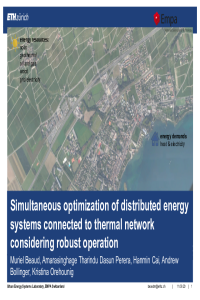
presentation_sept10-Beaud Muriel.pdf
Prediction of Cooling Energy Consumption Using Neural Network on the Example of the Hotel Building
Energy and Thermal Performance of Partially Bermed Earth-Sheltered House: Measure for Adapting to Climate Change in a Tropical Climate Region