Event submissions
Published

This submission belongs to the session 2. Potential nutraceutical effects of nutrients, phytochemicals, and microbiota in chronic metabolic disorders of the event The 1st International Electronic Conference on Nutrients
Published date
30 Oct, 2020
Citation
Azmah Saat, Nurmawati Syakroni, Razif Abas, Goh Yong Meng, Nur Izah Abdul Razak, Nurul Huda Mohd. Nor, Siti Fadziyah Mohamad Asri, Safuraa Salihan, Nurul Hayati Mohamad Zainal, Suryati Mohd. Thani, EVALUATION AND DETERMINATIONS OF SECONDARY METABOLITES AND ITS ANTIOXIDANT ACTIVITIES OF VARIOUS FRACTIONS OF ALBIZIA MYRIOPHYLLA BARK, in Proceedings of The 1st International Electronic Conference on Nutrients, 2 November–15 November 2020, MDPI: Basel, Switzerland, doi: 10.3390/IECN2020-07004
Share
Email
Facebook
Twitter
LinkedIn
EVALUATION AND DETERMINATIONS OF SECONDARY METABOLITES AND ITS ANTIOXIDANT ACTIVITIES OF VARIOUS FRACTIONS OF ALBIZIA MYRIOPHYLLA BARK
'%3e%3cpath%20d='M12.6647%2010.9104C12.4176%2010.325%2012.0589%209.7933%2011.6088%209.34485C11.16%208.89511%2010.6283%208.53653%2010.0432%208.28891C10.038%208.28629%2010.0327%208.28498%2010.0275%208.28236C10.8437%207.69282%2011.3743%206.73252%2011.3743%205.64907C11.3743%203.85423%209.92005%202.40002%208.12522%202.40002C6.33038%202.40002%204.87618%203.85423%204.87618%205.64907C4.87618%206.73252%205.40677%207.69282%206.22296%208.28367C6.21772%208.28629%206.21248%208.2876%206.20724%208.29022C5.62031%208.53783%205.09365%208.89287%204.64167%209.34616C4.19192%209.79496%203.83334%2010.3266%203.58573%2010.9117C3.34247%2011.4846%203.21128%2012.0987%203.19925%2012.721C3.1989%2012.735%203.20135%2012.7489%203.20646%2012.7619C3.21157%2012.7749%203.21924%2012.7868%203.22901%2012.7968C3.23877%2012.8068%203.25045%2012.8148%203.26334%2012.8202C3.27623%2012.8256%203.29007%2012.8284%203.30406%2012.8284H4.09012C4.14776%2012.8284%204.19362%2012.7825%204.19493%2012.7262C4.22113%2011.7148%204.62726%2010.7676%205.34519%2010.0497C6.08802%209.30686%207.07452%208.89811%208.12522%208.89811C9.17592%208.89811%2010.1624%209.30686%2010.9052%2010.0497C11.6232%2010.7676%2012.0293%2011.7148%2012.0555%2012.7262C12.0568%2012.7839%2012.1027%2012.8284%2012.1603%2012.8284H12.9464C12.9604%2012.8284%2012.9742%2012.8256%2012.9871%2012.8202C13%2012.8148%2013.0117%2012.8068%2013.0214%2012.7968C13.0312%2012.7868%2013.0389%2012.7749%2013.044%2012.7619C13.0491%2012.7489%2013.0515%2012.735%2013.0512%2012.721C13.0381%2012.0947%2012.9084%2011.4856%2012.6647%2010.9104ZM8.12522%207.90243C7.52388%207.90243%206.95792%207.66793%206.53214%207.24215C6.10636%206.81636%205.87185%206.2504%205.87185%205.64907C5.87185%205.04773%206.10636%204.48177%206.53214%204.05599C6.95792%203.63021%207.52388%203.3957%208.12522%203.3957C8.72655%203.3957%209.29252%203.63021%209.7183%204.05599C10.1441%204.48177%2010.3786%205.04773%2010.3786%205.64907C10.3786%206.2504%2010.1441%206.81636%209.7183%207.24215C9.29252%207.66793%208.72655%207.90243%208.12522%207.90243Z'%20fill='%235D1EE1'/%3e%3c/g%3e%3c/svg%3e)
Azmah Saat 1
Nurmawati Syakroni 1
Razif Abas 1
Goh Yong Meng 1
Nur Izah Abdul Razak 1
Nurul Huda Mohd. Nor 1
Siti Fadziyah Mohamad Asri 1
Safuraa Salihan 1
Nurul Hayati Mohamad Zainal 1
Suryati Mohd. Thani 1
1. Universiti Putra Malaysia
Abstract
Albizia myriophylla is a plant used in Thailand and East Coast Malaysia for the treatment of diabetes mellitus type II. The antioxidant activities of Albizia myriophylla have been suggested as one of the mechanism for the observed beneficial effects. Hence, this study examined the phenolic, flavonoid, saponin contents and anti-oxidant activity from methanol extract (ME) and its derived fractions hexane (HE), chloroform (CE), ethyl acetate (EAE), butanol (BE) and residual aqueous fraction of the bark of Albizia myriophylla (AE). Amongst the extracts, EAE showed the highest total phenolic content of about 0.77 mg of gallic acid equivalent/g of extract (mg GAE/mg). However the highest flavonoid content was detected in HE at 1.04 µg retinol equivalent (RE)/g extract), while the saponin content was highest in CE at 1.1 µg diosgenin equivalent (DE)/g extract). In 1,1-diphenyl-2-picrylhidrazyl (DPPH radical scavenging test), EAE at 100 µg/ml, had the highest percentage of inhibition of about 72.55%. 2-2’-azinobis 3-ethyl-6-sulfonic acid (ABTS radical scavenging test) showed BE had the highest percentage of inhibition at 100 µg/ml with an inhibition of 82.91%. Ferric reducing anti-oxidant power (FRAP test) elucidate BE as having the highest percentage of inhibition which is 86.04% followed closely by ME at 85.90% of inhibition. Thus, the different extracts of Albizia myriophylla displayed various antioxidant capacity with probable free radical scavenging activity which may be useful for the treatment of chronic inflammatory related metabolic diseases such as diabetes and obesity.
Keywords
antioxidant activity
phenolic
flavonoid
saponin
Albizia myriophylla
Manuscript
sciforum-037237-done.pdf
Poster
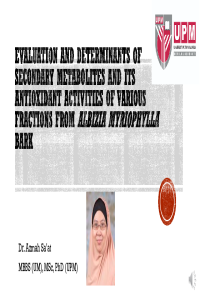
AZMAH SAAT PRESENTATION FOR IECN.pdf
VERY LOW-CALORIE KETOGENIC DIET WITH VEGAN MEAL REPLACEMENTS IN AN OBESE PATIENT WITH METABOLIC SYNDROME MODIFIES VISCERAL ADIPOSE TISSUE DISTRIBUTION AND TAXONOMIC COMPOSITION OF GUT MICROBIOTA.
Identification of Key Gut Microbiota Associated with Acquisition of Insulin Resistance on a High Fat High Sugar Diet