Event submissions
Published

This submission belongs to the session 2. Potential nutraceutical effects of nutrients, phytochemicals, and microbiota in chronic metabolic disorders of the event The 1st International Electronic Conference on Nutrients
Published date
30 Oct, 2020
Citation
Ryan du Preez, Sunil K. Panchal, Lindsay Brown, Tropical seaweeds improve cardiovascular and metabolic health of diet-induced obese and hypertensive rats, in Proceedings of The 1st International Electronic Conference on Nutrients, 2 November–15 November 2020, MDPI: Basel, Switzerland, doi: 10.3390/IECN2020-07011
Share
Email
Facebook
Twitter
LinkedIn
Tropical seaweeds improve cardiovascular and metabolic health of diet-induced obese and hypertensive rats
'%3e%3cpath%20d='M12.6647%2010.9104C12.4176%2010.325%2012.0589%209.7933%2011.6088%209.34485C11.16%208.89511%2010.6283%208.53653%2010.0432%208.28891C10.038%208.28629%2010.0327%208.28498%2010.0275%208.28236C10.8437%207.69282%2011.3743%206.73252%2011.3743%205.64907C11.3743%203.85423%209.92005%202.40002%208.12522%202.40002C6.33038%202.40002%204.87618%203.85423%204.87618%205.64907C4.87618%206.73252%205.40677%207.69282%206.22296%208.28367C6.21772%208.28629%206.21248%208.2876%206.20724%208.29022C5.62031%208.53783%205.09365%208.89287%204.64167%209.34616C4.19192%209.79496%203.83334%2010.3266%203.58573%2010.9117C3.34247%2011.4846%203.21128%2012.0987%203.19925%2012.721C3.1989%2012.735%203.20135%2012.7489%203.20646%2012.7619C3.21157%2012.7749%203.21924%2012.7868%203.22901%2012.7968C3.23877%2012.8068%203.25045%2012.8148%203.26334%2012.8202C3.27623%2012.8256%203.29007%2012.8284%203.30406%2012.8284H4.09012C4.14776%2012.8284%204.19362%2012.7825%204.19493%2012.7262C4.22113%2011.7148%204.62726%2010.7676%205.34519%2010.0497C6.08802%209.30686%207.07452%208.89811%208.12522%208.89811C9.17592%208.89811%2010.1624%209.30686%2010.9052%2010.0497C11.6232%2010.7676%2012.0293%2011.7148%2012.0555%2012.7262C12.0568%2012.7839%2012.1027%2012.8284%2012.1603%2012.8284H12.9464C12.9604%2012.8284%2012.9742%2012.8256%2012.9871%2012.8202C13%2012.8148%2013.0117%2012.8068%2013.0214%2012.7968C13.0312%2012.7868%2013.0389%2012.7749%2013.044%2012.7619C13.0491%2012.7489%2013.0515%2012.735%2013.0512%2012.721C13.0381%2012.0947%2012.9084%2011.4856%2012.6647%2010.9104ZM8.12522%207.90243C7.52388%207.90243%206.95792%207.66793%206.53214%207.24215C6.10636%206.81636%205.87185%206.2504%205.87185%205.64907C5.87185%205.04773%206.10636%204.48177%206.53214%204.05599C6.95792%203.63021%207.52388%203.3957%208.12522%203.3957C8.72655%203.3957%209.29252%203.63021%209.7183%204.05599C10.1441%204.48177%2010.3786%205.04773%2010.3786%205.64907C10.3786%206.2504%2010.1441%206.81636%209.7183%207.24215C9.29252%207.66793%208.72655%207.90243%208.12522%207.90243Z'%20fill='%235D1EE1'/%3e%3c/g%3e%3c/svg%3e)
Ryan du Preez 1

Sunil K. Panchal 2

Lindsay Brown 3
1. Central Queensland University
2. Western Sydney University
3. University of Southern Queensland
Abstract
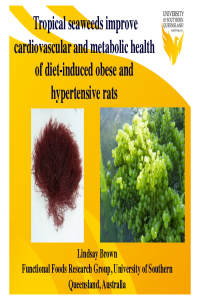
Seaweeds have been an important part of the diet of coastal populations in Asia possibly for millennia but only a few scattered coastal communities in Europe and the Americas have maintained these traditions (Mouritsen et al, 2019). Our studies have investigated the potential of two tropical seaweeds grown commercially in Asia, Sarconema and Caulerpa spp., as functional foods for the reversal of metabolic syndrome and possible mechanisms. Sarconema spp. are a source of carrageenans used as thickening and gelling agents in foods while Caulerpa spp. are consumed in South-East Asia as low-energy foods with high contents of vitamins and minerals. For our studies, male Wistar rats were divided into groups in a 16-week protocol: corn starch diet-fed rats (C); C rats supplemented with 5% dried seaweed for the last 8 weeks; high-carbohydrate, high-fat diet-fed rats (H); and H rats supplemented with 5% dried seaweed for the last 8 weeks. H rats developed obesity, hypertension, dyslipidaemia, glucose intolerance, fatty liver and increased left ventricular collagen deposition, infiltration of inflammatory cells and plasma liver enzyme activities. Seaweed supplementation decreased body weight, abdominal and liver fat, systolic blood pressure, plasma lipid concentrations, plasma activities of liver enzymes and collagen deposition. Further, seaweed supplementation modulated gut microbiota. Possible mechanisms for improved cardiovascular and metabolic health include a reduced infiltration of inflammatory cells into organs as well as an increased intake of fibre modulating gut microbiota composition.
Mouritsen OG, Rhatigan P, Pérez-Lloréns J: The rise of seaweed gastronomy: phycogastronomy. Botanica Marina 2019;62(3): 195-209.
Keywords
tropical seaweeds
obesity
hypertension
metabolic syndrome
rat model
Manuscript
sciforum-035943-done.pdf
Poster
IECN Nov 2020 Lindsay Brown.pdf
Assessment of negative factors affecting the intestinal microbiota in people with excessive body mass compared to people with normal body mass
Effect of Docosahexaenoic Acid supplementation on Microbiota in Obese ChiLdrEn: a pilot study. (The DAMOCLE study).