Event submissions
Published
 10.3390/IECB2020-07023 (registering DOI)
 This submission belongs to the session A. Technologies for innovative biosensors of the event The 1st International Electronic Conference on Biosensors
Published date
02 Nov, 2020
Citation
Ana Díaz-Fernández, Rebeca Miranda-Castro, Pedro Estrela, Noemí de-los-Santos-Álvarez, María Jesús Lobo-Castañón, CATCHING THE SUGARS: ELECTROCHEMICAL APTASENSORS FOR THE DETECTION OF CANCER-RELATED GLYCOSYLATION CHANGES IN PROSTATE SPECIFIC ANTIGEN, in Proceedings of The 1st International Electronic Conference on Biosensors, 2 November–17 November 2020, MDPI: Basel, Switzerland, doi: 10.3390/IECB2020-07023
Share
Email
Facebook
Twitter
LinkedIn
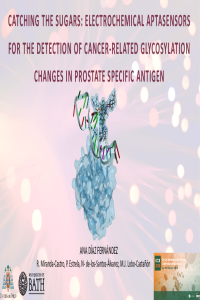
CATCHING THE SUGARS: ELECTROCHEMICAL APTASENSORS FOR THE DETECTION OF CANCER-RELATED GLYCOSYLATION CHANGES IN PROSTATE SPECIFIC ANTIGEN

Ana Díaz-Fernández 1

Rebeca Miranda-Castro 2

Pedro Estrela 3

Noemí de-los-Santos-Álvarez 2

María Jesús Lobo-Castañón 2
1. University of Oviedo
2. Universidad de Oviedo
3. 3Centre for Biosensors, Bioelectronics and Biodevices (C3Bio) and Department of Electronic & Electrical Engineering, University of Bath
Abstract
Cancer is associated with aberrant glycosylation and each type is characterized by a distinct change in the glycan structure. Therefore, analysis of tumor-linked glycan alterations is proposed as a valuable tool for cancer diagnosis. The glycosylation profile is currently characterized by long and complicated protocols, based on final MS detection or the use of lectins. However, these procedures cannot be applied for routine analysis in early detection of cancer and there is a clear need for new methods. Aptamers can be tailored to specifically detect glycosylation and their use as synthetic receptors appears to be a promising approach to replace the current methods . In the case of prostate cancer, it has been recently described that there is a variation in the fucose and the sialic acid of Prostate Specific Antigen (PSA).
We present two strategies to direct the selection of aptamers towards the glycans of PSA. The SELEX procedure is based on counter-selection steps against recombinant PSA and the use of lectins. Aptamers in the last cycle are cloned, sequenced and classified into families using bioinformatic tools. The most abundant aptamers are characterized by electrochemical binding assays. Two aptamers were obtained with different binding characteristics: ability to recognize glycans of any glycoprotein and to specifically recognize the glycans of PSA due to the interaction with amino acids of the protein.
We employ the selected aptamers and an aptamer previously described for the development of electrochemical aptasensors, based on sandwich or direct label-free assays. Both aptasensors respond to different levels of PSA in human serum and are applied to the analysis of serum samples. The results point to the detection of glycans as an alternative for the detection of prostate cancer, with potential to improve clinical outcomes of current PSA tests, which would reduce the number of unnecessary biopsies.
Keywords
aptamer
biosensor
prostate cancer
PSA
glycosylation
Manuscript
sciforum-034175-done.pdf
Poster
IECB ana diaz.pdf
Near-field sensor for non-invasive determination of blood glucose concentration
Giving New Uses to Glucose Meters: Detection of Prostate Cancer