Event submissions
Published
 10.3390/IECB2020-07033 (registering DOI)
 This submission belongs to the session D. Biosensors for emergency situations of the event The 1st International Electronic Conference on Biosensors
Published date
02 Nov, 2020
Citation
Khaled Alsabbagh, Tim Hornung, Achim Voigt, Sahba Sadir, Taleieh Rajabi, Kerstin Länge, Microfluidic impedance biosensor chip with DNA-based self-assembled monolayers for label-free detection of cardiac biomarker troponin I, in Proceedings of The 1st International Electronic Conference on Biosensors, 2 November–17 November 2020, MDPI: Basel, Switzerland, doi: 10.3390/IECB2020-07033
Share
Email
Facebook
Twitter
LinkedIn
Microfluidic impedance biosensor chip with DNA-based self-assembled monolayers for label-free detection of cardiac biomarker troponin I
'%3e%3cpath%20d='M12.6647%2010.9104C12.4176%2010.325%2012.0589%209.7933%2011.6088%209.34485C11.16%208.89511%2010.6283%208.53653%2010.0432%208.28891C10.038%208.28629%2010.0327%208.28498%2010.0275%208.28236C10.8437%207.69282%2011.3743%206.73252%2011.3743%205.64907C11.3743%203.85423%209.92005%202.40002%208.12522%202.40002C6.33038%202.40002%204.87618%203.85423%204.87618%205.64907C4.87618%206.73252%205.40677%207.69282%206.22296%208.28367C6.21772%208.28629%206.21248%208.2876%206.20724%208.29022C5.62031%208.53783%205.09365%208.89287%204.64167%209.34616C4.19192%209.79496%203.83334%2010.3266%203.58573%2010.9117C3.34247%2011.4846%203.21128%2012.0987%203.19925%2012.721C3.1989%2012.735%203.20135%2012.7489%203.20646%2012.7619C3.21157%2012.7749%203.21924%2012.7868%203.22901%2012.7968C3.23877%2012.8068%203.25045%2012.8148%203.26334%2012.8202C3.27623%2012.8256%203.29007%2012.8284%203.30406%2012.8284H4.09012C4.14776%2012.8284%204.19362%2012.7825%204.19493%2012.7262C4.22113%2011.7148%204.62726%2010.7676%205.34519%2010.0497C6.08802%209.30686%207.07452%208.89811%208.12522%208.89811C9.17592%208.89811%2010.1624%209.30686%2010.9052%2010.0497C11.6232%2010.7676%2012.0293%2011.7148%2012.0555%2012.7262C12.0568%2012.7839%2012.1027%2012.8284%2012.1603%2012.8284H12.9464C12.9604%2012.8284%2012.9742%2012.8256%2012.9871%2012.8202C13%2012.8148%2013.0117%2012.8068%2013.0214%2012.7968C13.0312%2012.7868%2013.0389%2012.7749%2013.044%2012.7619C13.0491%2012.7489%2013.0515%2012.735%2013.0512%2012.721C13.0381%2012.0947%2012.9084%2011.4856%2012.6647%2010.9104ZM8.12522%207.90243C7.52388%207.90243%206.95792%207.66793%206.53214%207.24215C6.10636%206.81636%205.87185%206.2504%205.87185%205.64907C5.87185%205.04773%206.10636%204.48177%206.53214%204.05599C6.95792%203.63021%207.52388%203.3957%208.12522%203.3957C8.72655%203.3957%209.29252%203.63021%209.7183%204.05599C10.1441%204.48177%2010.3786%205.04773%2010.3786%205.64907C10.3786%206.2504%2010.1441%206.81636%209.7183%207.24215C9.29252%207.66793%208.72655%207.90243%208.12522%207.90243Z'%20fill='%235D1EE1'/%3e%3c/g%3e%3c/svg%3e)
Khaled Alsabbagh 1
Tim Hornung 1
Achim Voigt 1
Sahba Sadir 1
Taleieh Rajabi 1
Kerstin Länge 1
1. Karlsruhe Institute of Technology
Abstract
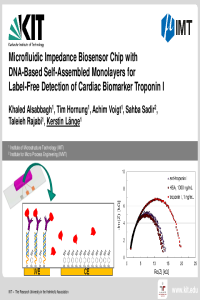
A microfluidic chip for electrochemical impedance spectroscopy (EIS) is presented as biosensor for the detection of cardiac troponin I (cTnI), which is one of the most specific diagnostic serum biomarkers for myocardial infarction. Impedimetric biosensors enable the detection of a variety of analytes, including small molecules, proteins, and cells. As analyte detection is direct and label-free, they allow fast detection of biomarkers, which is essential in the diagnosis of cardiac infarctions to promote a positive outcome. The EIS chip presented here consists of a microscope glass slide serving as base plate, sputtered electrodes, and a polydimethylsiloxane (PDMS) microchannel. The electrode design mainly consists of a working electrode and a counter electrode made of gold. A silver reference electrode can be included, if required. Protocols for electrode functionalization were developed considering a low initial impedance in addition to analyte-specific binding by corresponding antibodies and reduction of non-specific protein adsorption to prevent false-positive signals. Reagents tested for self-assembled monolayers (SAM) on gold electrodes included hydrocarbons with thiol groups and thiolated oligonucleotides. The optimized coating used thiolated single-strand DNA (ssDNA) and 1,4-benzenedithiol on the working electrode and 1,4-benzenedithiol on the counter electrode. After hybridization with corresponding ssDNA carrying an amino group, the reaction with glutaric anhydride led to carboxyl groups, on which anti-cTnI antibody was covalently coupled using carbodiimide chemistry. The PDMS microchannel was bonded on the glass slide with the functionalized electrodes, and the completed EIS chip was connected to the readout system. Sampling with human serum albumin (HSA), 1000 ng/mL, led to negligible signal changes, while sampling with cTnI, 1 ng/mL, led to a significant signal shift in the Nyquist plot. Sampling and measurement took only a few minutes. The results were promising regarding a future cost-effective biosensor array chip for the rapid detection of clinically relevant biomarkers in real samples.
Keywords
biosensor
cardiac troponin I
electrochemical impedance spectroscopy
microfluidic chip
Manuscript
sciforum-035072-done.pdf
Poster
Alsabbagh-etal-Länge_IECB2020_presentation_final_Upload.pdf
Highly multiplexed label-free imaging sensor for accurate quantification of small molecule binding kinetics
Polymeric magnetic microparticles as electrochemical immunosensing platforms