Event submissions
Published
 10.3390/IECB2020-07045 (registering DOI)
 This submission belongs to the session I. Posters of the event The 1st International Electronic Conference on Biosensors
Published date
02 Nov, 2020
Citation
Gheorghe Melinte, Oana Hosu, Giovanna Marrazza, Cecilia Cristea, Sensitive aptasensing of Lysozyme using a polymeric and metalLic nanostructured platform, in Proceedings of The 1st International Electronic Conference on Biosensors, 2 November–17 November 2020, MDPI: Basel, Switzerland, doi: 10.3390/IECB2020-07045
Share
Email
Facebook
Twitter
LinkedIn
Sensitive aptasensing of Lysozyme using a polymeric and metalLic nanostructured platform
'%3e%3cpath%20d='M12.6647%2010.9104C12.4176%2010.325%2012.0589%209.7933%2011.6088%209.34485C11.16%208.89511%2010.6283%208.53653%2010.0432%208.28891C10.038%208.28629%2010.0327%208.28498%2010.0275%208.28236C10.8437%207.69282%2011.3743%206.73252%2011.3743%205.64907C11.3743%203.85423%209.92005%202.40002%208.12522%202.40002C6.33038%202.40002%204.87618%203.85423%204.87618%205.64907C4.87618%206.73252%205.40677%207.69282%206.22296%208.28367C6.21772%208.28629%206.21248%208.2876%206.20724%208.29022C5.62031%208.53783%205.09365%208.89287%204.64167%209.34616C4.19192%209.79496%203.83334%2010.3266%203.58573%2010.9117C3.34247%2011.4846%203.21128%2012.0987%203.19925%2012.721C3.1989%2012.735%203.20135%2012.7489%203.20646%2012.7619C3.21157%2012.7749%203.21924%2012.7868%203.22901%2012.7968C3.23877%2012.8068%203.25045%2012.8148%203.26334%2012.8202C3.27623%2012.8256%203.29007%2012.8284%203.30406%2012.8284H4.09012C4.14776%2012.8284%204.19362%2012.7825%204.19493%2012.7262C4.22113%2011.7148%204.62726%2010.7676%205.34519%2010.0497C6.08802%209.30686%207.07452%208.89811%208.12522%208.89811C9.17592%208.89811%2010.1624%209.30686%2010.9052%2010.0497C11.6232%2010.7676%2012.0293%2011.7148%2012.0555%2012.7262C12.0568%2012.7839%2012.1027%2012.8284%2012.1603%2012.8284H12.9464C12.9604%2012.8284%2012.9742%2012.8256%2012.9871%2012.8202C13%2012.8148%2013.0117%2012.8068%2013.0214%2012.7968C13.0312%2012.7868%2013.0389%2012.7749%2013.044%2012.7619C13.0491%2012.7489%2013.0515%2012.735%2013.0512%2012.721C13.0381%2012.0947%2012.9084%2011.4856%2012.6647%2010.9104ZM8.12522%207.90243C7.52388%207.90243%206.95792%207.66793%206.53214%207.24215C6.10636%206.81636%205.87185%206.2504%205.87185%205.64907C5.87185%205.04773%206.10636%204.48177%206.53214%204.05599C6.95792%203.63021%207.52388%203.3957%208.12522%203.3957C8.72655%203.3957%209.29252%203.63021%209.7183%204.05599C10.1441%204.48177%2010.3786%205.04773%2010.3786%205.64907C10.3786%206.2504%2010.1441%206.81636%209.7183%207.24215C9.29252%207.66793%208.72655%207.90243%208.12522%207.90243Z'%20fill='%235D1EE1'/%3e%3c/g%3e%3c/svg%3e)
Gheorghe Melinte 1,2

Oana Hosu 1

Giovanna Marrazza 3

Cecilia Cristea 1
1. Department of Analytical Chemistry, Faculty of Pharmacy, "Iuliu Haţieganu" University of Medicine and Pharmacy, 4 Pasteur Street, 400349 Cluj-Napoca, Romania
2. Department of Chemistry ”Ugo Schiff”, University of Florence, Via della Lastruccia 3, 50019 Sesto Fiorentino (Fi), Italy
3. Department of Chemistry “Ugo Schiff”, University of Florence, Via della Lastruccia 3, 50019 Sesto Fiorentino (FI), Italy
Abstract
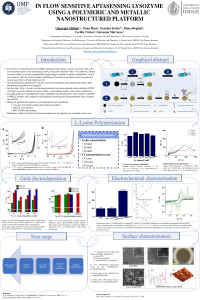
Lysozyme is an enzyme present in multiple organisms where it plays various vital roles. One of the most important relies on its antibacterial activity, being also called the body’s own antibiotic. Despite its proven utility, lysozyme can potentially trigger allergic reactions in sensitive individuals, even in trace amounts, thus the need of continue monitoring of lysozyme in products rich in lysozyme like wine or egg white is of high importance [1].
In this work, an electrochemical aptasensor was designed for the flow analysis of lysozyme. Firstly, polylysine, polydopamine and poly(lysine-co-dopamine) were electrodeposited at screen printed carbon electrodes (SPCE) in order to obtain a more structured platform with higher electroactive area. The best architecture was further chosen for sensor development. Next, gold nanostructures (nanoleaves) were electrodeposited from a mixture of HAuCl4 and PEG 6000 solution for enhanced electrocatalytic effect and to serve as immobilization platform for the thiolated aptamer [2]. All platforms were electrochemically and morphologically characterized.
For lysozyme detection, the best platform in terms of electronic conductivity was selected for the 1st aptamer immobilization within the thiol group from its 3’-end, followed by a blocking step of the remaining free sites of the gold nanoleaves with 6-mercaptohexanol. Next, after the lysozyme solution was dropped casted on the electrode surface and the aptamer-target reaction was performed, a 2nd aptamer, labelled with biotin, bounds also the lysozyme to obtain a sandwich assay. Further, streptavidin-alkaline phosphatase (ALP) reacted with the biotin bounds to the 2nd aptamer. For lysozyme quantification, ALP oxidised the substrate, 1-naphtil phosphate and the resulting signal was registered using differential pulse voltammetry.
References
[1] A. Vasilescu, Q, Wang, M. Li, R. Boukherroub, S. Szunerits, Chemosensors, 2016, 4(2), 10
[2] M. Negahdary, H. Heli, Talanta, 2019, 198, 510-517.
Acknowledgements
Ghorghe Melinte thanks: UMF “Iuliu Hațieganu” Cluj-Napoca, for internal grant no. 2462/37/17.01.2020
Keywords
Lysozyme
Gold nanostructured platform
polylysine
polydopamine.
Manuscript
Poster lysozyme.pdf
Poster
Poster lysozyme.pdf
Nanocomposite-based electrochemical platforms for pharmaceutical and environmental applications
Droplet reactors with bioluminescent enzymes for real time water pollution monitoring