Event submissions
Published
 10.3390/IECB2020-07048 (registering DOI)
 This submission belongs to the session I. Posters of the event The 1st International Electronic Conference on Biosensors
Published date
02 Nov, 2020
Citation
Adrian Olejnik, Katarzyna Siuzdak, Anna Dołęga, Jakub Karczewski, Katarzyna Grochowska, Non-enzymatic glucose sensing Au-Ti platform covered with photopolymerized poly(zwitterionic) coating with enhanced selectivity and durability in human serum, in Proceedings of The 1st International Electronic Conference on Biosensors, 2 November–17 November 2020, MDPI: Basel, Switzerland, doi: 10.3390/IECB2020-07048
Share
Email
Facebook
Twitter
LinkedIn
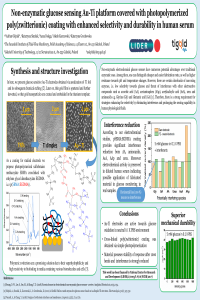
Non-enzymatic glucose sensing Au-Ti platform covered with photopolymerized poly(zwitterionic) coating with enhanced selectivity and durability in human serum
'%3e%3cpath%20d='M12.6647%2010.9104C12.4176%2010.325%2012.0589%209.7933%2011.6088%209.34485C11.16%208.89511%2010.6283%208.53653%2010.0432%208.28891C10.038%208.28629%2010.0327%208.28498%2010.0275%208.28236C10.8437%207.69282%2011.3743%206.73252%2011.3743%205.64907C11.3743%203.85423%209.92005%202.40002%208.12522%202.40002C6.33038%202.40002%204.87618%203.85423%204.87618%205.64907C4.87618%206.73252%205.40677%207.69282%206.22296%208.28367C6.21772%208.28629%206.21248%208.2876%206.20724%208.29022C5.62031%208.53783%205.09365%208.89287%204.64167%209.34616C4.19192%209.79496%203.83334%2010.3266%203.58573%2010.9117C3.34247%2011.4846%203.21128%2012.0987%203.19925%2012.721C3.1989%2012.735%203.20135%2012.7489%203.20646%2012.7619C3.21157%2012.7749%203.21924%2012.7868%203.22901%2012.7968C3.23877%2012.8068%203.25045%2012.8148%203.26334%2012.8202C3.27623%2012.8256%203.29007%2012.8284%203.30406%2012.8284H4.09012C4.14776%2012.8284%204.19362%2012.7825%204.19493%2012.7262C4.22113%2011.7148%204.62726%2010.7676%205.34519%2010.0497C6.08802%209.30686%207.07452%208.89811%208.12522%208.89811C9.17592%208.89811%2010.1624%209.30686%2010.9052%2010.0497C11.6232%2010.7676%2012.0293%2011.7148%2012.0555%2012.7262C12.0568%2012.7839%2012.1027%2012.8284%2012.1603%2012.8284H12.9464C12.9604%2012.8284%2012.9742%2012.8256%2012.9871%2012.8202C13%2012.8148%2013.0117%2012.8068%2013.0214%2012.7968C13.0312%2012.7868%2013.0389%2012.7749%2013.044%2012.7619C13.0491%2012.7489%2013.0515%2012.735%2013.0512%2012.721C13.0381%2012.0947%2012.9084%2011.4856%2012.6647%2010.9104ZM8.12522%207.90243C7.52388%207.90243%206.95792%207.66793%206.53214%207.24215C6.10636%206.81636%205.87185%206.2504%205.87185%205.64907C5.87185%205.04773%206.10636%204.48177%206.53214%204.05599C6.95792%203.63021%207.52388%203.3957%208.12522%203.3957C8.72655%203.3957%209.29252%203.63021%209.7183%204.05599C10.1441%204.48177%2010.3786%205.04773%2010.3786%205.64907C10.3786%206.2504%2010.1441%206.81636%209.7183%207.24215C9.29252%207.66793%208.72655%207.90243%208.12522%207.90243Z'%20fill='%235D1EE1'/%3e%3c/g%3e%3c/svg%3e)
Adrian Olejnik 1,2
Katarzyna Siuzdak 1
Anna Dołęga 3
Jakub Karczewski 4
Katarzyna Grochowska 1
1. Centre for Plasma and Laser Engineering, The Szewalski Institute of Fluid-Flow Machinery, Polish Academy of Sciences, 14 Fiszera st., 80-231 Gdańsk, Poland
2. Gdansk University of Technology, 11/12 Narutowicza st., 80-233 Gdańsk, Poland
3. Faculty of Chemistry, Gdańsk University of Technology, 11/12 Narutowicza st., 80-233 Gdańsk, Poland
4. Faculty of Applied Physics and Mathematics, Gdańsk University of Technology, 11/12 Narutowicza st., 80-233 Gdańsk, Poland
Abstract
Non-enzymatic electrochemical glucose sensors have numerous potential advantages over traditional enzymatic ones. Among them, one can distinguish cheaper and easier fabrication route, as well as higher resistance towards pH and temperature changes. However, there are certain drawbacks of non-using enzymes, i.e. low selectivity towards glucose and threat of interference with other electroactive compounds such as ascorbic acid (AA), acetaminophen (AAp), acetylsalicylic acid (AsA), urea and aminoacids [1]. Therefore, there is a strong requirement for strategies enhancing the selectivity by eliminating interference and prolonging the sensing capability in human physiological fluids.
In here, we present glucose sensitive Au-Ti electrodes obtained via anodization of Ti foil and their subsequent chemical etching [2]. Later on, thin gold film is sputtered and further dewetted, so that gold nanoparticles are created and embedded in the titanium template. As a coating for studied electrode we propose photopolymerized sulfobetaine methacrylate crosslinked with ethylene glycol dimethacrylate (p(SBMA:EGDMA)). Polymeric zwitterions are a promising solution due to their superhydrophilicity and high resistivity to biofouling in media containing various biomoleclues and cells [3]. According to our results, pSBMA:EGDMA coating provides significant interference reduction from AA, aminoacids, AsA and urea. Moreover electrochemical activity is preserved in diluted human serum indicating possible application of fabricated material in glucose monitoring in real samples.
References:
[1] Hwang, D. W., Lee, S., Seo, M., & Chung, T. D. (2018). Recent advances in electrochemical non-enzymatic glucose sensors–a review. Analytica Chimica Acta, 1033, 1-34.
[2] Olejnik, A., Siuzdak, K., Karczewski, J., & Grochowska, K. (2020). A Flexible Nafion Coated Enzyme‐free Glucose Sensor Based on Au‐dimpled Ti Structures. Electroanalysis, 32(2), 323-332.
[3] Venault, A., & Chang, Y. (2018). Designs of zwitterionic interfaces and membranes. Langmuir, 35(5), 1714-1726.
.Acknowledgements
This work has been financed by National Center for Research and Development under the LIDER program (LIDER/2/0003/L-8/16/NCBR/2017)
Keywords
glucose
poly(zwitterion)
voltammetry
gold nanoparticles,
Manuscript
Olejnik_IECB2020.pdf
Poster
Olejnik_IECB2020.pdf
Electrochemical glucose sensor based on glucose oxidase immobilized by chitosan matrix on laser-processed Au-Ti electrode
Driving Electrolyte-Gated Organic Field Effect Transistors with redox reactions