Event submissions
Published
 10.3390/IECB2020-07050 (registering DOI)
 This submission belongs to the session I. Posters of the event The 1st International Electronic Conference on Biosensors
Published date
02 Nov, 2020
Citation
Ana-Maria Drăgan, Florina Truță, Anca Florea, Jonas Schram, Andreea Cernat, Mihaela Tertiș, Bogdan Feier, Karolien De Wael, Radu Oprean, Cecilia Cristea, Sensitive detection of cathinones and their adulterants in street samples using electrochemical fingerprinting, in Proceedings of The 1st International Electronic Conference on Biosensors, 2 November–17 November 2020, MDPI: Basel, Switzerland, doi: 10.3390/IECB2020-07050
Share
Email
Facebook
Twitter
LinkedIn
Sensitive detection of cathinones and their adulterants in street samples using electrochemical fingerprinting
'%3e%3cpath%20d='M12.6647%2010.9104C12.4176%2010.325%2012.0589%209.7933%2011.6088%209.34485C11.16%208.89511%2010.6283%208.53653%2010.0432%208.28891C10.038%208.28629%2010.0327%208.28498%2010.0275%208.28236C10.8437%207.69282%2011.3743%206.73252%2011.3743%205.64907C11.3743%203.85423%209.92005%202.40002%208.12522%202.40002C6.33038%202.40002%204.87618%203.85423%204.87618%205.64907C4.87618%206.73252%205.40677%207.69282%206.22296%208.28367C6.21772%208.28629%206.21248%208.2876%206.20724%208.29022C5.62031%208.53783%205.09365%208.89287%204.64167%209.34616C4.19192%209.79496%203.83334%2010.3266%203.58573%2010.9117C3.34247%2011.4846%203.21128%2012.0987%203.19925%2012.721C3.1989%2012.735%203.20135%2012.7489%203.20646%2012.7619C3.21157%2012.7749%203.21924%2012.7868%203.22901%2012.7968C3.23877%2012.8068%203.25045%2012.8148%203.26334%2012.8202C3.27623%2012.8256%203.29007%2012.8284%203.30406%2012.8284H4.09012C4.14776%2012.8284%204.19362%2012.7825%204.19493%2012.7262C4.22113%2011.7148%204.62726%2010.7676%205.34519%2010.0497C6.08802%209.30686%207.07452%208.89811%208.12522%208.89811C9.17592%208.89811%2010.1624%209.30686%2010.9052%2010.0497C11.6232%2010.7676%2012.0293%2011.7148%2012.0555%2012.7262C12.0568%2012.7839%2012.1027%2012.8284%2012.1603%2012.8284H12.9464C12.9604%2012.8284%2012.9742%2012.8256%2012.9871%2012.8202C13%2012.8148%2013.0117%2012.8068%2013.0214%2012.7968C13.0312%2012.7868%2013.0389%2012.7749%2013.044%2012.7619C13.0491%2012.7489%2013.0515%2012.735%2013.0512%2012.721C13.0381%2012.0947%2012.9084%2011.4856%2012.6647%2010.9104ZM8.12522%207.90243C7.52388%207.90243%206.95792%207.66793%206.53214%207.24215C6.10636%206.81636%205.87185%206.2504%205.87185%205.64907C5.87185%205.04773%206.10636%204.48177%206.53214%204.05599C6.95792%203.63021%207.52388%203.3957%208.12522%203.3957C8.72655%203.3957%209.29252%203.63021%209.7183%204.05599C10.1441%204.48177%2010.3786%205.04773%2010.3786%205.64907C10.3786%206.2504%2010.1441%206.81636%209.7183%207.24215C9.29252%207.66793%208.72655%207.90243%208.12522%207.90243Z'%20fill='%235D1EE1'/%3e%3c/g%3e%3c/svg%3e)
Ana-Maria Drăgan 1,2
Florina Truță 3
Anca Florea 3
Jonas Schram 4
Andreea Cernat 3

Mihaela Tertiș 3

Bogdan Feier 3
Karolien De Wael 4,5
Radu Oprean 6

Cecilia Cristea 3
1. ‘Iuliu Hatieganu’ University of Medicine and Pharmacy Cluj-Napoca, Pasteur 6, Cluj-Napoca, Romania
2. A-Sens Lab, University of Antwerp, Groenenborgerlaan 171, 2010 Antwerp, Belgium
3. University of Medicine and Pharmacy ‘Iuliu Hatieganu’ Cluj-Napoca, Romania
Pasteur 6, Cluj-Napoca, Romania
4. AXES Research Group, University of Antwerp
Groenenborgerlaan 171, 2010 Antwerp, Belgium
5. NANOlab Center of Excellence, University of Antwerp
Groenenborgerlaan 171, 2010 Antwerp, Belgium
6. University of Medicine and Pharmacy ‘Iuliu Hatieganu’ Cluj-Napoca, Romania Pasteur 6, Cluj-Napoca, Romania
Abstract
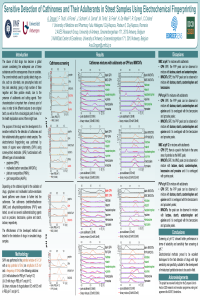
The abuse of illicit drugs has become a global concern considering the widespread use of these substances and the consequences it has on societies. The current methods used to quickly detect drugs on-site, such as color-tests, are presumptive tests and they lack selectivity, giving a high number of false negative and false positive results, due to the presence of adulterants and cutting agents. Their characterization is important from a forensic point of view, in order to link different seizures to one original batch, as well as from a toxicological point of view, for the health implications some of them might have. The purpose of the study was the development of a sensitive method for the detection of cathinones and their adulterants/cutting agents in street samples. The electrochemical fingerprinting was performed by means of square wave voltammetry using nanomaterials-modified electrodes. Several platforms were tested (graphene, carbon nanotubes, gold nanoparticles, platinum nanoparticles) and depending on the obtained signal for the oxidation of drugs, graphene and carbon-nanotubes based platforms were chosen to further test the cathinones. Several cathinones, such as methcathinone, chloroetcathinone were tested, as well as several adulterants/cutting agents such as procaine, benzocaine, creatine and mannitol, sorbitol, respectively. The effectiveness of the developed method was tested for the detection of drugs in simulated drugs samples. Electrochemical methods proved to be excellent techniques for the fast determination of drugs with high sensitivity and specificity, suitable for the development of miniaturized portable devices to be used in-field.
Acknowledgements: This project has received funding from the European Union's Horizon 2020 research and innovation programme under grant agreement No 833787, BorderSens.
Keywords
electrochemical fingerprint
cathinones
adulterants
street samples
nanomaterials
Manuscript
Poster_IECB2020_Ana-Maria Dragan.pdf
Poster
Poster_IECB2020_Ana-Maria Dragan.pdf
Driving Electrolyte-Gated Organic Field Effect Transistors with redox reactions
Electrochemical detection of doxorubicin and simvastatin for their combined use in the treatment of cancer