Event submissions
Published
 10.3390/IECB2020-07068 (registering DOI)
 This submission belongs to the session I. Posters of the event The 1st International Electronic Conference on Biosensors
Published date
02 Nov, 2020
Citation
Florina Truta, Ana-Maria Dragan, Anca Florea, Jonas Schram, Andreea Cernat, Bogdan Feier, Karolien De Wael, Cecilia Cristea, Detection of cocaine and cathinones by electrochemical fingerprinting using nanomaterials, in Proceedings of The 1st International Electronic Conference on Biosensors, 2 November–17 November 2020, MDPI: Basel, Switzerland, doi: 10.3390/IECB2020-07068
Share
Email
Facebook
Twitter
LinkedIn
Detection of cocaine and cathinones by electrochemical fingerprinting using nanomaterials
'%3e%3cpath%20d='M12.6647%2010.9104C12.4176%2010.325%2012.0589%209.7933%2011.6088%209.34485C11.16%208.89511%2010.6283%208.53653%2010.0432%208.28891C10.038%208.28629%2010.0327%208.28498%2010.0275%208.28236C10.8437%207.69282%2011.3743%206.73252%2011.3743%205.64907C11.3743%203.85423%209.92005%202.40002%208.12522%202.40002C6.33038%202.40002%204.87618%203.85423%204.87618%205.64907C4.87618%206.73252%205.40677%207.69282%206.22296%208.28367C6.21772%208.28629%206.21248%208.2876%206.20724%208.29022C5.62031%208.53783%205.09365%208.89287%204.64167%209.34616C4.19192%209.79496%203.83334%2010.3266%203.58573%2010.9117C3.34247%2011.4846%203.21128%2012.0987%203.19925%2012.721C3.1989%2012.735%203.20135%2012.7489%203.20646%2012.7619C3.21157%2012.7749%203.21924%2012.7868%203.22901%2012.7968C3.23877%2012.8068%203.25045%2012.8148%203.26334%2012.8202C3.27623%2012.8256%203.29007%2012.8284%203.30406%2012.8284H4.09012C4.14776%2012.8284%204.19362%2012.7825%204.19493%2012.7262C4.22113%2011.7148%204.62726%2010.7676%205.34519%2010.0497C6.08802%209.30686%207.07452%208.89811%208.12522%208.89811C9.17592%208.89811%2010.1624%209.30686%2010.9052%2010.0497C11.6232%2010.7676%2012.0293%2011.7148%2012.0555%2012.7262C12.0568%2012.7839%2012.1027%2012.8284%2012.1603%2012.8284H12.9464C12.9604%2012.8284%2012.9742%2012.8256%2012.9871%2012.8202C13%2012.8148%2013.0117%2012.8068%2013.0214%2012.7968C13.0312%2012.7868%2013.0389%2012.7749%2013.044%2012.7619C13.0491%2012.7489%2013.0515%2012.735%2013.0512%2012.721C13.0381%2012.0947%2012.9084%2011.4856%2012.6647%2010.9104ZM8.12522%207.90243C7.52388%207.90243%206.95792%207.66793%206.53214%207.24215C6.10636%206.81636%205.87185%206.2504%205.87185%205.64907C5.87185%205.04773%206.10636%204.48177%206.53214%204.05599C6.95792%203.63021%207.52388%203.3957%208.12522%203.3957C8.72655%203.3957%209.29252%203.63021%209.7183%204.05599C10.1441%204.48177%2010.3786%205.04773%2010.3786%205.64907C10.3786%206.2504%2010.1441%206.81636%209.7183%207.24215C9.29252%207.66793%208.72655%207.90243%208.12522%207.90243Z'%20fill='%235D1EE1'/%3e%3c/g%3e%3c/svg%3e)
Florina Truta 1
Ana-Maria Dragan 1
Anca Florea 1
Jonas Schram 2
Andreea Cernat 1

Bogdan Feier 1
Karolien De Wael 2,3

Cecilia Cristea 1
1. University of Medicine and Pharmacy ‘Iuliu Hatieganu’ Cluj-Napoca
Pasteur 6, Cluj-Napoca, Romania
2. AXES Research Group, University of Antwerp
Groenenborgerlaan 171, 2010 Antwerp, Belgium
3. NANOlab Center of Excellence, University of Antwerp
Groenenborgerlaan 171, 2010 Antwerp, Belgium
Abstract
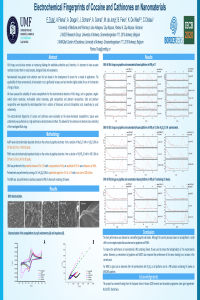
Illicit drugs use and abuse remains an increasing challenge for worldwide authorities and, therefore, it is important to have accurate methods to detect them in seized samples, biological fluids and wastewaters. They are recently classified as the latest group of emerging pollutants as their consumption increased tremendously in recent years.
Nanomaterials have gained much attention over the last decade in the development of sensors for a myriad of applications. The applicability of these nanomaterials, functionalized or not, significantly increases and are therefore highly suitable for use in the detection of drugs of abuse.
We have assessed the suitability of various nanoplatforms for the electrochemical detection of illicit drugs, such as graphene, singled-walled carbon nanotubes, multi-walled carbon nanotubes functionalized with platinum nanoparticles, gold nanoparticles and platinum nanoparticles. Graphene and singled-walled carbon nanotubes were drop-casted onto graphite screen printed electrodes and left to dry at room temperature. Multi-walled carbon nanotubes were functionalized with platinum nanoparticles using a simple and efficient chemical process, in which carboxylic acid-functionalized multi-walled carbon nanotubes were mixed with chloroplatinic acid in a mixture of ethylene glycol and water to result in platinum-functionalized multi-walled carbon nanotubes. The functionalized multiwalled carbon nanotubes were drop-casted onto graphite screen printed electrodes. Gold and platinum nanoparticles were deposited by electrodeposition from a solution of chloroauric acid and chloroplatinic acid, respectively, by cyclic voltammetry.
The electrochemical fingerprints of cocaine and cathinones (such as mephedrone, alpha-polyvinylpirolidone, methylmethcatinone, chloroethcatinone, chloromethcathinone, etylone) were elucidated on the above-mentioned nanoplatforms. Square wave voltammetry was performed as a high-performance electrochemical method. This allowed for the sensitive and selective (class selectivity) of the investigated illicit drugs.
Keywords
cocaine
cathinones
electrochemical fingerprints
nanomaterials
Manuscript
Poster_IECB2020_FlorinaTruta_MT.pdf
Poster
Poster_IECB2020_FlorinaTruta_MT.pdf
Development of electrochemical DNA detection methods to measure circulating tumour DNA for enhanced diagnosis and monitoring cancer
Comparison of the performance of two aptamers on a colorimetric assay for the quantification of FB1