Event submissions
Published
 10.3390/IECB2020-07084 (registering DOI)
 This submission belongs to the session I. Posters of the event The 1st International Electronic Conference on Biosensors
Published date
02 Nov, 2020
Citation
Agnieszka Borysowiec, Angelika Świtalska, Anna Dembska, Spectroscopic studies upon silver nanoclusters formed on oligonucleotides containing a tricyclic cytosine analogue, tC, in Proceedings of The 1st International Electronic Conference on Biosensors, 2 November–17 November 2020, MDPI: Basel, Switzerland, doi: 10.3390/IECB2020-07084
Share
Email
Facebook
Twitter
LinkedIn
Spectroscopic studies upon silver nanoclusters formed on oligonucleotides containing a tricyclic cytosine analogue, tC
'%3e%3cpath%20d='M12.6647%2010.9104C12.4176%2010.325%2012.0589%209.7933%2011.6088%209.34485C11.16%208.89511%2010.6283%208.53653%2010.0432%208.28891C10.038%208.28629%2010.0327%208.28498%2010.0275%208.28236C10.8437%207.69282%2011.3743%206.73252%2011.3743%205.64907C11.3743%203.85423%209.92005%202.40002%208.12522%202.40002C6.33038%202.40002%204.87618%203.85423%204.87618%205.64907C4.87618%206.73252%205.40677%207.69282%206.22296%208.28367C6.21772%208.28629%206.21248%208.2876%206.20724%208.29022C5.62031%208.53783%205.09365%208.89287%204.64167%209.34616C4.19192%209.79496%203.83334%2010.3266%203.58573%2010.9117C3.34247%2011.4846%203.21128%2012.0987%203.19925%2012.721C3.1989%2012.735%203.20135%2012.7489%203.20646%2012.7619C3.21157%2012.7749%203.21924%2012.7868%203.22901%2012.7968C3.23877%2012.8068%203.25045%2012.8148%203.26334%2012.8202C3.27623%2012.8256%203.29007%2012.8284%203.30406%2012.8284H4.09012C4.14776%2012.8284%204.19362%2012.7825%204.19493%2012.7262C4.22113%2011.7148%204.62726%2010.7676%205.34519%2010.0497C6.08802%209.30686%207.07452%208.89811%208.12522%208.89811C9.17592%208.89811%2010.1624%209.30686%2010.9052%2010.0497C11.6232%2010.7676%2012.0293%2011.7148%2012.0555%2012.7262C12.0568%2012.7839%2012.1027%2012.8284%2012.1603%2012.8284H12.9464C12.9604%2012.8284%2012.9742%2012.8256%2012.9871%2012.8202C13%2012.8148%2013.0117%2012.8068%2013.0214%2012.7968C13.0312%2012.7868%2013.0389%2012.7749%2013.044%2012.7619C13.0491%2012.7489%2013.0515%2012.735%2013.0512%2012.721C13.0381%2012.0947%2012.9084%2011.4856%2012.6647%2010.9104ZM8.12522%207.90243C7.52388%207.90243%206.95792%207.66793%206.53214%207.24215C6.10636%206.81636%205.87185%206.2504%205.87185%205.64907C5.87185%205.04773%206.10636%204.48177%206.53214%204.05599C6.95792%203.63021%207.52388%203.3957%208.12522%203.3957C8.72655%203.3957%209.29252%203.63021%209.7183%204.05599C10.1441%204.48177%2010.3786%205.04773%2010.3786%205.64907C10.3786%206.2504%2010.1441%206.81636%209.7183%207.24215C9.29252%207.66793%208.72655%207.90243%208.12522%207.90243Z'%20fill='%235D1EE1'/%3e%3c/g%3e%3c/svg%3e)
Agnieszka Borysowiec 1
Angelika Świtalska 1

Anna Dembska 1
1. Adam Mickiewicz University
Abstract
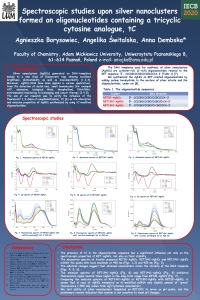
Silver nanoclusters (AgNCs) generated on DNA-templates belong to a new class of fluorescent tags showing excellent brightness, photostability as well as biocompatibility. Thus, AgNCs-DNA have been applied in various applications, from the detection of DNA/RNA, environmental monitoring to bioimaging and cancer therapy. In this work, we report fluorescent AgNCs synthesized using two 1,3-diaza-2-oxophenothiazine (tC)-modified oligonucleotides that contain RET-related sequence CCCCGCCCCGCCCCGCCCCA. The communication compares the absorption and emission properties of the obtained systems with silver nanoclusters synthesized on the unmodified oligonucleotide. First, we showed the optimal conditions for AgNCs-DNA synthesis on three DNA templates: (1) RET20 with the sequence 5'-CCC CGC CCC GCC CCG CCC CA-3'; (2) 19tC with the sequence 5'-CCC CGC CCC GCC CCG CCC tCA-3'; (3) 14tC with the sequence 5'-CCC CGC CCC GCC CtCG CCC CA-3'. Next, the silver nanoclusters were characterized by UV/Vis absorption, fluorescence and circular dichroism spectroscopy. Silver nanoclusters RET19tC-AgNCs and RET14tC-AgNCs indicated the several times higher fluorescence intensities in the long-wave emission spectra as compared to RET20-AgNCs. Moreover, silver nanoclusters on tC-modified oligonucleotides showed the higher stability over time. The possibility of using of the silver nanoclusters RET19tC-AgNCs and RET14tC-AgNCs for monitoring pH changes would be also demonstrated.
Keywords
silver nanoclusters
cytosine analogue
fluorescent probe
Manuscript
sciforum-035750-done.pdf
Poster
035750--adembska poster iecb 2020.pdf
Colorimetric lab-on-a-tip based on a bimetallic nanoarchitecture
Developing technologies for biological experiments in deep space