Event submissions
Published

This submission belongs to the session S4. Emerging Infectious Diseases of the event The 1st International Electronic Conference on Microbiology
Published date
02 Nov, 2020
Citation
Bruna A Caetano*, Daniela B Mourão*, Patricia A Abreu, Denize Monaris, Cynthia S Galhardo, Marcio A Menezes, Halyka L Vasconcellos, Daniela Luz, Flavia A Lima, Waldir P Elias, Monamaris M Borges, Roxane M Piazza, Macrophage inflammatory response mediated by intimin and bundle-forming pilus from enteropathogenic Escherichia coli, in Proceedings of The 1st International Electronic Conference on Microbiology, 2 November–30 November 2020, MDPI: Basel, Switzerland, doi: 10.3390/ECM2020-07102
Share
Email
Facebook
Twitter
LinkedIn
Macrophage inflammatory response mediated by intimin and bundle-forming pilus from enteropathogenic Escherichia coli
'%3e%3cpath%20d='M12.6647%2010.9104C12.4176%2010.325%2012.0589%209.7933%2011.6088%209.34485C11.16%208.89511%2010.6283%208.53653%2010.0432%208.28891C10.038%208.28629%2010.0327%208.28498%2010.0275%208.28236C10.8437%207.69282%2011.3743%206.73252%2011.3743%205.64907C11.3743%203.85423%209.92005%202.40002%208.12522%202.40002C6.33038%202.40002%204.87618%203.85423%204.87618%205.64907C4.87618%206.73252%205.40677%207.69282%206.22296%208.28367C6.21772%208.28629%206.21248%208.2876%206.20724%208.29022C5.62031%208.53783%205.09365%208.89287%204.64167%209.34616C4.19192%209.79496%203.83334%2010.3266%203.58573%2010.9117C3.34247%2011.4846%203.21128%2012.0987%203.19925%2012.721C3.1989%2012.735%203.20135%2012.7489%203.20646%2012.7619C3.21157%2012.7749%203.21924%2012.7868%203.22901%2012.7968C3.23877%2012.8068%203.25045%2012.8148%203.26334%2012.8202C3.27623%2012.8256%203.29007%2012.8284%203.30406%2012.8284H4.09012C4.14776%2012.8284%204.19362%2012.7825%204.19493%2012.7262C4.22113%2011.7148%204.62726%2010.7676%205.34519%2010.0497C6.08802%209.30686%207.07452%208.89811%208.12522%208.89811C9.17592%208.89811%2010.1624%209.30686%2010.9052%2010.0497C11.6232%2010.7676%2012.0293%2011.7148%2012.0555%2012.7262C12.0568%2012.7839%2012.1027%2012.8284%2012.1603%2012.8284H12.9464C12.9604%2012.8284%2012.9742%2012.8256%2012.9871%2012.8202C13%2012.8148%2013.0117%2012.8068%2013.0214%2012.7968C13.0312%2012.7868%2013.0389%2012.7749%2013.044%2012.7619C13.0491%2012.7489%2013.0515%2012.735%2013.0512%2012.721C13.0381%2012.0947%2012.9084%2011.4856%2012.6647%2010.9104ZM8.12522%207.90243C7.52388%207.90243%206.95792%207.66793%206.53214%207.24215C6.10636%206.81636%205.87185%206.2504%205.87185%205.64907C5.87185%205.04773%206.10636%204.48177%206.53214%204.05599C6.95792%203.63021%207.52388%203.3957%208.12522%203.3957C8.72655%203.3957%209.29252%203.63021%209.7183%204.05599C10.1441%204.48177%2010.3786%205.04773%2010.3786%205.64907C10.3786%206.2504%2010.1441%206.81636%209.7183%207.24215C9.29252%207.66793%208.72655%207.90243%208.12522%207.90243Z'%20fill='%235D1EE1'/%3e%3c/g%3e%3c/svg%3e)
Bruna A Caetano* 1
Daniela B Mourão* 1
Patricia A Abreu 1
Denize Monaris 1
Cynthia S Galhardo 1
Marcio A Menezes 1
Halyka L Vasconcellos 1
Daniela Luz 1

Flavia A Lima 1
Waldir P Elias 1
Monamaris M Borges 1

Roxane M Piazza 1
1. Instituto Butantan
Abstract
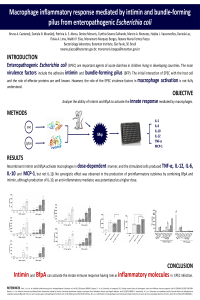
Enteropathogenic Escherichia coli (EPEC) are important agents of acute diarrhea in children living in developing countries. A severe dysfunction of the intestinal epithelial barrier occurs during EPEC infection, leading to diarrhea and inflammation as consequences. EPEC main virulence factors include the adhesins intimin and bundle-forming pilus (BFP), as well as several effector proteins translocated to the enterocyte by the type three-secretion system. The initial interaction of EPEC with the host cell and the role of effector proteins in this process are well known. However, the role of the EPEC virulence factors in macrophage activation is not fully understood. Hence, we analyzed the ability of intimin and BfpA, to activate the innate response mediated by macrophages, where the production of the proinflammatory cytokines TNF-α, IL-1, IL-6 and IL-12, and the anti-inflammatory cytokine IL-10 and chemokine MCP-1 were evaluated. Our results showed that recombinant intimin and BfpA activate macrophages in a dose-dependent manner, and the stimulated cells produced TNF-α, IL-12 and IL-6, IL-10 and MCP-1, but not IL-1β. No synergistic effect was observed in the production of proinflammatory cytokines by combining BfpA and intimin, although production of IL-10, an anti-inflammatory mediator, was potentiated at a higher dose. The effect observed was largely attributed to these proteins, as the treatment of proteins with polymyxin B did not alter the production of TNF-α. Thus, herein we showed that intimin and BfpA can activate the innate immune response, inducing the production of pro and anti-inflammatory cytokines, as well as chemokine’s, playing additional role as inflammatory molecules in the early steps of EPEC infection.
Keywords
enteropathogenic E. coli
intimin
bundle-forming pilus (BfpA)
macrophage
innate immune response
cytokines.
Manuscript
037338.pdf
Poster
ID sciforum 037338- poster.pdf
Virulence Reversion in Staphylococcus aureus
Multiple drug-resistant Vibrio cholerae responsible for cholera outbreak among migrant domestic workers in Kerala, South India