Event submissions
Published

This submission belongs to the session S8. Microbial Characterization and Bioprocess of the event The 1st International Electronic Conference on Microbiology
Published date
02 Nov, 2020
Citation
Lidia Martin-Gordillo, Maria Cuaresma, Mª Ángeles Fernández-Recamales, Ana Sayago, Carlos Vilchez, Ines Garbayo, Cultivation of microalgae Chlorella using wine industry by-products, in Proceedings of The 1st International Electronic Conference on Microbiology, 2 November–30 November 2020, MDPI: Basel, Switzerland, doi: 10.3390/ECM2020-07110
Share
Email
Facebook
Twitter
LinkedIn
Cultivation of microalgae Chlorella using wine industry by-products
'%3e%3cpath%20d='M12.6647%2010.9104C12.4176%2010.325%2012.0589%209.7933%2011.6088%209.34485C11.16%208.89511%2010.6283%208.53653%2010.0432%208.28891C10.038%208.28629%2010.0327%208.28498%2010.0275%208.28236C10.8437%207.69282%2011.3743%206.73252%2011.3743%205.64907C11.3743%203.85423%209.92005%202.40002%208.12522%202.40002C6.33038%202.40002%204.87618%203.85423%204.87618%205.64907C4.87618%206.73252%205.40677%207.69282%206.22296%208.28367C6.21772%208.28629%206.21248%208.2876%206.20724%208.29022C5.62031%208.53783%205.09365%208.89287%204.64167%209.34616C4.19192%209.79496%203.83334%2010.3266%203.58573%2010.9117C3.34247%2011.4846%203.21128%2012.0987%203.19925%2012.721C3.1989%2012.735%203.20135%2012.7489%203.20646%2012.7619C3.21157%2012.7749%203.21924%2012.7868%203.22901%2012.7968C3.23877%2012.8068%203.25045%2012.8148%203.26334%2012.8202C3.27623%2012.8256%203.29007%2012.8284%203.30406%2012.8284H4.09012C4.14776%2012.8284%204.19362%2012.7825%204.19493%2012.7262C4.22113%2011.7148%204.62726%2010.7676%205.34519%2010.0497C6.08802%209.30686%207.07452%208.89811%208.12522%208.89811C9.17592%208.89811%2010.1624%209.30686%2010.9052%2010.0497C11.6232%2010.7676%2012.0293%2011.7148%2012.0555%2012.7262C12.0568%2012.7839%2012.1027%2012.8284%2012.1603%2012.8284H12.9464C12.9604%2012.8284%2012.9742%2012.8256%2012.9871%2012.8202C13%2012.8148%2013.0117%2012.8068%2013.0214%2012.7968C13.0312%2012.7868%2013.0389%2012.7749%2013.044%2012.7619C13.0491%2012.7489%2013.0515%2012.735%2013.0512%2012.721C13.0381%2012.0947%2012.9084%2011.4856%2012.6647%2010.9104ZM8.12522%207.90243C7.52388%207.90243%206.95792%207.66793%206.53214%207.24215C6.10636%206.81636%205.87185%206.2504%205.87185%205.64907C5.87185%205.04773%206.10636%204.48177%206.53214%204.05599C6.95792%203.63021%207.52388%203.3957%208.12522%203.3957C8.72655%203.3957%209.29252%203.63021%209.7183%204.05599C10.1441%204.48177%2010.3786%205.04773%2010.3786%205.64907C10.3786%206.2504%2010.1441%206.81636%209.7183%207.24215C9.29252%207.66793%208.72655%207.90243%208.12522%207.90243Z'%20fill='%235D1EE1'/%3e%3c/g%3e%3c/svg%3e)
Lidia Martin-Gordillo 1
Maria Cuaresma 1
Mª Ángeles Fernández-Recamales 2
Ana Sayago 2

Carlos Vilchez 1
Ines Garbayo 1
1. Algal Biotechnology Group, Ciderta and RENSMA (Center of Research in Natural Resources, Health and Environment), University of Huelva, 21007 Huelva, Spain
2. Dpt. of Chemistry, Faculty of Experimental Science. University of Huelva, 21007 Huelva, Spain
Abstract
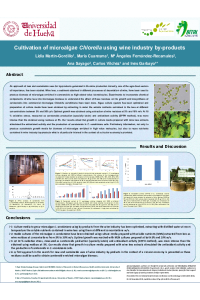
An approach of new and sustainable uses for by-products generated in the wine production industry, one of the agro-food sectors of importance, has been studied. Wine lees, a sediment obtained in different processes of decantation of wine, have been used to produce biomass of microalgae enriched in carotenoids as high added value biomolecules. Experiments to incorporate chemical components of wine lees into microalgae biomass to understand the effect of these residues on the growth and biosynthesis of carotenoids into commercial microalgae Chlorella sorokiniana have been done. Algae culture system has been optimized and preparation of culture media have been obtained by extracting in water the soluble nutrients contained in the lees at different concentrations between 5% and 50% p/v. Optimal growth was obtained using extraction of wine residues at 5% and 10% w/v. At 10 % oxidative stress, measured as carotenoids production (specially lutein) and antioxidant activity (DPPH method), was more intense than the obtained using residues at 5%. Our results show that growth in culture media prepared with wine lees extracts at 10% stimulated the antioxidant activity and the production of carotenoids in C. sorokiniana cells. Preliminary information, not only to produce sustainable growth media for biomass of microalgae enriched in high value molecules, but also to reuse nutrients contained in wine industry by-products what is of particular interest in the context of a circular economy is provided.
Funding: This research was funded by PROGRAMA OPERATIVO FEDER ANDALUCIA (Spain) 2014-2020. Proyectos de I+D+I., grant number UHU-1265804.
Keywords
C. sorokiniana
wine industry by-products
microalgae biomass
carotenoids.
Manuscript
sciforum_037321_original_sciforum_037321_manuscript.pdf
Poster
sciforum_037321_presentation.pdf
Temporal changes and alternating host tree root and shoot growth affect soil microbiomes
Anti-biofilm properties exhibited by different types of monofloral honey