Event submissions
Published

This submission belongs to the session S2. Foodborne Pathogens and Food Safety of the event The 1st International Electronic Conference on Microbiology
Published date
02 Nov, 2020
Citation
Jose Manuel Silvan, Lucia Domingo-Serrano, Teresa Alarcon, Marin Prodanov, Adolfo J. Martinez-Rodriguez, Potential therapeutic use of olive leaf extracts obtained from the olive tree (Olea europaea) against Helicobacter pylori infection, in Proceedings of The 1st International Electronic Conference on Microbiology, 2 November–30 November 2020, MDPI: Basel, Switzerland, doi: 10.3390/ECM2020-07131
Share
Email
Facebook
Twitter
LinkedIn
Potential therapeutic use of olive leaf extracts obtained from the olive tree (Olea europaea) against Helicobacter pylori infection

Jose Manuel Silvan 1
'%3e%3cpath%20d='M12.6647%2010.9104C12.4176%2010.325%2012.0589%209.7933%2011.6088%209.34485C11.16%208.89511%2010.6283%208.53653%2010.0432%208.28891C10.038%208.28629%2010.0327%208.28498%2010.0275%208.28236C10.8437%207.69282%2011.3743%206.73252%2011.3743%205.64907C11.3743%203.85423%209.92005%202.40002%208.12522%202.40002C6.33038%202.40002%204.87618%203.85423%204.87618%205.64907C4.87618%206.73252%205.40677%207.69282%206.22296%208.28367C6.21772%208.28629%206.21248%208.2876%206.20724%208.29022C5.62031%208.53783%205.09365%208.89287%204.64167%209.34616C4.19192%209.79496%203.83334%2010.3266%203.58573%2010.9117C3.34247%2011.4846%203.21128%2012.0987%203.19925%2012.721C3.1989%2012.735%203.20135%2012.7489%203.20646%2012.7619C3.21157%2012.7749%203.21924%2012.7868%203.22901%2012.7968C3.23877%2012.8068%203.25045%2012.8148%203.26334%2012.8202C3.27623%2012.8256%203.29007%2012.8284%203.30406%2012.8284H4.09012C4.14776%2012.8284%204.19362%2012.7825%204.19493%2012.7262C4.22113%2011.7148%204.62726%2010.7676%205.34519%2010.0497C6.08802%209.30686%207.07452%208.89811%208.12522%208.89811C9.17592%208.89811%2010.1624%209.30686%2010.9052%2010.0497C11.6232%2010.7676%2012.0293%2011.7148%2012.0555%2012.7262C12.0568%2012.7839%2012.1027%2012.8284%2012.1603%2012.8284H12.9464C12.9604%2012.8284%2012.9742%2012.8256%2012.9871%2012.8202C13%2012.8148%2013.0117%2012.8068%2013.0214%2012.7968C13.0312%2012.7868%2013.0389%2012.7749%2013.044%2012.7619C13.0491%2012.7489%2013.0515%2012.735%2013.0512%2012.721C13.0381%2012.0947%2012.9084%2011.4856%2012.6647%2010.9104ZM8.12522%207.90243C7.52388%207.90243%206.95792%207.66793%206.53214%207.24215C6.10636%206.81636%205.87185%206.2504%205.87185%205.64907C5.87185%205.04773%206.10636%204.48177%206.53214%204.05599C6.95792%203.63021%207.52388%203.3957%208.12522%203.3957C8.72655%203.3957%209.29252%203.63021%209.7183%204.05599C10.1441%204.48177%2010.3786%205.04773%2010.3786%205.64907C10.3786%206.2504%2010.1441%206.81636%209.7183%207.24215C9.29252%207.66793%208.72655%207.90243%208.12522%207.90243Z'%20fill='%235D1EE1'/%3e%3c/g%3e%3c/svg%3e)
Lucia Domingo-Serrano 1
Teresa Alarcon 2
Marin Prodanov 3

Adolfo J. Martinez-Rodriguez 1
1. Microbiology and Food Biocatalysis Group, Department of Biotechnology and Food Microbiology, Institute of Food Science Research (CIAL, CSIC-UAM), C/ Nicolás Cabrera, 9. Cantoblanco Campus, Autonoma University of Madrid, 28049 Madrid, Spain
2. Microbiology Department, Hospital Universitario de La Princesa, Sanitaria Princesa Research Institute, Madrid, Spain. Department of Preventive Medicine, Public Health and Microbiology, School of Medicine, Autonomous University of Madrid, Madrid, Spain
3. Department of Production and Characterization of Novel Foods, Institute of Food Science Research (CIAL, CSIC-UAM), C/ Nicolas Cabrera 9. Cantoblanco Campus, Autonoma University of Madrid, 28049 Madrid, Spain
Abstract
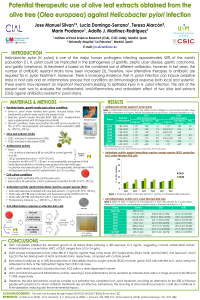
H. pylori is one of the major human pathogens infecting approximately 50% of the world's population. Its treatment is based on the combined use of different antibiotics. In recent years, the number of antibiotic resistant strains have been increased. Therefore, new alternative therapies are required for H. pylori treatment. The aim of the present work was to evaluate the antibacterial, anti-inflammatory and antioxidant effect of olive leaf extracts against antibiotics resistant H. pylori strains. Two olive leaf extracts were used: E1, enriched in hydroxytyrosol (10%); and E2, enriched in oleuropein (20%). E1 extract showed a bactericidal effect for all evaluated H. pylori strains (7/7), while the E2 extract was bactericidal for three of the studied strains (3/7) and caused a decrease of around 1 log in colony forming units (CFU) for the rest of the strains. About antioxidant activity, both extracts reduced up to 33% the production of intracellular reactive oxygen species in human gastric AGS cells infected by H. pylori, being the antioxidant activity of the E2 extract higher than E1. Finally, E1 and E2 extracts showed anti-inflammatory activity, reducing IL-8 pro-inflammatory factor secretion by infected-AGS cells in a range of 20-74% and 71-93%, respectively. Therefore, the olive leaf extracts could be consider as a potential new candidate for H. pylori treatment, providing an alternative for the 20% of infected people with symptoms for whom antibiotic treatments are not effective. Furthermore, the recycling of olive industry by-products could also contribute to its revalorization, reducing also the environmental impact.
Keywords
H. pylori
antibiotic resistant
olive leaf extract
antibacterial activity
antioxidant activity
anti-inflammation activity
Manuscript
Silvan et al., 2020 - Poster.pdf
Poster
Silvan et al., 2020 - Poster.pdf
Sequenced-based Discovery of Antibacterial PeptidesUsing Ensemble Gradient Boosting
Characterisation and enzymatic profiling of a halotolerant Penicillium strain