Event submissions
Published

This submission belongs to the session S9. Microbe-Plant Interactions of the event The 1st International Electronic Conference on Microbiology
Published date
02 Nov, 2020
Citation
Scott M. Holt, Alexis Zaide, Jeff Hillyer, Analysis of Beneficial Bacterial Populations from Chinese Longbeans, in Proceedings of The 1st International Electronic Conference on Microbiology, 2 November–30 November 2020, MDPI: Basel, Switzerland, doi: 10.3390/ECM2020-07134
Share
Email
Facebook
Twitter
LinkedIn
Analysis of Beneficial Bacterial Populations from Chinese Longbeans
'%3e%3cpath%20d='M12.6647%2010.9104C12.4176%2010.325%2012.0589%209.7933%2011.6088%209.34485C11.16%208.89511%2010.6283%208.53653%2010.0432%208.28891C10.038%208.28629%2010.0327%208.28498%2010.0275%208.28236C10.8437%207.69282%2011.3743%206.73252%2011.3743%205.64907C11.3743%203.85423%209.92005%202.40002%208.12522%202.40002C6.33038%202.40002%204.87618%203.85423%204.87618%205.64907C4.87618%206.73252%205.40677%207.69282%206.22296%208.28367C6.21772%208.28629%206.21248%208.2876%206.20724%208.29022C5.62031%208.53783%205.09365%208.89287%204.64167%209.34616C4.19192%209.79496%203.83334%2010.3266%203.58573%2010.9117C3.34247%2011.4846%203.21128%2012.0987%203.19925%2012.721C3.1989%2012.735%203.20135%2012.7489%203.20646%2012.7619C3.21157%2012.7749%203.21924%2012.7868%203.22901%2012.7968C3.23877%2012.8068%203.25045%2012.8148%203.26334%2012.8202C3.27623%2012.8256%203.29007%2012.8284%203.30406%2012.8284H4.09012C4.14776%2012.8284%204.19362%2012.7825%204.19493%2012.7262C4.22113%2011.7148%204.62726%2010.7676%205.34519%2010.0497C6.08802%209.30686%207.07452%208.89811%208.12522%208.89811C9.17592%208.89811%2010.1624%209.30686%2010.9052%2010.0497C11.6232%2010.7676%2012.0293%2011.7148%2012.0555%2012.7262C12.0568%2012.7839%2012.1027%2012.8284%2012.1603%2012.8284H12.9464C12.9604%2012.8284%2012.9742%2012.8256%2012.9871%2012.8202C13%2012.8148%2013.0117%2012.8068%2013.0214%2012.7968C13.0312%2012.7868%2013.0389%2012.7749%2013.044%2012.7619C13.0491%2012.7489%2013.0515%2012.735%2013.0512%2012.721C13.0381%2012.0947%2012.9084%2011.4856%2012.6647%2010.9104ZM8.12522%207.90243C7.52388%207.90243%206.95792%207.66793%206.53214%207.24215C6.10636%206.81636%205.87185%206.2504%205.87185%205.64907C5.87185%205.04773%206.10636%204.48177%206.53214%204.05599C6.95792%203.63021%207.52388%203.3957%208.12522%203.3957C8.72655%203.3957%209.29252%203.63021%209.7183%204.05599C10.1441%204.48177%2010.3786%205.04773%2010.3786%205.64907C10.3786%206.2504%2010.1441%206.81636%209.7183%207.24215C9.29252%207.66793%208.72655%207.90243%208.12522%207.90243Z'%20fill='%235D1EE1'/%3e%3c/g%3e%3c/svg%3e)
Scott M. Holt 1
Alexis Zaide 1
Jeff Hillyer 1
1. Western Illinois University, Biological Sciences, Macomb, IL 61455
Abstract
Chinese Longbean (Vigna unguiculate (L.) Walp. Ssp. Sesquipedalis (L.) Verdc.)
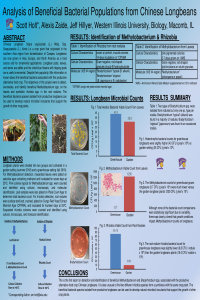
is a crop plant that originated in the southern Asia region from domestication of Cowpea. Longbeans are now grown in Asia, Europe, and North America as a food source and for ornamental applications. Longbean pods, leaves, and stems are edible and the violet-blue flowers with draping pods are a useful ornamental. Despite their popularity, little information is known about the beneficial bacteria associated with this productive alternative food crop. The objectives of this project were to detect, enumerate, and identify beneficial Methylobacterium spp. on the leaves and symbiotic rhizobia spp. in the root nodules. The long-term goal is to develop natural agricultural biologicals that support the growth of crop plants. For this study, longbean plants were divided into two groups and cultivated in a garden setting (summer 2018) and a greenhouse setting (fall 2018). For Methylobacterium detection, macerated leaves were plated on selective agar containing methanol and incubated for seven days at 25ºC. Pink colonies typical for Methylobacterium spp. were counted and identified using cultural, microscopic, and molecular identification. Leaf samples were also plated on Plate Count Agar to determine total bacterial count. For rhizobia detection, root nodules were surface sterilized, crushed, plated on Congo Red Yeast Extract Mannitol Agar (CRYMA), and incubated for fourteen days at 25ºC. Suspected rhizobia colonies were counted and identified using cultural, microscopic, and molecular identification. Interestingly, Root-nodule rhizobia were identified as Bradyrhizobium spp. Two types of Bradyrhizobium spp. were isolated from nodules but only one sp. type per nodule. The typical Bradyrhizobium sp. (elkanii) was found in a majority of nodules. The atypical Bradyrhizobium sp. (japonicum) was found in an occasional nodule. Heterotrophic bacterial counts for greenhouse longbeans were slightly higher (43 CFU /g leaf x 106) versus the garden setting (36 CFU /g leaf x 106). The Methylobacterium counts for greenhouse-grown longbeans (8.7 CFU /g leaf x 104) were much lower versus the garden longbean plants 1230 CFU /g leaf x 104). The root-nodule rhizobia bacterial count for greenhouse longbeans was slightly lower (9.8 CFU / nodule x 106) than the garden longbeans plants (16.0 CFU/ nodule x 106). Although none of the bacterial count comparisons were statistically significant due to variability, there was clearly a trend that growth conditions impact Methylobacterium counts on longbeans. This is the first report on detection and identification of beneficial Methylobacterium and Bradyrhizobium spp. associated with the productive alternative food crop Chinese Longbeans. It is also unusual to find two different rhizobia species form a symbiosis with the same crop plant. The beneficial bacterial species isolated from productive longbeans can be used to develop natural microbial inoculants that support the growth of other crop plants.
Keywords
Bradyrhizobium
Methylobacterium
Manuscript
ECM Poster PPT Holt Longbean Research OCT 20.pdf
Poster
S. Holt Zaide ECM Poster OCT 2020.pdf
Unlocking rhizospheric bacteria secondary metabolism: genome analysis for the discovery of novel antimicrobial compounds
Growth Assessment of Bifidobacterium on Glucansucrase-Derived Oligosaccharides