Event submissions
Published

This submission belongs to the session S1. Gut Microbiota and Health Disease of the event The 1st International Electronic Conference on Microbiology
Published date
02 Nov, 2020
Citation
Scott M. Holt, Chris Skory, Greg Cote, Growth Assessment of Bifidobacterium on Glucansucrase-Derived Oligosaccharides, in Proceedings of The 1st International Electronic Conference on Microbiology, 2 November–30 November 2020, MDPI: Basel, Switzerland, doi: 10.3390/ECM2020-07135
Share
Email
Facebook
Twitter
LinkedIn
Growth Assessment of Bifidobacterium on Glucansucrase-Derived Oligosaccharides
'%3e%3cpath%20d='M12.6647%2010.9104C12.4176%2010.325%2012.0589%209.7933%2011.6088%209.34485C11.16%208.89511%2010.6283%208.53653%2010.0432%208.28891C10.038%208.28629%2010.0327%208.28498%2010.0275%208.28236C10.8437%207.69282%2011.3743%206.73252%2011.3743%205.64907C11.3743%203.85423%209.92005%202.40002%208.12522%202.40002C6.33038%202.40002%204.87618%203.85423%204.87618%205.64907C4.87618%206.73252%205.40677%207.69282%206.22296%208.28367C6.21772%208.28629%206.21248%208.2876%206.20724%208.29022C5.62031%208.53783%205.09365%208.89287%204.64167%209.34616C4.19192%209.79496%203.83334%2010.3266%203.58573%2010.9117C3.34247%2011.4846%203.21128%2012.0987%203.19925%2012.721C3.1989%2012.735%203.20135%2012.7489%203.20646%2012.7619C3.21157%2012.7749%203.21924%2012.7868%203.22901%2012.7968C3.23877%2012.8068%203.25045%2012.8148%203.26334%2012.8202C3.27623%2012.8256%203.29007%2012.8284%203.30406%2012.8284H4.09012C4.14776%2012.8284%204.19362%2012.7825%204.19493%2012.7262C4.22113%2011.7148%204.62726%2010.7676%205.34519%2010.0497C6.08802%209.30686%207.07452%208.89811%208.12522%208.89811C9.17592%208.89811%2010.1624%209.30686%2010.9052%2010.0497C11.6232%2010.7676%2012.0293%2011.7148%2012.0555%2012.7262C12.0568%2012.7839%2012.1027%2012.8284%2012.1603%2012.8284H12.9464C12.9604%2012.8284%2012.9742%2012.8256%2012.9871%2012.8202C13%2012.8148%2013.0117%2012.8068%2013.0214%2012.7968C13.0312%2012.7868%2013.0389%2012.7749%2013.044%2012.7619C13.0491%2012.7489%2013.0515%2012.735%2013.0512%2012.721C13.0381%2012.0947%2012.9084%2011.4856%2012.6647%2010.9104ZM8.12522%207.90243C7.52388%207.90243%206.95792%207.66793%206.53214%207.24215C6.10636%206.81636%205.87185%206.2504%205.87185%205.64907C5.87185%205.04773%206.10636%204.48177%206.53214%204.05599C6.95792%203.63021%207.52388%203.3957%208.12522%203.3957C8.72655%203.3957%209.29252%203.63021%209.7183%204.05599C10.1441%204.48177%2010.3786%205.04773%2010.3786%205.64907C10.3786%206.2504%2010.1441%206.81636%209.7183%207.24215C9.29252%207.66793%208.72655%207.90243%208.12522%207.90243Z'%20fill='%235D1EE1'/%3e%3c/g%3e%3c/svg%3e)
Scott M. Holt 1
Chris Skory 2
Greg Cote 3
1. Western Illinois University, Biological Sciences, Macomb, IL 61455
2. USDA, ARS, NCAUR, USA
3. USDA,ARS,NCAUR
Abstract
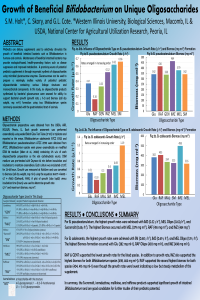
Prebiotics are dietary supplements used to selectively stimulate the growth of beneficial intestinal bacteria such as Bifidobacterium in humans and animals. Maintenance of beneficial intestinal bacteria may provide ecological-based, health-promoting factors such as disease suppression and improved metabolism. A promising source of potential prebiotic supplements is through enzymatic synthesis of oligosaccharides using microbial glucansucrase enzymes. Glucansucrases can be used to prepare a seemingly endless variety of potential prebiotic oligosaccharides containing various linkage structures and monosaccharide components. In this study, six oligosaccharide products synthesized by bacterial glucansucrase were assessed for ability to support bacterial growth (growth rate, µ h-1) and biomass (cell dry weight, mg ml-1) formation using two Bifidobacterium species commonly associated with the gastrointestinal tract of animals. Each growth assessment was performed in triplicate and reported as the mean. Overall, oligosaccharide products Sucromalt (Cargill, Inc) and isomelezitose supported the highest growth rates for B. adolescentis (0.60, 0.69 µ h-1) and B. pseudocatenulatum (0.66, 0.52 µ h-1) when compared to glucose (0.51, 0.37 µ h-1). The raffinose-derived and gentiobiose-derived oligosaccharide products supported the lowest growth rates for the listed species. In addition to growth rate, isomelezitose also supported the highest biomass formation for both Bifidobacterium species (497, 464 mg ml-1) when compared to glucose and the other oligosaccharides. The raffinose-derived product, however, supported the second highest biomass formation for both species (404, 416 mg ml-1) even though the growth rates were lowest indicating a slow but steady metabolism of this supplement by Bifidobacterium. In summary, the Sucromalt, isomelezitose, and raffinose products supported significant growth of intestinal Bifidobacterium and are good candidates for further studies of their prebiotic potential.
Keywords
prebiotic
Bifidobacterium
probiotic
Manuscript
ECM Poster PPT Holt Oligosaccharides Research OCT 2020.pdf
Poster
S. Holt Skory ECM Poster OCT 2020.pdf
Analysis of Beneficial Bacterial Populations from Chinese Longbeans
Clonal diversity and antimicrobial resistance of Staphylococcus pseudintermedius isolated from canine pyoderma