Event submissions
Published

This submission belongs to the session S3. Antimicrobial Agents and Resistance of the event The 1st International Electronic Conference on Microbiology
Published date
02 Nov, 2020
Citation
Vanessa Silva, Ana Oliveira, Manuela Caniça, Vera Manageiro, José Luis Capelo, Gilberto Igrejas, Patrícia Poeta, Clonal diversity and antimicrobial resistance of Staphylococcus pseudintermedius isolated from canine pyoderma, in Proceedings of The 1st International Electronic Conference on Microbiology, 2 November–30 November 2020, MDPI: Basel, Switzerland, doi: 10.3390/ECM2020-07136
Share
Email
Facebook
Twitter
LinkedIn
Clonal diversity and antimicrobial resistance of Staphylococcus pseudintermedius isolated from canine pyoderma

Vanessa Silva 1,2,3,4
'%3e%3cpath%20d='M12.6647%2010.9104C12.4176%2010.325%2012.0589%209.7933%2011.6088%209.34485C11.16%208.89511%2010.6283%208.53653%2010.0432%208.28891C10.038%208.28629%2010.0327%208.28498%2010.0275%208.28236C10.8437%207.69282%2011.3743%206.73252%2011.3743%205.64907C11.3743%203.85423%209.92005%202.40002%208.12522%202.40002C6.33038%202.40002%204.87618%203.85423%204.87618%205.64907C4.87618%206.73252%205.40677%207.69282%206.22296%208.28367C6.21772%208.28629%206.21248%208.2876%206.20724%208.29022C5.62031%208.53783%205.09365%208.89287%204.64167%209.34616C4.19192%209.79496%203.83334%2010.3266%203.58573%2010.9117C3.34247%2011.4846%203.21128%2012.0987%203.19925%2012.721C3.1989%2012.735%203.20135%2012.7489%203.20646%2012.7619C3.21157%2012.7749%203.21924%2012.7868%203.22901%2012.7968C3.23877%2012.8068%203.25045%2012.8148%203.26334%2012.8202C3.27623%2012.8256%203.29007%2012.8284%203.30406%2012.8284H4.09012C4.14776%2012.8284%204.19362%2012.7825%204.19493%2012.7262C4.22113%2011.7148%204.62726%2010.7676%205.34519%2010.0497C6.08802%209.30686%207.07452%208.89811%208.12522%208.89811C9.17592%208.89811%2010.1624%209.30686%2010.9052%2010.0497C11.6232%2010.7676%2012.0293%2011.7148%2012.0555%2012.7262C12.0568%2012.7839%2012.1027%2012.8284%2012.1603%2012.8284H12.9464C12.9604%2012.8284%2012.9742%2012.8256%2012.9871%2012.8202C13%2012.8148%2013.0117%2012.8068%2013.0214%2012.7968C13.0312%2012.7868%2013.0389%2012.7749%2013.044%2012.7619C13.0491%2012.7489%2013.0515%2012.735%2013.0512%2012.721C13.0381%2012.0947%2012.9084%2011.4856%2012.6647%2010.9104ZM8.12522%207.90243C7.52388%207.90243%206.95792%207.66793%206.53214%207.24215C6.10636%206.81636%205.87185%206.2504%205.87185%205.64907C5.87185%205.04773%206.10636%204.48177%206.53214%204.05599C6.95792%203.63021%207.52388%203.3957%208.12522%203.3957C8.72655%203.3957%209.29252%203.63021%209.7183%204.05599C10.1441%204.48177%2010.3786%205.04773%2010.3786%205.64907C10.3786%206.2504%2010.1441%206.81636%209.7183%207.24215C9.29252%207.66793%208.72655%207.90243%208.12522%207.90243Z'%20fill='%235D1EE1'/%3e%3c/g%3e%3c/svg%3e)
Ana Oliveira 5
Manuela Caniça 6,7

Vera Manageiro 6,7
José Luis Capelo 8,9

Gilberto Igrejas 3,4,10

Patrícia Poeta 1,4
1. Microbiology and Antibiotic Resistance Team (MicroART), Department of Veterinary Sciences, University of Trás-os-Montes and Alto Douro (UTAD), Vila Real, Portugal
2. Department of Genetics and Biotechnology, University of Trás-os-Montes and Alto Douro (UTAD), Vila Real, Portugal
3. Functional Genomics and Proteomics Unit, University of Trás-os-Montes and Alto Douro (UTAD), Vila Real, Portugal
4. Associated Laboratory for Green Chemistry (LAQV-REQUIMTE), University NOVA of Lisboa, Lisboa, Caparica, Portugal
5. Faculty of Veterinary Medicine, University Lusófona de Humanidades e Tecnologias, 1749-024 Lisboa, Portugal
6. National Reference Laboratory of Antibiotic Resistances and Healthcare Associated Infections (NRL-AMR/HAI), Department of Infectious Diseases, National Institute of Health Dr Ricardo Jorge, Av. Padre Cruz, 1649-016, Lisbon, Portugal
7. Centre for the Studies of Animal Science, Institute of Agrarian and Agri-Food Sciences and Technologies, Oporto University, Oporto, Portugal
8. BIOSCOPE Group, LAQV@REQUIMTE, Chemistry Department, Faculty of Science and Technology, NOVA University of Lisbon, Almada, Portugal
9. Proteomass Scientific Society, Costa de Caparica, Portugal.
10. Department of Genetics and Biotechnology, Functional Genomics and Proteomics’ Unit, University of Trás-os-Montes and Alto Douro, Vila Real, Portugal
Abstract
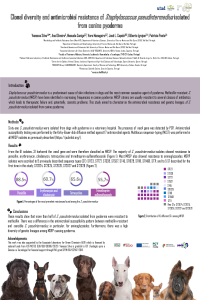
Staphylococcus pseudintermedius is a predominant cause of skin infections in dogs and the most common causative agent of pyoderma. Methicillin-resistant S. pseudintermedius (MRSP) have been identified in increasing frequencies in canine pyoderma. MRSP strains are usually resistant to several classes of antibiotics which leads to therapeutic failure and, potentially, zoonotic problems. This study aimed to characterize the antimicrobial resistance and genetic lineages of S. pseudintermedius isolated from canine pyoderma.
Sixty-one S. pseudintermedius were isolated from dogs with pyoderma in a veterinary hospital. The presence of mecA gene was detected by PCR. Antimicrobial susceptibility testing was performed by the Kirby-Bauer disk diffusion method against 17 antimicrobial agents. Multilocus‐sequence‐typing (MLST) was performed in all MRSP isolates as previously described (https://pubmlst.org/).
From the 61 isolates, 31 harbored the mecA gene and were therefore classified as MRSP. The majority of S. pseudintermedius isolates showed resistance to penicillin (88,5%), erythromycin (60,7%), clindamycin (60,7%), tetracycline (65,6%) and trimethoprim-sulfamethoxazole (55,7%). Most MRSP also showed resistance to aminoglycosides. MSRP isolates were ascribed to 9 previously described sequence types (ST): ST123, ST727, ST339, ST537, ST45, ST1029, ST118, ST1468, ST71; and to 5 ST described for the first time in this study: ST2024, ST2025, ST2026, ST2027 and ST2028.
These results show that more than half of S. pseudintermedius isolated from pyoderma were resistant to methicillin. There was a difference in the antimicrobial susceptibility pattern between methicillin-resistant and -sensible S. pseudintermedius, in particular for aminoglycosides. Furthermore, there was a high diversity of genetic lineages among MSRP causing pyoderma.
Keywords
Staphylococcus pseudintermedius
MLST
clonal lineages
antimicrobial resistance
Manuscript
Silva et al pseudintermedius.pdf
Poster
Silva et al pseudintermedius.pdf
Growth Assessment of Bifidobacterium on Glucansucrase-Derived Oligosaccharides
Antimicrobial and Antioxidant Activity of Phenolic Compounds Extracted from Wine Industry By-Products of Tinto Cão Variety