Event submissions
Published

This submission belongs to the session S3. Antimicrobial Agents and Resistance of the event The 1st International Electronic Conference on Microbiology
Published date
02 Nov, 2020
Citation
Jessica Ribeiro, Vanessa Silva, Rupesh Singh, Alfredo AIres, Rosa Carvalho, Virgílio Falco, Gilberto Igrejas, Patrícia Poeta, Antimicrobial and Antioxidant Activity of Phenolic Compounds Extracted from Wine Industry By-Products of Tinto Cão Variety, in Proceedings of The 1st International Electronic Conference on Microbiology, 2 November–30 November 2020, MDPI: Basel, Switzerland, doi: 10.3390/ECM2020-07137
Share
Email
Facebook
Twitter
LinkedIn
Antimicrobial and Antioxidant Activity of Phenolic Compounds Extracted from Wine Industry By-Products of Tinto Cão Variety
'%3e%3cpath%20d='M12.6647%2010.9104C12.4176%2010.325%2012.0589%209.7933%2011.6088%209.34485C11.16%208.89511%2010.6283%208.53653%2010.0432%208.28891C10.038%208.28629%2010.0327%208.28498%2010.0275%208.28236C10.8437%207.69282%2011.3743%206.73252%2011.3743%205.64907C11.3743%203.85423%209.92005%202.40002%208.12522%202.40002C6.33038%202.40002%204.87618%203.85423%204.87618%205.64907C4.87618%206.73252%205.40677%207.69282%206.22296%208.28367C6.21772%208.28629%206.21248%208.2876%206.20724%208.29022C5.62031%208.53783%205.09365%208.89287%204.64167%209.34616C4.19192%209.79496%203.83334%2010.3266%203.58573%2010.9117C3.34247%2011.4846%203.21128%2012.0987%203.19925%2012.721C3.1989%2012.735%203.20135%2012.7489%203.20646%2012.7619C3.21157%2012.7749%203.21924%2012.7868%203.22901%2012.7968C3.23877%2012.8068%203.25045%2012.8148%203.26334%2012.8202C3.27623%2012.8256%203.29007%2012.8284%203.30406%2012.8284H4.09012C4.14776%2012.8284%204.19362%2012.7825%204.19493%2012.7262C4.22113%2011.7148%204.62726%2010.7676%205.34519%2010.0497C6.08802%209.30686%207.07452%208.89811%208.12522%208.89811C9.17592%208.89811%2010.1624%209.30686%2010.9052%2010.0497C11.6232%2010.7676%2012.0293%2011.7148%2012.0555%2012.7262C12.0568%2012.7839%2012.1027%2012.8284%2012.1603%2012.8284H12.9464C12.9604%2012.8284%2012.9742%2012.8256%2012.9871%2012.8202C13%2012.8148%2013.0117%2012.8068%2013.0214%2012.7968C13.0312%2012.7868%2013.0389%2012.7749%2013.044%2012.7619C13.0491%2012.7489%2013.0515%2012.735%2013.0512%2012.721C13.0381%2012.0947%2012.9084%2011.4856%2012.6647%2010.9104ZM8.12522%207.90243C7.52388%207.90243%206.95792%207.66793%206.53214%207.24215C6.10636%206.81636%205.87185%206.2504%205.87185%205.64907C5.87185%205.04773%206.10636%204.48177%206.53214%204.05599C6.95792%203.63021%207.52388%203.3957%208.12522%203.3957C8.72655%203.3957%209.29252%203.63021%209.7183%204.05599C10.1441%204.48177%2010.3786%205.04773%2010.3786%205.64907C10.3786%206.2504%2010.1441%206.81636%209.7183%207.24215C9.29252%207.66793%208.72655%207.90243%208.12522%207.90243Z'%20fill='%235D1EE1'/%3e%3c/g%3e%3c/svg%3e)
Jessica Ribeiro 1

Vanessa Silva 1,2,3,4

Rupesh Singh 5

Alfredo AIres 6
Rosa Carvalho 7
Virgílio Falco 5

Gilberto Igrejas 2,3,4

Patrícia Poeta 1,2,3,4
1. Microbiology and Antibiotic Resistance Team (MicroART), Department of Veterinary Sciences, University of Trás-os-Montes and Alto Douro (UTAD), Vila Real, Portugal.
2. Department of Genetics and Biotechnology, University of Trás-os-Montes and Alto Douro, Vila Real, Portugal.
3. Functional Genomics and Proteomics Unit, University of Trás-os-Montes and Alto Douro (UTAD), Vila Real, Portugal.
4. Associated Laboratory for Green Chemistry (LAQV-REQUIMTE), University NOVA of Lisbon, Caparica, Portugal.
5. Chemistry Research Centre (CQ-VR), University of Trás-os-Montes and Alto Douro (UTAD), Vila Real, Portugal.
6. Centre for the Research and Technology of Agro-Environmental and Biological Sciences (CITAB), University of Trás-os-Montes and Alto Douro (UTAD), Vila Real, Portugal.
7. Department of Agronomy, School of Agrarian and Veterinary Sciences, University of Trás‐os‐Montes e Alto Douro (UTAD), Vila Real, Portugal.
Abstract
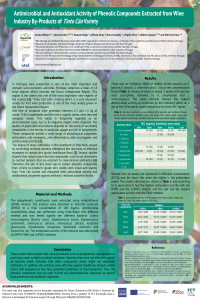
In Portugal, wine production is one of the most important and relevant socio-economic activities. Winery by-products are rich in phenolic compounds which exhibit a wide range of physiological properties. Therefore, the aim of this study was to extract phenolic compounds from grape skin, seeds, stems, shoats and leaves from the Tinto Cão variety and evaluate their antioxidant activity and antibacterial properties against antibiotic resistant bacterial strains.
The polyphenolic constituents were extracted using water/ethanol (20:80) mixture. The extracts were dissolved in dimethyl sulfoxide (DMSO) to a final concentration of 100 μg/mL. Antimicrobial susceptibility assay was performed using Kirby-Bauer disc diffusion method and was tested against ten different bacteria: Listeria, Pseudomonas aeruginosa, Enterecoccus faecium, Klebsiella pneumoniae, Staphylococcus aureus, Salmonella enteriditis, Enterococcus faecalis, Bacillus cereus, Staphylococcus epidermidis e Escherichia coli. The antioxidant activity of the extracts was determined by DPPH, FRAP and CuPRAC methods.
The higher antioxidant activity was found in the seed extracts, followed by the leaves extracts. The shoats extracts showed the highest antimicrobial properties with minimum inhibitory concentration (MIC) of 25mg/mL, except for B. Cereus, followed by the stems extracts. None of the extracts showed antibacterial activity against E. faecium, S. enteriditis, E.faecalis and E.coli.
These results show that, natural products, such as polyphenols, may represent a promising mean to fight microbial resistance. However, they were not effective against all bacteria which shows that polyphenols, alone, might not substitute antibiotics. Thus, the phenolic compounds may be used in food and pharmaceutical industries as natural food preservers and antibiotic adjuvants.
Keywords
polyphenols
winery by-products
antioxidant activity
antibacterial activity
bacterial resistance.
Manuscript
Poster_ECM_TintoCão .pdf
Poster
Poster_ECM_TintoCão .pdf
Clonal diversity and antimicrobial resistance of Staphylococcus pseudintermedius isolated from canine pyoderma
Antimicrobial Activity of Phenolic Compounds Extracted from Platanus hybrida: Exploring Alternative Therapies for a Post-Antibiotic Era