Event submissions
Published

This submission belongs to the session S8. Microbial Characterization and Bioprocess of the event The 1st International Electronic Conference on Microbiology
Published date
02 Nov, 2020
Citation
Augusta Jankutė, Simona Guobužaitė, Ronaldas Jakubovskis, Viktor Gribniak, Jaunius Urbonavičius, Effect of sub-zero temperatures and cement type on viability of Bacillus pseudofirmus in biological self-healing concrete, in Proceedings of The 1st International Electronic Conference on Microbiology, 2 November–30 November 2020, MDPI: Basel, Switzerland, doi: 10.3390/ECM2020-07143
Share
Email
Facebook
Twitter
LinkedIn
Effect of sub-zero temperatures and cement type on viability of Bacillus pseudofirmus in biological self-healing concrete
'%3e%3cpath%20d='M12.6647%2010.9104C12.4176%2010.325%2012.0589%209.7933%2011.6088%209.34485C11.16%208.89511%2010.6283%208.53653%2010.0432%208.28891C10.038%208.28629%2010.0327%208.28498%2010.0275%208.28236C10.8437%207.69282%2011.3743%206.73252%2011.3743%205.64907C11.3743%203.85423%209.92005%202.40002%208.12522%202.40002C6.33038%202.40002%204.87618%203.85423%204.87618%205.64907C4.87618%206.73252%205.40677%207.69282%206.22296%208.28367C6.21772%208.28629%206.21248%208.2876%206.20724%208.29022C5.62031%208.53783%205.09365%208.89287%204.64167%209.34616C4.19192%209.79496%203.83334%2010.3266%203.58573%2010.9117C3.34247%2011.4846%203.21128%2012.0987%203.19925%2012.721C3.1989%2012.735%203.20135%2012.7489%203.20646%2012.7619C3.21157%2012.7749%203.21924%2012.7868%203.22901%2012.7968C3.23877%2012.8068%203.25045%2012.8148%203.26334%2012.8202C3.27623%2012.8256%203.29007%2012.8284%203.30406%2012.8284H4.09012C4.14776%2012.8284%204.19362%2012.7825%204.19493%2012.7262C4.22113%2011.7148%204.62726%2010.7676%205.34519%2010.0497C6.08802%209.30686%207.07452%208.89811%208.12522%208.89811C9.17592%208.89811%2010.1624%209.30686%2010.9052%2010.0497C11.6232%2010.7676%2012.0293%2011.7148%2012.0555%2012.7262C12.0568%2012.7839%2012.1027%2012.8284%2012.1603%2012.8284H12.9464C12.9604%2012.8284%2012.9742%2012.8256%2012.9871%2012.8202C13%2012.8148%2013.0117%2012.8068%2013.0214%2012.7968C13.0312%2012.7868%2013.0389%2012.7749%2013.044%2012.7619C13.0491%2012.7489%2013.0515%2012.735%2013.0512%2012.721C13.0381%2012.0947%2012.9084%2011.4856%2012.6647%2010.9104ZM8.12522%207.90243C7.52388%207.90243%206.95792%207.66793%206.53214%207.24215C6.10636%206.81636%205.87185%206.2504%205.87185%205.64907C5.87185%205.04773%206.10636%204.48177%206.53214%204.05599C6.95792%203.63021%207.52388%203.3957%208.12522%203.3957C8.72655%203.3957%209.29252%203.63021%209.7183%204.05599C10.1441%204.48177%2010.3786%205.04773%2010.3786%205.64907C10.3786%206.2504%2010.1441%206.81636%209.7183%207.24215C9.29252%207.66793%208.72655%207.90243%208.12522%207.90243Z'%20fill='%235D1EE1'/%3e%3c/g%3e%3c/svg%3e)
Augusta Jankutė 1,2
Simona Guobužaitė 1,2
Ronaldas Jakubovskis 2

Viktor Gribniak 2

Jaunius Urbonavičius 1
1. Department of Chemistry and Bioengineering, Vilnius Gediminas Technical University, Vilnius, Lithuania
2. Laboratory of Innovative Building Structures, Vilnius Gediminas Technical University, Vilnius, Lithuania
Abstract
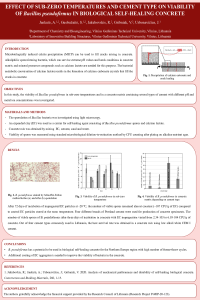
Microbiologically induced calcite precipitation (MICP) can be used to fill cracks arising in concrete. Alkaliphilic spore-forming bacteria, which can survive extreme pH values and harsh conditions in concrete matrix, are needed for this purpose. In this study, the viability of Bacillus pseudofirmus in sub-zero temperatures and in a concrete matrix containing several types of cement with different pH and metal ion concentrations was investigated. Expanded clay (EC) was used as a carrier for two-component self-healing agent consisting of Bacillus pseudofirmus spores and calcium lactate. The concrete consists of EC, cement, sand and water. Viability of endospores was measured using a standard microbiological dilution-to-extinction method by CFU counting after plating on alkaline nutrient agar. The results showed that after 72 days of incubation at temperatures below 0 °C (-20 °C), the number of viable spores remained almost constant (~107 CFU/g of EC) compared to control specimens stored at the room temperature. That indicates that B. pseudofirmus has a potential to be used in biological self-healing concrete for the Northern Europe region with high number of freeze-thaw cycles. Out of four cement types commonly used in Lithuania, the best survival rate was obtained in a concrete mix using the low alkali white CEM I cement. The number of viable spores after three days of concrete curing varied from 2.34 × 10³ to 6.59 × 10⁴ CFU/g of EC. Thus, an additional coating of EC aggregates is needed to improve the viability of bacteria in the concrete.
Keywords
biological self-healing
concrete
bacteria
viability of spores
sub-zero temperature
tests
Manuscript
Effect of sub-zero temperatures and cement type on viability of Bacillus pseudofirmus in biological self-healing concrete.pdf
Poster
Effect of sub-zero temperatures and cement type on viability of Bacillus pseudofirmus in biological self-healing concrete .pdf
The effect of lipids on the natural biodiversity of cultivated aboriginal microflora of urban soils