Event submissions
Published
 10.3390/IECB2020-07145 (registering DOI)
 This submission belongs to the session I. Posters of the event The 1st International Electronic Conference on Biosensors
Published date
02 Nov, 2020
Citation
Mattia Titubante, Leonardo Severini, Claudia Mazzuca, Laura Micheli, Biosensors for cellulose-biosed materials in cultural heritage: case studies, in Proceedings of The 1st International Electronic Conference on Biosensors, 2 November–17 November 2020, MDPI: Basel, Switzerland, doi: 10.3390/IECB2020-07145
Share
Email
Facebook
Twitter
LinkedIn
Biosensors for cellulose-biosed materials in cultural heritage: case studies
'%3e%3cpath%20d='M12.6647%2010.9104C12.4176%2010.325%2012.0589%209.7933%2011.6088%209.34485C11.16%208.89511%2010.6283%208.53653%2010.0432%208.28891C10.038%208.28629%2010.0327%208.28498%2010.0275%208.28236C10.8437%207.69282%2011.3743%206.73252%2011.3743%205.64907C11.3743%203.85423%209.92005%202.40002%208.12522%202.40002C6.33038%202.40002%204.87618%203.85423%204.87618%205.64907C4.87618%206.73252%205.40677%207.69282%206.22296%208.28367C6.21772%208.28629%206.21248%208.2876%206.20724%208.29022C5.62031%208.53783%205.09365%208.89287%204.64167%209.34616C4.19192%209.79496%203.83334%2010.3266%203.58573%2010.9117C3.34247%2011.4846%203.21128%2012.0987%203.19925%2012.721C3.1989%2012.735%203.20135%2012.7489%203.20646%2012.7619C3.21157%2012.7749%203.21924%2012.7868%203.22901%2012.7968C3.23877%2012.8068%203.25045%2012.8148%203.26334%2012.8202C3.27623%2012.8256%203.29007%2012.8284%203.30406%2012.8284H4.09012C4.14776%2012.8284%204.19362%2012.7825%204.19493%2012.7262C4.22113%2011.7148%204.62726%2010.7676%205.34519%2010.0497C6.08802%209.30686%207.07452%208.89811%208.12522%208.89811C9.17592%208.89811%2010.1624%209.30686%2010.9052%2010.0497C11.6232%2010.7676%2012.0293%2011.7148%2012.0555%2012.7262C12.0568%2012.7839%2012.1027%2012.8284%2012.1603%2012.8284H12.9464C12.9604%2012.8284%2012.9742%2012.8256%2012.9871%2012.8202C13%2012.8148%2013.0117%2012.8068%2013.0214%2012.7968C13.0312%2012.7868%2013.0389%2012.7749%2013.044%2012.7619C13.0491%2012.7489%2013.0515%2012.735%2013.0512%2012.721C13.0381%2012.0947%2012.9084%2011.4856%2012.6647%2010.9104ZM8.12522%207.90243C7.52388%207.90243%206.95792%207.66793%206.53214%207.24215C6.10636%206.81636%205.87185%206.2504%205.87185%205.64907C5.87185%205.04773%206.10636%204.48177%206.53214%204.05599C6.95792%203.63021%207.52388%203.3957%208.12522%203.3957C8.72655%203.3957%209.29252%203.63021%209.7183%204.05599C10.1441%204.48177%2010.3786%205.04773%2010.3786%205.64907C10.3786%206.2504%2010.1441%206.81636%209.7183%207.24215C9.29252%207.66793%208.72655%207.90243%208.12522%207.90243Z'%20fill='%235D1EE1'/%3e%3c/g%3e%3c/svg%3e)
Mattia Titubante 1
Leonardo Severini 2
Claudia Mazzuca 3

Laura Micheli 3
1. Department of Chemical Scienc eand Technology, University of Rome “Tor Vergata”, Via della Ricerca Scientifica 1, 00133 Rome, Italy
2. Department of Chemical Scienceand Technology, University of Rome “Tor Vergata”, Via della Ricerca Scientifica 1, 00133 Rome, Italy
3. Department of Chemical Science and Technology, University of Rome “Tor Vergata”, Via della Ricerca Scientifica 1, 00133 Rome, Italy
Abstract
New methodologies for the characterization of chemical composition and the monitoring of cleaning processes of paper and wood artifacts are based on tuned electrochemical sensors based on screen printed electrodes (SPE) coupled with a portable instrumentation1,2. Electrochemical biosensors, based on enzymes, have been successfully applied in many fields from environment to medicine, from foods to pharmaceuticals but the use of them in the cultural heritage field is still an almost unexplored world. Many of these biosensors are well suitable to be used for the characterization of several important materials used in cultural heritage such as paper, paintings, textiles, metals or glass, with the aim of determining their composition, health state and/or the effectiveness of conservation or restoration interventions. Opportune biosensors could be indeed applied to determine both inorganic than organic compounds present as components, pollutants or degradation products of artworks. In this work, several application of sensors coupled with hydrogel is presented to underline the potentiality of these tools in cultural heritage.
- Mazzuca, C., Carbone, M., Cancelliere, R., Prati, S., Sciutto, G., Mazzeo, R., Tositti, L., Regazzi, R., Mostacci, D., Micheli, L. (2018) A new analytical approach to characterize the effect of γ-ray sterilization on wood Microchemical Journal, 143, pp. 493-502. DOI: 10.1016/j.microc.2018.08.001
- 18) Micheli, L., Mazzuca, C., Palleschi, A., Palleschi G. (2016) Development of a diagnostic and cleaning tool for paper artworks: a case of study Microchemical Journal, 126, 32-41 DOI: 10.1016/j.microc.2015.11.052
Keywords
biosnesors
cellulose
hydrogel
Manuscript
poster IECB BC - Titubante Mazzuca Micheli 2020.pdf
Poster
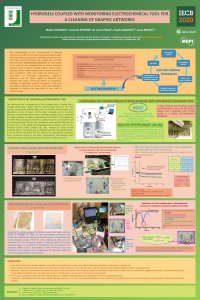
poster IECB BC - Titubante Mazzuca Micheli 2020.pdf
Nanomaterials-modified screen-printed electrodes: a powerful platform for sensor and biosensor set-up.
An ultra-sensitive biosensor to investigate Random Telegraph Noise in human breast cancer cells