Event submissions
Events1st International Electronic Conference on Genes: Theoretical and Applied Genomics
Published
 10.3390/IECGE-07146 (registering DOI)
 This submission belongs to the session S2. Applications of Genomic Technologies of the event 1st International Electronic Conference on Genes: Theoretical and Applied Genomics
Published date
02 Nov, 2020
Citation
Tuomas Tall, Pere Puigbò, The glyphosate target enzyme 5-enolpyruvylshikimate 3-phosphate synthase (EPSPS) contains several EPSPS-associated domains in fungi, in Proceedings of 1st International Electronic Conference on Genes: Theoretical and Applied Genomics, 2 November–30 November 2020, MDPI: Basel, Switzerland, doi: 10.3390/IECGE-07146
Share
Email
Facebook
Twitter
LinkedIn
The glyphosate target enzyme 5-enolpyruvylshikimate 3-phosphate synthase (EPSPS) contains several EPSPS-associated domains in fungi
'%3e%3cpath%20d='M12.6647%2010.9104C12.4176%2010.325%2012.0589%209.7933%2011.6088%209.34485C11.16%208.89511%2010.6283%208.53653%2010.0432%208.28891C10.038%208.28629%2010.0327%208.28498%2010.0275%208.28236C10.8437%207.69282%2011.3743%206.73252%2011.3743%205.64907C11.3743%203.85423%209.92005%202.40002%208.12522%202.40002C6.33038%202.40002%204.87618%203.85423%204.87618%205.64907C4.87618%206.73252%205.40677%207.69282%206.22296%208.28367C6.21772%208.28629%206.21248%208.2876%206.20724%208.29022C5.62031%208.53783%205.09365%208.89287%204.64167%209.34616C4.19192%209.79496%203.83334%2010.3266%203.58573%2010.9117C3.34247%2011.4846%203.21128%2012.0987%203.19925%2012.721C3.1989%2012.735%203.20135%2012.7489%203.20646%2012.7619C3.21157%2012.7749%203.21924%2012.7868%203.22901%2012.7968C3.23877%2012.8068%203.25045%2012.8148%203.26334%2012.8202C3.27623%2012.8256%203.29007%2012.8284%203.30406%2012.8284H4.09012C4.14776%2012.8284%204.19362%2012.7825%204.19493%2012.7262C4.22113%2011.7148%204.62726%2010.7676%205.34519%2010.0497C6.08802%209.30686%207.07452%208.89811%208.12522%208.89811C9.17592%208.89811%2010.1624%209.30686%2010.9052%2010.0497C11.6232%2010.7676%2012.0293%2011.7148%2012.0555%2012.7262C12.0568%2012.7839%2012.1027%2012.8284%2012.1603%2012.8284H12.9464C12.9604%2012.8284%2012.9742%2012.8256%2012.9871%2012.8202C13%2012.8148%2013.0117%2012.8068%2013.0214%2012.7968C13.0312%2012.7868%2013.0389%2012.7749%2013.044%2012.7619C13.0491%2012.7489%2013.0515%2012.735%2013.0512%2012.721C13.0381%2012.0947%2012.9084%2011.4856%2012.6647%2010.9104ZM8.12522%207.90243C7.52388%207.90243%206.95792%207.66793%206.53214%207.24215C6.10636%206.81636%205.87185%206.2504%205.87185%205.64907C5.87185%205.04773%206.10636%204.48177%206.53214%204.05599C6.95792%203.63021%207.52388%203.3957%208.12522%203.3957C8.72655%203.3957%209.29252%203.63021%209.7183%204.05599C10.1441%204.48177%2010.3786%205.04773%2010.3786%205.64907C10.3786%206.2504%2010.1441%206.81636%209.7183%207.24215C9.29252%207.66793%208.72655%207.90243%208.12522%207.90243Z'%20fill='%235D1EE1'/%3e%3c/g%3e%3c/svg%3e)
Tuomas Tall 1

Pere Puigbò 2
1. Department of Biology, University of Turku (Turku, Finland)
2. Nutrition and Health Unit, Eurecat Technology Centre of Catalonia (Reus, Catalonia)
Abstract
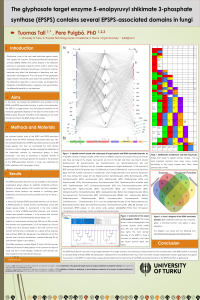
The 5-enolpyruvylshikimate 3-phosphate synthase (EPSPS) is the central enzyme of the shikimate pathway to synthesize three aromatic amino acids in fungi, plants and prokaryotes. Glyphosate is a multi-spectrum herbicide largely utilized to control weeds, which targets the EPSPS enzyme and inhibits the production of these essential amino acids. In most plants and prokaryotes, the EPSPS protein is constituted by a single domain, whereas in fungi contains the EPSPS and several EPSPS-associated domains. Here, we perform a comprehensive analysis of 391 EPSPS proteins of fungi gathered from the Pfam database. We analyze our dataset with a bipartite graph (Cytoscape) and dollon parsimony (Count) to determine the distribution and the evolution of the 22 EPSPS-associated domains in fungi. The EPSPS-associated domains can be classified into four partially overlapping groups: shikimate pathway, other enzymes, gene expression and structural proteins. The most frequent EPSPS-associated domains are shikimate kinase, 3-dehydroquinate synthase, 3-dehydroquinate dehydratase, shikimate dehydrogenase substrate binding domain and shikimate DH. These domains are present in 56% of the proteins analyzed and 34% of proteins contain shikimate DH at the end of sequence. The most common domain architecture of the EPSPS enzyme in fungi contains 5-6 domains. A parsimony analysis suggests that a 6-domain protein is the ancestral form of the EPSPS in fungi and that alternative architectures are due to domain losses (also some gains) and duplications. The results of this study will be useful to determine the impact of glyphosate in fungi and to quantify its putative differential effects on alternative domain architectures.
Keywords
shikimate pathway
herbicide
glyphosate
domain architecture
fungi
Manuscript
sciforum-034483-Final version_Layout.pdf
Poster
TTall-poster-EPSPS v6.pdf
OMICs role in Heridatarian prostate cancer.