Event submissions
Events1st International Electronic Conference on Genes: Theoretical and Applied Genomics
Published
 10.3390/IECGE-07147 (registering DOI)
 This submission belongs to the session S2. Applications of Genomic Technologies of the event 1st International Electronic Conference on Genes: Theoretical and Applied Genomics
Published date
02 Nov, 2020
Citation
Sergio Cuenca-Lopez, Patricia Porras-Quesada, Fernando Vazquez-Alonso, Victor Sanchez-Conde, Maria del Pilar Gomez-Matas, Adoracion Aneas-Alaminos, Veronica Arenas-Rodriguez, Blanca Cano-Gutierrez, Luis Javier Martinez-Gonzalez, Maria Jesus Alvarez-Cubero, OMICs role in Heridatarian prostate cancer. , in Proceedings of 1st International Electronic Conference on Genes: Theoretical and Applied Genomics, 2 November–30 November 2020, MDPI: Basel, Switzerland, doi: 10.3390/IECGE-07147
Share
Email
Facebook
Twitter
LinkedIn
OMICs role in Heridatarian prostate cancer.
'%3e%3cpath%20d='M12.6647%2010.9104C12.4176%2010.325%2012.0589%209.7933%2011.6088%209.34485C11.16%208.89511%2010.6283%208.53653%2010.0432%208.28891C10.038%208.28629%2010.0327%208.28498%2010.0275%208.28236C10.8437%207.69282%2011.3743%206.73252%2011.3743%205.64907C11.3743%203.85423%209.92005%202.40002%208.12522%202.40002C6.33038%202.40002%204.87618%203.85423%204.87618%205.64907C4.87618%206.73252%205.40677%207.69282%206.22296%208.28367C6.21772%208.28629%206.21248%208.2876%206.20724%208.29022C5.62031%208.53783%205.09365%208.89287%204.64167%209.34616C4.19192%209.79496%203.83334%2010.3266%203.58573%2010.9117C3.34247%2011.4846%203.21128%2012.0987%203.19925%2012.721C3.1989%2012.735%203.20135%2012.7489%203.20646%2012.7619C3.21157%2012.7749%203.21924%2012.7868%203.22901%2012.7968C3.23877%2012.8068%203.25045%2012.8148%203.26334%2012.8202C3.27623%2012.8256%203.29007%2012.8284%203.30406%2012.8284H4.09012C4.14776%2012.8284%204.19362%2012.7825%204.19493%2012.7262C4.22113%2011.7148%204.62726%2010.7676%205.34519%2010.0497C6.08802%209.30686%207.07452%208.89811%208.12522%208.89811C9.17592%208.89811%2010.1624%209.30686%2010.9052%2010.0497C11.6232%2010.7676%2012.0293%2011.7148%2012.0555%2012.7262C12.0568%2012.7839%2012.1027%2012.8284%2012.1603%2012.8284H12.9464C12.9604%2012.8284%2012.9742%2012.8256%2012.9871%2012.8202C13%2012.8148%2013.0117%2012.8068%2013.0214%2012.7968C13.0312%2012.7868%2013.0389%2012.7749%2013.044%2012.7619C13.0491%2012.7489%2013.0515%2012.735%2013.0512%2012.721C13.0381%2012.0947%2012.9084%2011.4856%2012.6647%2010.9104ZM8.12522%207.90243C7.52388%207.90243%206.95792%207.66793%206.53214%207.24215C6.10636%206.81636%205.87185%206.2504%205.87185%205.64907C5.87185%205.04773%206.10636%204.48177%206.53214%204.05599C6.95792%203.63021%207.52388%203.3957%208.12522%203.3957C8.72655%203.3957%209.29252%203.63021%209.7183%204.05599C10.1441%204.48177%2010.3786%205.04773%2010.3786%205.64907C10.3786%206.2504%2010.1441%206.81636%209.7183%207.24215C9.29252%207.66793%208.72655%207.90243%208.12522%207.90243Z'%20fill='%235D1EE1'/%3e%3c/g%3e%3c/svg%3e)
Sergio Cuenca-Lopez 1
Patricia Porras-Quesada 2

Fernando Vazquez-Alonso 3
Victor Sanchez-Conde 3
Maria del Pilar Gomez-Matas 4
Adoracion Aneas-Alaminos 5
Veronica Arenas-Rodriguez 1
Blanca Cano-Gutierrez 6

Luis Javier Martinez-Gonzalez 1

Maria Jesus Alvarez-Cubero 7
1. GENYO (Pfizer-University of Granada-Andalusian Regional Government Centre for Genomics and Oncological Research), Av. de la Ilustracion, 114, 18016, Granada, Spain.
2. Department of Biochemistry and Molecular Biology III and Immunology, Faculty of Medicine, University of Granada, Av. de la Investigacion, 11, 18016, Granada, Spain.
3. Urology Department, University Hospital Virgen de las Nieves, Av. de las Fuerzas Armadas, 2, 18014, Granada, Spain.
4. Surgical Block, University Hospital Virgen de las Nieves, Av. de las Fuerzas Armadas 2, 18014, Granada, Spain
5. Surgical Block, University Hospital Virgen de las Nieves, Av. de las Fuerzas Armadas 2, 18014, Granada, Spain.
6. Urology Department, University Hospital Virgen de las Nieves, Av. de las Fuerzas Armadas 2, 18014, Granada, Spain.
7. Department of Biochemistry and Molecular Biology III and Immunology, Faculty of Medicine, University of Granada, Av. de la Investigacion, 11, 18016, Granada, Spain; GENYO (Pfizer-University of Granada-Andalusian Regional Government Centre for Genomics and
Abstract
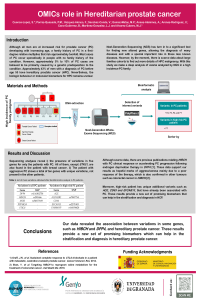
Prostate cancer (PC) is one of the most prevalent tumors in the world, however, the hereditary (Hereditary PC; HPC) form is a rare pathology (ORPHA: 1331), without exceeding 6%. Despite its very low incidence, a family history of PC in a first-degree relative multiplies the risk to suffer from PC approximately twofold. Therefore, the search for genetic variables associated with detection, monitoring and treatment is unavoidable.
Although the study of the genome and its expression have provided us with valuable information, it has not been able to describe biomarkers that help us resolve the appearance and evolution of the tumor. With this study, we make a deep analysis in data of exome and miRNAs analyzed by Next-generation sequencing (NGS) analysis in search of new biomarkers as variants of aggressiveness of this tumor. We performed this analysis in a family of a high incidence of PC.
Our data revealed that some genes such as HIBCH and DPP4 are just present in all HPC patients. Moreover, high-risk patients have unique additional variants such as FANK1, TUBA3FP and ALDH3B2. These results provide a new set of promising biomarkers in HCP.
Keywords
Hereditary prostate cancer
OMICs technologies
Next-Generation Sequencing
biomarker
aggressiveness.
Manuscript
sciforum-034509-Final version_Layout.pdf
Poster
Presentation OMICs role in Hereditarian prostate cancer .pdf
The glyphosate target enzyme 5-enolpyruvylshikimate 3-phosphate synthase (EPSPS) contains several EPSPS-associated domains in fungi
Determination of expression signature and proportion of mtDNA in plasma fractions in patients with Renal Cell Carcinoma.