Event submissions
Events1st International Electronic Conference on Genes: Theoretical and Applied Genomics
Published
 10.3390/IECGE-07149 (registering DOI)
 This submission belongs to the session S2. Applications of Genomic Technologies of the event 1st International Electronic Conference on Genes: Theoretical and Applied Genomics
Published date
02 Nov, 2020
Citation
Azamat Totickov, Andrei Tomarovsky, Lorena Derezanin, Olga Dudchenko, Erez Lieberman-Aiden, Klaus Koepfli, Sergei Kliver, Chromosome-level genome assemblies expanded capabilities of conservation biology , in Proceedings of 1st International Electronic Conference on Genes: Theoretical and Applied Genomics, 2 November–30 November 2020, MDPI: Basel, Switzerland, doi: 10.3390/IECGE-07149
Share
Email
Facebook
Twitter
LinkedIn
Chromosome-level genome assemblies expanded capabilities of conservation biology
'%3e%3cpath%20d='M12.6647%2010.9104C12.4176%2010.325%2012.0589%209.7933%2011.6088%209.34485C11.16%208.89511%2010.6283%208.53653%2010.0432%208.28891C10.038%208.28629%2010.0327%208.28498%2010.0275%208.28236C10.8437%207.69282%2011.3743%206.73252%2011.3743%205.64907C11.3743%203.85423%209.92005%202.40002%208.12522%202.40002C6.33038%202.40002%204.87618%203.85423%204.87618%205.64907C4.87618%206.73252%205.40677%207.69282%206.22296%208.28367C6.21772%208.28629%206.21248%208.2876%206.20724%208.29022C5.62031%208.53783%205.09365%208.89287%204.64167%209.34616C4.19192%209.79496%203.83334%2010.3266%203.58573%2010.9117C3.34247%2011.4846%203.21128%2012.0987%203.19925%2012.721C3.1989%2012.735%203.20135%2012.7489%203.20646%2012.7619C3.21157%2012.7749%203.21924%2012.7868%203.22901%2012.7968C3.23877%2012.8068%203.25045%2012.8148%203.26334%2012.8202C3.27623%2012.8256%203.29007%2012.8284%203.30406%2012.8284H4.09012C4.14776%2012.8284%204.19362%2012.7825%204.19493%2012.7262C4.22113%2011.7148%204.62726%2010.7676%205.34519%2010.0497C6.08802%209.30686%207.07452%208.89811%208.12522%208.89811C9.17592%208.89811%2010.1624%209.30686%2010.9052%2010.0497C11.6232%2010.7676%2012.0293%2011.7148%2012.0555%2012.7262C12.0568%2012.7839%2012.1027%2012.8284%2012.1603%2012.8284H12.9464C12.9604%2012.8284%2012.9742%2012.8256%2012.9871%2012.8202C13%2012.8148%2013.0117%2012.8068%2013.0214%2012.7968C13.0312%2012.7868%2013.0389%2012.7749%2013.044%2012.7619C13.0491%2012.7489%2013.0515%2012.735%2013.0512%2012.721C13.0381%2012.0947%2012.9084%2011.4856%2012.6647%2010.9104ZM8.12522%207.90243C7.52388%207.90243%206.95792%207.66793%206.53214%207.24215C6.10636%206.81636%205.87185%206.2504%205.87185%205.64907C5.87185%205.04773%206.10636%204.48177%206.53214%204.05599C6.95792%203.63021%207.52388%203.3957%208.12522%203.3957C8.72655%203.3957%209.29252%203.63021%209.7183%204.05599C10.1441%204.48177%2010.3786%205.04773%2010.3786%205.64907C10.3786%206.2504%2010.1441%206.81636%209.7183%207.24215C9.29252%207.66793%208.72655%207.90243%208.12522%207.90243Z'%20fill='%235D1EE1'/%3e%3c/g%3e%3c/svg%3e)
Azamat Totickov 1
Andrei Tomarovsky 1
Lorena Derezanin 2
Olga Dudchenko 3
Erez Lieberman-Aiden 3
Klaus Koepfli 4
Sergei Kliver 5
1. Saint Petersburg State University, Saint Petersburg, Russia
2. Leibniz Institute for Zoo and Wildlife Research, Berlin, Germany
3. Baylor College of Medicine, Houston, Texas, USA
4. Smithsonian-Mason School of Conservation, Front Royal, VA, USA
5. Institute for Molecular and Cellular Biology SB RAS, Novosibirsk, Russia
Abstract
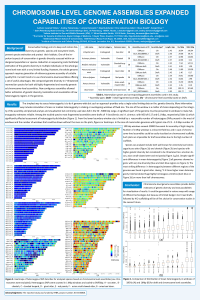
Conservation biology aims to keep and restore biodiversity on genetic, species and ecosystem levels, prevent species extinction and protect their habitats. One of the important aspects of a conservation is genetic diversity assessed within endangered populations or species. Reduction in sequencing costs facilitated estimation of the genetic diversity in multiple individuals on the whole genome level even with a very limited budget. However, whole genome approach requires generation of reference genome assembly of suitable quality first. Current trend is to use chromosome-level assemblies offering a set of useful advantages.
We compared genetic diversity in endangered species (cheetah, sea otter and others) for both old highly fragmented and recently generated chromosome-level assemblies. New contiguous assemblies allowed to calculate more precisely broadly used indicators of genetic diversity such as length and number of ROHs (runs of homozygosity) and visualize regions of low heterozygosity in the genome. In addition, we located known microsatellite loci previously used in STR-fingerprinting on chromosomes to understand diversity of what regions were estimated in previous diversity studies.
Chromosome level genome assemblies provide better estimates of genetic diversity, better understanding for results of previous studies and new possibilities for visualization of results. Another new opportunity is the simple and cheap procedure for development of comprehensive STR-arrays or microarrays with known localization of each locus to use it for diversity estimates in multiple (hundreds and thousands) individuals and in low quality samples.
Keywords
conservation
genome
assembly
chromosome-level
Manuscript
sciforum-034647-Final version_Layout.pdf
Poster
IECGE2020.poster.pdf
Determination of expression signature and proportion of mtDNA in plasma fractions in patients with Renal Cell Carcinoma.
Influence of a major mountainous landscape barrier (Mount Cameroon) on the spread of metabolic (GSTe2) and target-site (Rdl) resistance alleles in the African malaria vector Anopheles funestus