Event submissions
Events1st International Electronic Conference on Genes: Theoretical and Applied Genomics
Published
 10.3390/IECGE-07150 (registering DOI)
 This submission belongs to the session S2. Applications of Genomic Technologies of the event 1st International Electronic Conference on Genes: Theoretical and Applied Genomics
Published date
02 Nov, 2020
Citation
Nathalie Amvongo-Adjia, Jacob M. Riveron, Flobert Njiokou, Samuel Wanji, Charles S. Wondji, Influence of a major mountainous landscape barrier (Mount Cameroon) on the spread of metabolic (GSTe2) and target-site (Rdl) resistance alleles in the African malaria vector Anopheles funestus, in Proceedings of 1st International Electronic Conference on Genes: Theoretical and Applied Genomics, 2 November–30 November 2020, MDPI: Basel, Switzerland, doi: 10.3390/IECGE-07150
Share
Email
Facebook
Twitter
LinkedIn
Influence of a major mountainous landscape barrier (Mount Cameroon) on the spread of metabolic (GSTe2) and target-site (Rdl) resistance alleles in the African malaria vector Anopheles funestus

Nathalie Amvongo-Adjia 1,2,3,4
'%3e%3cpath%20d='M12.6647%2010.9104C12.4176%2010.325%2012.0589%209.7933%2011.6088%209.34485C11.16%208.89511%2010.6283%208.53653%2010.0432%208.28891C10.038%208.28629%2010.0327%208.28498%2010.0275%208.28236C10.8437%207.69282%2011.3743%206.73252%2011.3743%205.64907C11.3743%203.85423%209.92005%202.40002%208.12522%202.40002C6.33038%202.40002%204.87618%203.85423%204.87618%205.64907C4.87618%206.73252%205.40677%207.69282%206.22296%208.28367C6.21772%208.28629%206.21248%208.2876%206.20724%208.29022C5.62031%208.53783%205.09365%208.89287%204.64167%209.34616C4.19192%209.79496%203.83334%2010.3266%203.58573%2010.9117C3.34247%2011.4846%203.21128%2012.0987%203.19925%2012.721C3.1989%2012.735%203.20135%2012.7489%203.20646%2012.7619C3.21157%2012.7749%203.21924%2012.7868%203.22901%2012.7968C3.23877%2012.8068%203.25045%2012.8148%203.26334%2012.8202C3.27623%2012.8256%203.29007%2012.8284%203.30406%2012.8284H4.09012C4.14776%2012.8284%204.19362%2012.7825%204.19493%2012.7262C4.22113%2011.7148%204.62726%2010.7676%205.34519%2010.0497C6.08802%209.30686%207.07452%208.89811%208.12522%208.89811C9.17592%208.89811%2010.1624%209.30686%2010.9052%2010.0497C11.6232%2010.7676%2012.0293%2011.7148%2012.0555%2012.7262C12.0568%2012.7839%2012.1027%2012.8284%2012.1603%2012.8284H12.9464C12.9604%2012.8284%2012.9742%2012.8256%2012.9871%2012.8202C13%2012.8148%2013.0117%2012.8068%2013.0214%2012.7968C13.0312%2012.7868%2013.0389%2012.7749%2013.044%2012.7619C13.0491%2012.7489%2013.0515%2012.735%2013.0512%2012.721C13.0381%2012.0947%2012.9084%2011.4856%2012.6647%2010.9104ZM8.12522%207.90243C7.52388%207.90243%206.95792%207.66793%206.53214%207.24215C6.10636%206.81636%205.87185%206.2504%205.87185%205.64907C5.87185%205.04773%206.10636%204.48177%206.53214%204.05599C6.95792%203.63021%207.52388%203.3957%208.12522%203.3957C8.72655%203.3957%209.29252%203.63021%209.7183%204.05599C10.1441%204.48177%2010.3786%205.04773%2010.3786%205.64907C10.3786%206.2504%2010.1441%206.81636%209.7183%207.24215C9.29252%207.66793%208.72655%207.90243%208.12522%207.90243Z'%20fill='%235D1EE1'/%3e%3c/g%3e%3c/svg%3e)
Jacob M. Riveron 3
Flobert Njiokou 1,3
Samuel Wanji 2,5

Charles S. Wondji 3,6
1. Department of Animal Biology and Physiology, Faculty of Science, University of Yaoundé 1, P.O. BOX 812 Yaoundé, Cameroon
2. Research Foundation for Tropical Diseases and Environment (REFOTDE), University of Buea, P.O. BOX 474 Buea, Cameroon
3. Centre for Research in Infectious Diseases (CRID), LSTM Research Unit, P.O. Box 13591 Yaoundé, Cameroon
4. Medical Research Centre, Institute of Medical Research and Medicinal Plants Studies (IMPM), P.O. BOX 13033 Yaoundé, Cameroon
5. Department of Microbiology and Parasitology, University of Buea, P.O. BOX 63 Buea, Cameroon
6. Department of Vector Biology, Liverpool School of Tropical Medicine, Liverpool L35QAUK, United Kingdom
Abstract
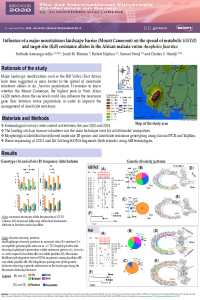
Increased levels of insecticide resistance in major malaria vectors such as Anopheles funestus is threatening the continued effectiveness of insecticide-based control programmes. Understanding the ecological factors impacting the spread of resistance alleles in necessary to design suitable resistance management strategies. Here we examined the influence of the highest mountain in West Africa (4,100 meters elevation) on the spread of both metabolic and target-site resistance alleles in An. funestus sensu stricto (s.s) populations. High frequencies of both 296S-Rdl (49% - 90%) and 119F-GSTe2 (67% - 81%) resistance alleles were observed An. funestus s.s. populations across Mount Cameroon. Genetic variability parameters suggested that these resistance markers underwent high levels of polymorphisms with 16 to 12 haplotypes identified respectively. However, neutrality tests were not consistent with recent expansion or resistance genes being under selection. Analysis of the maximum likelihood phylogenetic trees of haplotypes indicated that populations primarily clustered according to resistance patterns, whereas the neighbour joining trees of distances suggested that landscape variations could potentially be associated with the risk of presence and insecticide resistance for malaria vectors. These raise the need for further investigations covering different bioecological zones for a detailed report on current status of insecticide resistance in malaria vectors.
Keywords
Malaria
Anopheles funestus sensu stricto
Insecticide resistance
Mount Cameroon.
Manuscript
sciforum-034654 -Final version_Layout.pdf
Poster
IECGE 2020 _Poster Presentation_AAN.pdf
Chromosome-level genome assemblies expanded capabilities of conservation biology
Genetic analysis algorithm for the study of patients with Multiple Congenital Anomalies and isolated Congenital Heart Disease