Event submissions
Events1st International Electronic Conference on Genes: Theoretical and Applied Genomics
Published
 10.3390/IECGE-07152 (registering DOI)
 This submission belongs to the session S2. Applications of Genomic Technologies of the event 1st International Electronic Conference on Genes: Theoretical and Applied Genomics
Published date
02 Nov, 2020
Citation
IVANETE DE OLIVEIRA FURO, RAFAEL KRETSCHMER, PATRICIA O’BRIEN, JORGE PEREIRA, DARREN GRIFFIN, REBECCA O’CONNOR, MALCOLM FERGUSON-SMITH, EDIVALDO DE OLIVEIRA, A new nomenclature for the chromosome-specific probes of white hawk (Leucopternis albicollis), in Proceedings of 1st International Electronic Conference on Genes: Theoretical and Applied Genomics, 2 November–30 November 2020, MDPI: Basel, Switzerland, doi: 10.3390/IECGE-07152
Share
Email
Facebook
Twitter
LinkedIn
A new nomenclature for the chromosome-specific probes of white hawk (Leucopternis albicollis)
'%3e%3cpath%20d='M12.6647%2010.9104C12.4176%2010.325%2012.0589%209.7933%2011.6088%209.34485C11.16%208.89511%2010.6283%208.53653%2010.0432%208.28891C10.038%208.28629%2010.0327%208.28498%2010.0275%208.28236C10.8437%207.69282%2011.3743%206.73252%2011.3743%205.64907C11.3743%203.85423%209.92005%202.40002%208.12522%202.40002C6.33038%202.40002%204.87618%203.85423%204.87618%205.64907C4.87618%206.73252%205.40677%207.69282%206.22296%208.28367C6.21772%208.28629%206.21248%208.2876%206.20724%208.29022C5.62031%208.53783%205.09365%208.89287%204.64167%209.34616C4.19192%209.79496%203.83334%2010.3266%203.58573%2010.9117C3.34247%2011.4846%203.21128%2012.0987%203.19925%2012.721C3.1989%2012.735%203.20135%2012.7489%203.20646%2012.7619C3.21157%2012.7749%203.21924%2012.7868%203.22901%2012.7968C3.23877%2012.8068%203.25045%2012.8148%203.26334%2012.8202C3.27623%2012.8256%203.29007%2012.8284%203.30406%2012.8284H4.09012C4.14776%2012.8284%204.19362%2012.7825%204.19493%2012.7262C4.22113%2011.7148%204.62726%2010.7676%205.34519%2010.0497C6.08802%209.30686%207.07452%208.89811%208.12522%208.89811C9.17592%208.89811%2010.1624%209.30686%2010.9052%2010.0497C11.6232%2010.7676%2012.0293%2011.7148%2012.0555%2012.7262C12.0568%2012.7839%2012.1027%2012.8284%2012.1603%2012.8284H12.9464C12.9604%2012.8284%2012.9742%2012.8256%2012.9871%2012.8202C13%2012.8148%2013.0117%2012.8068%2013.0214%2012.7968C13.0312%2012.7868%2013.0389%2012.7749%2013.044%2012.7619C13.0491%2012.7489%2013.0515%2012.735%2013.0512%2012.721C13.0381%2012.0947%2012.9084%2011.4856%2012.6647%2010.9104ZM8.12522%207.90243C7.52388%207.90243%206.95792%207.66793%206.53214%207.24215C6.10636%206.81636%205.87185%206.2504%205.87185%205.64907C5.87185%205.04773%206.10636%204.48177%206.53214%204.05599C6.95792%203.63021%207.52388%203.3957%208.12522%203.3957C8.72655%203.3957%209.29252%203.63021%209.7183%204.05599C10.1441%204.48177%2010.3786%205.04773%2010.3786%205.64907C10.3786%206.2504%2010.1441%206.81636%209.7183%207.24215C9.29252%207.66793%208.72655%207.90243%208.12522%207.90243Z'%20fill='%235D1EE1'/%3e%3c/g%3e%3c/svg%3e)
IVANETE DE OLIVEIRA FURO 1,2

RAFAEL KRETSCHMER 3
PATRICIA O’BRIEN 2
JORGE PEREIRA 4

DARREN GRIFFIN 5
REBECCA O’CONNOR 5

MALCOLM FERGUSON-SMITH 2
EDIVALDO DE OLIVEIRA 6,7
1. Laboratório de Reprodução Animal, LABRAC, Universidade Federal Rural da Amazônia, UFRA, Parauapebas, PA, Brazil
2. Cambridge Resource Centre for Comparative Genomics, University of Cambridge Department of Veterinary Medicine, Cambridge, United Kingdom
3. Programa de Pós-graduação em Genética e Biologia Molecular, PPGBM, Universidade Federal do Rio Grande do Sul, Porto Alegre, Rio Grande do Sul, RS, Brazil
4. Animal and Veterinary Research Centre (CECAV), University of Tràs-os-Montes and Alto Douro (UTAD), Vila Real, Portugal
5. School of Biosciences, University of Kent, Canterbury CT2 7NJ, UK
6. Laboratório de Cultura de Tecidos e Citogenética, SAMAM, Instituto Evandro Chagas, Ananindeua, PA, Brazil
7. Instituto de Ciências Exatas e Naturais, Universidade Federal do Pará, Belém-PA-Brazil
Abstract
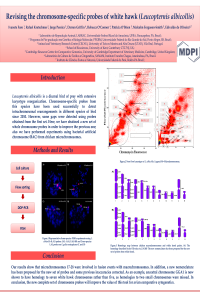
The white hawk (Leucopternis albicollis) is a diurnal bird of prey (Accipriformes, Accipitridae). This species has a karyotype with a low diploid number (2n=66), however, the comparison with Gallus gallus (2n=78) and the putative avian ancestral karyotype indicates the occurrence of extensive chromosome fissions in the ancestral macrochromosomes. Hence, it is likely that fusions involving microchromosomes underly the decrease in the diploid number in the white hawk. Considering that the ancestral macrochromosomes are fissioned, the chromosome-specific probes made for each of the chromosome segments resulting from the fissions allow the detection of intrachromosomal rearrangements in species with conserved karyotype. Using this strategy, whole chromosome probes from the white hawk have been exploited as a cytogenetic tool for phylogenetic studies in birds since 2010. However, some problems were detected with this first set of probes. Here, we have constructed new probes of the white hawk in order to improve the previous set. Additionally, we have employed bacterial artificial chromosome (BAC) hybridization for chromosome 17-28 to confirm the expected microchromosome fusions. Our results show that microchromosomes 17-28 were involved in fusion events with macrochromosomes. In addition, a new nomenclature has been proposed for the new set of probes and some previous inaccuracies corrected. As an example, ancestral chromosome GGA1 is now shown to have homology to seven white hawk chromosomes rather than five, as homologies to two small chromosomes were missed. In conclusion, the new complete set of chromosome probes will improve the value of this tool for avian comparative cytogenetics.
Keywords
Fission
chromosome probes
nomenclature
microchromosomes
BAC
Manuscript
sciforum-035247-Final version_Layout.pdf
Poster
Pôster_LAL.pdf
Genetic analysis algorithm for the study of patients with Multiple Congenital Anomalies and isolated Congenital Heart Disease
Study of some candidate genes for treatment in prostate cancer.