Event submissions
Events1st International Electronic Conference on Genes: Theoretical and Applied Genomics
Published
 10.3390/IECGE-07155 (registering DOI)
 This submission belongs to the session S2. Applications of Genomic Technologies of the event 1st International Electronic Conference on Genes: Theoretical and Applied Genomics
Published date
02 Nov, 2020
Citation
Katarzyna Sieńko, Kacper Żukowski, Kenji Yamada, Shino Goto-Yamada, NGS screening for identification of novel pexophagy-related mutant in Arabidopsis thaliana, in Proceedings of 1st International Electronic Conference on Genes: Theoretical and Applied Genomics, 2 November–30 November 2020, MDPI: Basel, Switzerland, doi: 10.3390/IECGE-07155
Share
Email
Facebook
Twitter
LinkedIn
NGS screening for identification of novel pexophagy-related mutant in Arabidopsis thaliana
'%3e%3cpath%20d='M12.6647%2010.9104C12.4176%2010.325%2012.0589%209.7933%2011.6088%209.34485C11.16%208.89511%2010.6283%208.53653%2010.0432%208.28891C10.038%208.28629%2010.0327%208.28498%2010.0275%208.28236C10.8437%207.69282%2011.3743%206.73252%2011.3743%205.64907C11.3743%203.85423%209.92005%202.40002%208.12522%202.40002C6.33038%202.40002%204.87618%203.85423%204.87618%205.64907C4.87618%206.73252%205.40677%207.69282%206.22296%208.28367C6.21772%208.28629%206.21248%208.2876%206.20724%208.29022C5.62031%208.53783%205.09365%208.89287%204.64167%209.34616C4.19192%209.79496%203.83334%2010.3266%203.58573%2010.9117C3.34247%2011.4846%203.21128%2012.0987%203.19925%2012.721C3.1989%2012.735%203.20135%2012.7489%203.20646%2012.7619C3.21157%2012.7749%203.21924%2012.7868%203.22901%2012.7968C3.23877%2012.8068%203.25045%2012.8148%203.26334%2012.8202C3.27623%2012.8256%203.29007%2012.8284%203.30406%2012.8284H4.09012C4.14776%2012.8284%204.19362%2012.7825%204.19493%2012.7262C4.22113%2011.7148%204.62726%2010.7676%205.34519%2010.0497C6.08802%209.30686%207.07452%208.89811%208.12522%208.89811C9.17592%208.89811%2010.1624%209.30686%2010.9052%2010.0497C11.6232%2010.7676%2012.0293%2011.7148%2012.0555%2012.7262C12.0568%2012.7839%2012.1027%2012.8284%2012.1603%2012.8284H12.9464C12.9604%2012.8284%2012.9742%2012.8256%2012.9871%2012.8202C13%2012.8148%2013.0117%2012.8068%2013.0214%2012.7968C13.0312%2012.7868%2013.0389%2012.7749%2013.044%2012.7619C13.0491%2012.7489%2013.0515%2012.735%2013.0512%2012.721C13.0381%2012.0947%2012.9084%2011.4856%2012.6647%2010.9104ZM8.12522%207.90243C7.52388%207.90243%206.95792%207.66793%206.53214%207.24215C6.10636%206.81636%205.87185%206.2504%205.87185%205.64907C5.87185%205.04773%206.10636%204.48177%206.53214%204.05599C6.95792%203.63021%207.52388%203.3957%208.12522%203.3957C8.72655%203.3957%209.29252%203.63021%209.7183%204.05599C10.1441%204.48177%2010.3786%205.04773%2010.3786%205.64907C10.3786%206.2504%2010.1441%206.81636%209.7183%207.24215C9.29252%207.66793%208.72655%207.90243%208.12522%207.90243Z'%20fill='%235D1EE1'/%3e%3c/g%3e%3c/svg%3e)
Katarzyna Sieńko 1

Kacper Żukowski 2
Kenji Yamada 1
Shino Goto-Yamada 1
1. Malopolska Centre of Biotechnology, Jagiellonian University Krakow, Poland
2. National Research Institute of Animal Production, Balice, Poland
Abstract
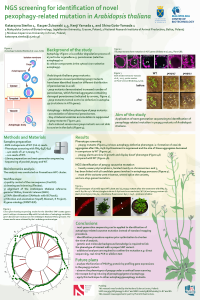
Nowadays, there is a strong interest to study autophagy mechanisms in plants, as it is one of the main cellular degradation and recycling pathways involved in the adaptation of organisms to stress conditions. We have isolated a number of peroxisome unusual positioning (peup) mutants, which display the accumulation of abnormal peroxisomes, and demonstrated that autophagy is involved in removing damaged organelles. These peup mutants also show defects of other autophagy-related processes, such as the recovery from dark-senescence, and also failed to induce vacuole-related vesicle formations during microautophagy under nutrient deprivations. Although most of peup mutants are identified as the mutants defective in autophagy-related (ATG) genes, the causative genes of several mutants are still staying undiscovered.
The aim of this study is to identify the causative gene of the peup33 mutant using Next Generation Sequencing (NGS) as a tool. Identification of mutations with NGS will allow us to save time compared to the conventional mapping method. Here we present the workflow of the experiment, the procedure of bioinformatic analysis and the software applied to the sequence data produced by NGS.
Keywords
autophagy
pexophagy-related mutants
Next Generation Sequencing
mutation identification
Manuscript
sciforum-037466-Final version_Layout.pdf
Poster
Sieńko_et al_Poster.pdf
First draft genome sequence of Salmonella enterica subsp. enterica serovar enteritidis isolated from the chicken meat in Russia
Cytomorphological, molecular diagnosis and evaluation of insertion of the LINE-1 element in the C-MYC gene in canine transmissible venereal tumor: Applicability in veterinary clinical routine.