Event submissions
Events1st International Electronic Conference on Genes: Theoretical and Applied Genomics
Published
 10.3390/IECGE-07156 (registering DOI)
 This submission belongs to the session S2. Applications of Genomic Technologies of the event 1st International Electronic Conference on Genes: Theoretical and Applied Genomics
Published date
02 Nov, 2020
Citation
Thamirys Faro, Wallax Augusto da Silva Ferreira, Edivaldo Herculano Correa de Oliveira, Cytomorphological, molecular diagnosis and evaluation of insertion of the LINE-1 element in the C-MYC gene in canine transmissible venereal tumor: Applicability in veterinary clinical routine., in Proceedings of 1st International Electronic Conference on Genes: Theoretical and Applied Genomics, 2 November–30 November 2020, MDPI: Basel, Switzerland, doi: 10.3390/IECGE-07156
Share
Email
Facebook
Twitter
LinkedIn
Cytomorphological, molecular diagnosis and evaluation of insertion of the LINE-1 element in the C-MYC gene in canine transmissible venereal tumor: Applicability in veterinary clinical routine.
'%3e%3cpath%20d='M12.6647%2010.9104C12.4176%2010.325%2012.0589%209.7933%2011.6088%209.34485C11.16%208.89511%2010.6283%208.53653%2010.0432%208.28891C10.038%208.28629%2010.0327%208.28498%2010.0275%208.28236C10.8437%207.69282%2011.3743%206.73252%2011.3743%205.64907C11.3743%203.85423%209.92005%202.40002%208.12522%202.40002C6.33038%202.40002%204.87618%203.85423%204.87618%205.64907C4.87618%206.73252%205.40677%207.69282%206.22296%208.28367C6.21772%208.28629%206.21248%208.2876%206.20724%208.29022C5.62031%208.53783%205.09365%208.89287%204.64167%209.34616C4.19192%209.79496%203.83334%2010.3266%203.58573%2010.9117C3.34247%2011.4846%203.21128%2012.0987%203.19925%2012.721C3.1989%2012.735%203.20135%2012.7489%203.20646%2012.7619C3.21157%2012.7749%203.21924%2012.7868%203.22901%2012.7968C3.23877%2012.8068%203.25045%2012.8148%203.26334%2012.8202C3.27623%2012.8256%203.29007%2012.8284%203.30406%2012.8284H4.09012C4.14776%2012.8284%204.19362%2012.7825%204.19493%2012.7262C4.22113%2011.7148%204.62726%2010.7676%205.34519%2010.0497C6.08802%209.30686%207.07452%208.89811%208.12522%208.89811C9.17592%208.89811%2010.1624%209.30686%2010.9052%2010.0497C11.6232%2010.7676%2012.0293%2011.7148%2012.0555%2012.7262C12.0568%2012.7839%2012.1027%2012.8284%2012.1603%2012.8284H12.9464C12.9604%2012.8284%2012.9742%2012.8256%2012.9871%2012.8202C13%2012.8148%2013.0117%2012.8068%2013.0214%2012.7968C13.0312%2012.7868%2013.0389%2012.7749%2013.044%2012.7619C13.0491%2012.7489%2013.0515%2012.735%2013.0512%2012.721C13.0381%2012.0947%2012.9084%2011.4856%2012.6647%2010.9104ZM8.12522%207.90243C7.52388%207.90243%206.95792%207.66793%206.53214%207.24215C6.10636%206.81636%205.87185%206.2504%205.87185%205.64907C5.87185%205.04773%206.10636%204.48177%206.53214%204.05599C6.95792%203.63021%207.52388%203.3957%208.12522%203.3957C8.72655%203.3957%209.29252%203.63021%209.7183%204.05599C10.1441%204.48177%2010.3786%205.04773%2010.3786%205.64907C10.3786%206.2504%2010.1441%206.81636%209.7183%207.24215C9.29252%207.66793%208.72655%207.90243%208.12522%207.90243Z'%20fill='%235D1EE1'/%3e%3c/g%3e%3c/svg%3e)
Thamirys Faro 1
Wallax Augusto da Silva Ferreira 2
Edivaldo Herculano Correa de Oliveira 2
1. Program in Genetics and Molecular Biology
2. Tissue Culture and Cytogenetics Laboratory
Abstract
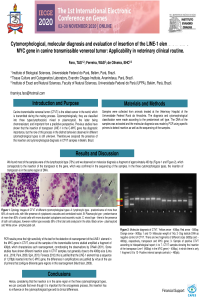
Canine transmissible venereal tumor is the oldest cancer in the world, which is transmitted during the mating process. They are classified into three types:lymphocytoid, mixed or plasmocytoid, the latter being chemoresistant, and important from a predictive perspective. Previous studies have shown that the insertion of transposon LINE-1 in the C-MYC gene has diagnostic importance, but the role of this process in the distinct behaviors observed in different cytomorphological types is still unknown. Therefore,we analyzed this insertion and cytomorphological diagnosis in CTVT samples in Belém, Brazil. Samples were collected from animals treated at the Veterinary Hospital of the Universidade Federal Rural da Amazônia. The diagnosis and cytomorphological classification were made according to the predominant cell type. The DNA of the samples was extracted and the molecular diagnosis was made by PCR using specific primers to detect insertion as well as the sequencing of the samples. We found most of the samples were of the lymphocytoid type (75%) and we observed on molecular diagnosis a fragment of approximately 400 bp, which corresponds to the insertion of the transposon to the gene, which was confirmed in the sequencing of the samples. In the three cytomorphological types, the insertion of transposon is in the same region of DNA. Hence, considering that the insertion is in the same region in the three cytomorphological types, we can conclude that even though it is important for the oncogenesis process, this insertion has no influence on the cytomorphological type and its clinical differences.
Keywords
CTVT
Cytomorphological diagnosis
Molecular diagnosis
Dogs.
Manuscript
sciforum-037473-Final version_Layout.pdf
Poster
Poster Thamirys iecge.pdf
NGS screening for identification of novel pexophagy-related mutant in Arabidopsis thaliana