Event submissions
Published

This submission belongs to the session S2. Polymer Bioapplications of the event The First International Conference on “Green” Polymer Materials 2020
Published date
03 Nov, 2020
Citation
Tigoianu Ionut Radu, Serpa Carlos, Prata Amilcar, Pina Joao, Mihaela Avadanei, Dorel Ursu, Mirela Fernanda Zaltariov, Applications and Properties by Using Time-resolved Fluorescence and Transient Absorption Spectroscopy, in Proceedings of The First International Conference on “Green” Polymer Materials 2020, 5 November–25 November 2020, MDPI: Basel, Switzerland, doi: 10.3390/CGPM2020-07163
Share
Email
Facebook
Twitter
LinkedIn
Applications and Properties by Using Time-resolved Fluorescence and Transient Absorption Spectroscopy
'%3e%3cpath%20d='M12.6647%2010.9104C12.4176%2010.325%2012.0589%209.7933%2011.6088%209.34485C11.16%208.89511%2010.6283%208.53653%2010.0432%208.28891C10.038%208.28629%2010.0327%208.28498%2010.0275%208.28236C10.8437%207.69282%2011.3743%206.73252%2011.3743%205.64907C11.3743%203.85423%209.92005%202.40002%208.12522%202.40002C6.33038%202.40002%204.87618%203.85423%204.87618%205.64907C4.87618%206.73252%205.40677%207.69282%206.22296%208.28367C6.21772%208.28629%206.21248%208.2876%206.20724%208.29022C5.62031%208.53783%205.09365%208.89287%204.64167%209.34616C4.19192%209.79496%203.83334%2010.3266%203.58573%2010.9117C3.34247%2011.4846%203.21128%2012.0987%203.19925%2012.721C3.1989%2012.735%203.20135%2012.7489%203.20646%2012.7619C3.21157%2012.7749%203.21924%2012.7868%203.22901%2012.7968C3.23877%2012.8068%203.25045%2012.8148%203.26334%2012.8202C3.27623%2012.8256%203.29007%2012.8284%203.30406%2012.8284H4.09012C4.14776%2012.8284%204.19362%2012.7825%204.19493%2012.7262C4.22113%2011.7148%204.62726%2010.7676%205.34519%2010.0497C6.08802%209.30686%207.07452%208.89811%208.12522%208.89811C9.17592%208.89811%2010.1624%209.30686%2010.9052%2010.0497C11.6232%2010.7676%2012.0293%2011.7148%2012.0555%2012.7262C12.0568%2012.7839%2012.1027%2012.8284%2012.1603%2012.8284H12.9464C12.9604%2012.8284%2012.9742%2012.8256%2012.9871%2012.8202C13%2012.8148%2013.0117%2012.8068%2013.0214%2012.7968C13.0312%2012.7868%2013.0389%2012.7749%2013.044%2012.7619C13.0491%2012.7489%2013.0515%2012.735%2013.0512%2012.721C13.0381%2012.0947%2012.9084%2011.4856%2012.6647%2010.9104ZM8.12522%207.90243C7.52388%207.90243%206.95792%207.66793%206.53214%207.24215C6.10636%206.81636%205.87185%206.2504%205.87185%205.64907C5.87185%205.04773%206.10636%204.48177%206.53214%204.05599C6.95792%203.63021%207.52388%203.3957%208.12522%203.3957C8.72655%203.3957%209.29252%203.63021%209.7183%204.05599C10.1441%204.48177%2010.3786%205.04773%2010.3786%205.64907C10.3786%206.2504%2010.1441%206.81636%209.7183%207.24215C9.29252%207.66793%208.72655%207.90243%208.12522%207.90243Z'%20fill='%235D1EE1'/%3e%3c/g%3e%3c/svg%3e)
Tigoianu Ionut Radu 1

Serpa Carlos 2

Prata Amilcar 2

Pina Joao 2

Mihaela Avadanei 3
Dorel Ursu 3
Mirela Fernanda Zaltariov 3
1. Petru Poni” Institute of Macromolecular Chemistry, 41A Gr. Ghica Voda Alley, 700487 Iasi, Romania
2. University of Coimbra, Department of Chemistry, 3004-535 Coimbra, Portugal
3. “Petru Poni” Institute of Macromolecular Chemistry, 41A Gr. Ghica Voda Alley, 700487, Iasi, Romania
Abstract
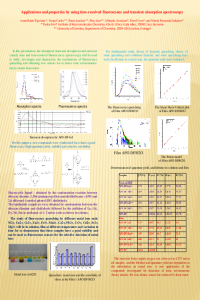
In this presentation, the absorption (transient absorption) and emission (steady state and time-resolved fluorescence) spectroscopy will be used to study, investigate and characterize the mechanisms of fluorescence quenching and obtaining new sensors for to detect toxic environments: heavy metals from water. For this purpose, new compounds were synthesized for to have a good fluorescence (high quantum yield), stability and selective sensibility. The study of fluorescence quenching by different metal ions such: Ni2+ , Cu2+ , Co2+ , Zn2+ , Fe3+ , Mn2+ , Ca2+ , Pb2+ , Cr3+ , Cd2+ , Sr2+ , Mg2+ will be study in solution, film at different temperature and variation in time for to demonstrate that these samples have a good stability and can be used as fluorescence sensors for the selective detection of metal ions. For fundamental study, theory of dynamic quenching, theory of static quenching and combined dynamic and static quenching were used, and the constants of the process, the lifetime in excited state, the quantum yield, the non-radiative and radiative rate constants were estimated. The lifetime, around 0.0001 s for each metal complexes was calculated by the analysis of the decays with and without oxygen. The emission from singlet oxygen was observed at 1275 nm in all samples, and the lifetime and quantum yield are dependent on the substitution on metal ions. Also, new application of the compounds investigated for detection of toxic environments (heavy metals- Fe) was obtain, sensor for to detect Fe from water.
Keywords
fluorescence
lifetime
heavy metals
Manuscript
sciforum_035075-Abstract Tigoianu-done.pdf
Poster
sciforum-035075 poster.pdf
Self-assembly and Electrorheological Effect of Phthalocyanine-Based Liquid Crystalline Polysiloxanes
Polymer Nanocomposites for Lowering Heating and Cooling Loads in Buildings