Event submissions
Published

This submission belongs to the session 4. Poster of the event The 1st International Electronic Conference on Nutrients
Published date
03 Nov, 2020
Citation
Carme Grau-Bové, Alba Miguéns-Gómez, Carlos González-Quilen, Marta Sierra-Cruz, Esther Rodríguez-Gallego, Raúl Beltrán-Debón, M Teresa Blay, Ximena Terra, Anna Ardévol, Montserrat Pinent, Modulation of food intake by selective TAS2R stimulation in rat, in Proceedings of The 1st International Electronic Conference on Nutrients, 2 November–15 November 2020, MDPI: Basel, Switzerland, doi: 10.3390/IECN2020-07168
Share
Email
Facebook
Twitter
LinkedIn
Modulation of food intake by selective TAS2R stimulation in rat
'%3e%3cpath%20d='M12.6647%2010.9104C12.4176%2010.325%2012.0589%209.7933%2011.6088%209.34485C11.16%208.89511%2010.6283%208.53653%2010.0432%208.28891C10.038%208.28629%2010.0327%208.28498%2010.0275%208.28236C10.8437%207.69282%2011.3743%206.73252%2011.3743%205.64907C11.3743%203.85423%209.92005%202.40002%208.12522%202.40002C6.33038%202.40002%204.87618%203.85423%204.87618%205.64907C4.87618%206.73252%205.40677%207.69282%206.22296%208.28367C6.21772%208.28629%206.21248%208.2876%206.20724%208.29022C5.62031%208.53783%205.09365%208.89287%204.64167%209.34616C4.19192%209.79496%203.83334%2010.3266%203.58573%2010.9117C3.34247%2011.4846%203.21128%2012.0987%203.19925%2012.721C3.1989%2012.735%203.20135%2012.7489%203.20646%2012.7619C3.21157%2012.7749%203.21924%2012.7868%203.22901%2012.7968C3.23877%2012.8068%203.25045%2012.8148%203.26334%2012.8202C3.27623%2012.8256%203.29007%2012.8284%203.30406%2012.8284H4.09012C4.14776%2012.8284%204.19362%2012.7825%204.19493%2012.7262C4.22113%2011.7148%204.62726%2010.7676%205.34519%2010.0497C6.08802%209.30686%207.07452%208.89811%208.12522%208.89811C9.17592%208.89811%2010.1624%209.30686%2010.9052%2010.0497C11.6232%2010.7676%2012.0293%2011.7148%2012.0555%2012.7262C12.0568%2012.7839%2012.1027%2012.8284%2012.1603%2012.8284H12.9464C12.9604%2012.8284%2012.9742%2012.8256%2012.9871%2012.8202C13%2012.8148%2013.0117%2012.8068%2013.0214%2012.7968C13.0312%2012.7868%2013.0389%2012.7749%2013.044%2012.7619C13.0491%2012.7489%2013.0515%2012.735%2013.0512%2012.721C13.0381%2012.0947%2012.9084%2011.4856%2012.6647%2010.9104ZM8.12522%207.90243C7.52388%207.90243%206.95792%207.66793%206.53214%207.24215C6.10636%206.81636%205.87185%206.2504%205.87185%205.64907C5.87185%205.04773%206.10636%204.48177%206.53214%204.05599C6.95792%203.63021%207.52388%203.3957%208.12522%203.3957C8.72655%203.3957%209.29252%203.63021%209.7183%204.05599C10.1441%204.48177%2010.3786%205.04773%2010.3786%205.64907C10.3786%206.2504%2010.1441%206.81636%209.7183%207.24215C9.29252%207.66793%208.72655%207.90243%208.12522%207.90243Z'%20fill='%235D1EE1'/%3e%3c/g%3e%3c/svg%3e)
Carme Grau-Bové 1
Alba Miguéns-Gómez 1
Carlos González-Quilen 1
Marta Sierra-Cruz 1
Esther Rodríguez-Gallego 1

Raúl Beltrán-Debón 1

M Teresa Blay 1
Ximena Terra 1

Anna Ardévol 1

Montserrat Pinent 1
1. MoBioFood Research Group. Department of Biochemistry and Biotechnology, Universitat Rovira i Virgili, Tarragona (Spain)
Abstract
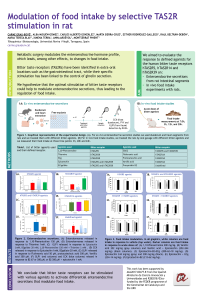
Metabolic surgery modulates the enteroendrocrine hormone profile, which leads, among other effects, to changes in food intake. Bitter taste receptors (TAS2Rs) have been identified in extra-oral locations such as the gastrointestinal tract, while their specific stimulation has been linked to the control of ghrelin secretion. We hypothesize that the optimal stimulation of bitter taste receptors could help to modulate enteroendocrine secretions, thus leading to the regulation of food intake. We assayed the response to defined agonists for the human bitter taste receptors hTAS2R5, hTAS2R14 and hTAS2R39 on enteroendocrine secretions from rat intestinal segments and in vivo food intake experiemtns with rats. hTAS2R5 agonists stimulate the secretion of GLP1 and CCK and reduce food intake. While hTAS2R14 agonists induce GLP1, hTASR39 agonists tend to increase PYY but both fail to reduce food intake. The effect of simultaneously activating hTAS2R5 and hTAS2R39 is heterogeneous and depends on the relative affinity of the agonists for each receptor. Therefore, depending of the relative amount of hTAS2R5 and hTAS2R39 agonists and their affinity to each receptor, both activation or inhibition of food intake can be achieved. We conclude that bitter taste receptors can be stimulated with various agonists to activate differential enteroendocrine secretions that modulate food intake. This research was funded by the Spanish Government grant number AGL2017-83477-Rand R2B2018/03co-funded by the FEDER programme of the Generalitat de Catalunya and the URV.
Keywords
TAS2R5
TAS2R39
TAS2R14
agonist
food intake
GLP1
CCK
PYY
Manuscript
poster_CGrau-Bove.pdf
Poster
poster_CGrau-Bove.pdf
Thermally processed diet-induced albuminuria, Enterobacteriaceae expansion and cecal metabolome alterations are attenuated by resistant starch in diabetes
Intake of 3 Eggs/Day or Equivalent Amount of Choline as Supplement for 4 Weeks Increases Plasma Choline Without Changing Plasma TMAO or Microbiota diversity in Participants with Metabolic Syndrome