Event submissions
Published

This submission belongs to the session 4. Poster of the event The 1st International Electronic Conference on Nutrients
Published date
03 Nov, 2020
Citation
Kokila Vani Perumal, Kasturi Kanniappan, Hasnah Bahari, Khairul Kamilah Abdul Kadir, Zunoliza Abdullah, Mohd Radzi Ahmad, NorShafarina Shari, Ibrahim Kalle Kwaifa, Azrina Zainal Abidin, Sabariah Md Noor, Yong Yoke Keong, Santhra Segaran Balan, POTENTIAL EFFECTS ON A COMBINATION OF ZINGER OFFICINALE, ALLIUM SATIVUM, CITRUS LEMON, HONEY, AND MALUS DOMESTICA VINEGAR (ZACA) EXTRACT IN RATS FED WITH HIGH CHOLESTEROL DIET, in Proceedings of The 1st International Electronic Conference on Nutrients, 2 November–15 November 2020, MDPI: Basel, Switzerland, doi: 10.3390/IECN2020-07171
Share
Email
Facebook
Twitter
LinkedIn
POTENTIAL EFFECTS ON A COMBINATION OF ZINGER OFFICINALE, ALLIUM SATIVUM, CITRUS LEMON, HONEY, AND MALUS DOMESTICA VINEGAR (ZACA) EXTRACT IN RATS FED WITH HIGH CHOLESTEROL DIET
'%3e%3cpath%20d='M12.6647%2010.9104C12.4176%2010.325%2012.0589%209.7933%2011.6088%209.34485C11.16%208.89511%2010.6283%208.53653%2010.0432%208.28891C10.038%208.28629%2010.0327%208.28498%2010.0275%208.28236C10.8437%207.69282%2011.3743%206.73252%2011.3743%205.64907C11.3743%203.85423%209.92005%202.40002%208.12522%202.40002C6.33038%202.40002%204.87618%203.85423%204.87618%205.64907C4.87618%206.73252%205.40677%207.69282%206.22296%208.28367C6.21772%208.28629%206.21248%208.2876%206.20724%208.29022C5.62031%208.53783%205.09365%208.89287%204.64167%209.34616C4.19192%209.79496%203.83334%2010.3266%203.58573%2010.9117C3.34247%2011.4846%203.21128%2012.0987%203.19925%2012.721C3.1989%2012.735%203.20135%2012.7489%203.20646%2012.7619C3.21157%2012.7749%203.21924%2012.7868%203.22901%2012.7968C3.23877%2012.8068%203.25045%2012.8148%203.26334%2012.8202C3.27623%2012.8256%203.29007%2012.8284%203.30406%2012.8284H4.09012C4.14776%2012.8284%204.19362%2012.7825%204.19493%2012.7262C4.22113%2011.7148%204.62726%2010.7676%205.34519%2010.0497C6.08802%209.30686%207.07452%208.89811%208.12522%208.89811C9.17592%208.89811%2010.1624%209.30686%2010.9052%2010.0497C11.6232%2010.7676%2012.0293%2011.7148%2012.0555%2012.7262C12.0568%2012.7839%2012.1027%2012.8284%2012.1603%2012.8284H12.9464C12.9604%2012.8284%2012.9742%2012.8256%2012.9871%2012.8202C13%2012.8148%2013.0117%2012.8068%2013.0214%2012.7968C13.0312%2012.7868%2013.0389%2012.7749%2013.044%2012.7619C13.0491%2012.7489%2013.0515%2012.735%2013.0512%2012.721C13.0381%2012.0947%2012.9084%2011.4856%2012.6647%2010.9104ZM8.12522%207.90243C7.52388%207.90243%206.95792%207.66793%206.53214%207.24215C6.10636%206.81636%205.87185%206.2504%205.87185%205.64907C5.87185%205.04773%206.10636%204.48177%206.53214%204.05599C6.95792%203.63021%207.52388%203.3957%208.12522%203.3957C8.72655%203.3957%209.29252%203.63021%209.7183%204.05599C10.1441%204.48177%2010.3786%205.04773%2010.3786%205.64907C10.3786%206.2504%2010.1441%206.81636%209.7183%207.24215C9.29252%207.66793%208.72655%207.90243%208.12522%207.90243Z'%20fill='%235D1EE1'/%3e%3c/g%3e%3c/svg%3e)
Kokila Vani Perumal 1
Kasturi Kanniappan 2
Hasnah Bahari 1
Khairul Kamilah Abdul Kadir 3
Zunoliza Abdullah 4
Mohd Radzi Ahmad 5
NorShafarina Shari 2

Ibrahim Kalle Kwaifa 6
Azrina Zainal Abidin 1,2
Sabariah Md Noor 6

Yong Yoke Keong 1
Santhra Segaran Balan 1,2
1. Department Human Anatomy, Faculty Medicine and Health Sciences, Universiti Putra Malaysia, 43400 Serdang, Selangor, Malaysia.
2. Department of Diagnostic and Allied Health Sciences, Faculty of Health and Life Sciences, 40100 Shah Alam, Selangor, Malaysia.
3. Cawangan Inkubasi Teknologi, Bahagian Inovasi dan Komersialisasi, Institut Penyelidikan Perhutanan Malaysia (FRIM), 52109 Kepong, Selangor.
4. Natural Products Division, FRIM, 52109 Kepong, Selangor
5. Products Division, FRIM, 52109 Kepong, Selangor
6. Department of Pathology, Faculty of Medicine and Health Sciences, Universiti Putra Malaysia (UPM), Selangor 43400, Malaysia
Abstract
ABSTRACT:
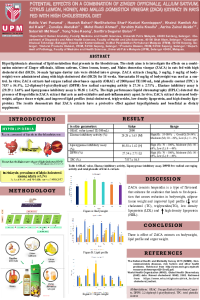
Introduction: Hyperlipidemia is abnormal of lipid metabolism that presents in the bloodstream. The study aims is to investigate the effects on a combination mixture of Zinger officinale, Allium sativum, Citrus lemon, honey, and Malus domestica vinegar (ZACA) in rats fed with high cholesterol diet (HCD). Method: 36 male Sprague dawley rats were divided into 6 groups. ZACA extracts (1mg/kg, 3 mg/kg, 5 mg/kg of bodyweight) were administered along with high cholesterol diet (HCD) for 18 weeks. Simvastatin 10 mg/kg of bodyweight was used as a control. Results: In vitro; ZACA extracts had oxygen radical absorbance capacity (ORAC) of 2000 µmol TE/100 mL, total phenolic content (TPC) is 7537 ± 54.5%, 2,2-diphenyl-1-picrylhydrazyl (DPPH) free radical scavenging activity is 27.34 ± 2.71% , Elastase inhibitory assay is (29.29 ± 1.65% and lipoxygenase inhibitory assay is 98.58 ± 1.42%. The high performance liquid chromatography (HPLC) detected the presence of Hesperidin in ZACA extract that acts as anti-oxidative and anti-inflammatory agent. In vivo; ZACA extract decreased bodyweight, adipose tissue weight, and improved lipid profiles (total cholesterol, triglycerides, low density lipoprotein, and high density lipoprotein). Conclusion: The results demonstrate that ZACA extracts have a protective effect against hyperlipidemia and beneficial as dietary supplement.
Keywords
ZACA extracts
Hyperlipidemia activity
High cholesterol diet
Manuscript
Poster_sciforum 036866.pdf
Poster
Poster_sciforum 036866.pdf
Mikania micrantha Extract Ameliorates Hypercholesterolemia by Inhibiting HMG-CoA Reductase and Acetyl-CoA Acetyltransferase 2 in High Cholesterol-Fed Rats
Lipid and Blood Pressure Lowering Potential of Mikania micrantha Through Enzymatic Inhibition