Event submissions
Published

This submission belongs to the session 4. Poster of the event The 1st International Electronic Conference on Nutrients
Published date
03 Nov, 2020
Citation
Amirah Haziyah Ishak, Nurul Husna Shafie, Norhaizan Mohd Esa, Hasnah Bahari, Lipid and Blood Pressure Lowering Potential of Mikania micrantha Through Enzymatic Inhibition, in Proceedings of The 1st International Electronic Conference on Nutrients, 2 November–15 November 2020, MDPI: Basel, Switzerland, doi: 10.3390/IECN2020-07172
Share
Email
Facebook
Twitter
LinkedIn
Lipid and Blood Pressure Lowering Potential of Mikania micrantha Through Enzymatic Inhibition
'%3e%3cpath%20d='M12.6647%2010.9104C12.4176%2010.325%2012.0589%209.7933%2011.6088%209.34485C11.16%208.89511%2010.6283%208.53653%2010.0432%208.28891C10.038%208.28629%2010.0327%208.28498%2010.0275%208.28236C10.8437%207.69282%2011.3743%206.73252%2011.3743%205.64907C11.3743%203.85423%209.92005%202.40002%208.12522%202.40002C6.33038%202.40002%204.87618%203.85423%204.87618%205.64907C4.87618%206.73252%205.40677%207.69282%206.22296%208.28367C6.21772%208.28629%206.21248%208.2876%206.20724%208.29022C5.62031%208.53783%205.09365%208.89287%204.64167%209.34616C4.19192%209.79496%203.83334%2010.3266%203.58573%2010.9117C3.34247%2011.4846%203.21128%2012.0987%203.19925%2012.721C3.1989%2012.735%203.20135%2012.7489%203.20646%2012.7619C3.21157%2012.7749%203.21924%2012.7868%203.22901%2012.7968C3.23877%2012.8068%203.25045%2012.8148%203.26334%2012.8202C3.27623%2012.8256%203.29007%2012.8284%203.30406%2012.8284H4.09012C4.14776%2012.8284%204.19362%2012.7825%204.19493%2012.7262C4.22113%2011.7148%204.62726%2010.7676%205.34519%2010.0497C6.08802%209.30686%207.07452%208.89811%208.12522%208.89811C9.17592%208.89811%2010.1624%209.30686%2010.9052%2010.0497C11.6232%2010.7676%2012.0293%2011.7148%2012.0555%2012.7262C12.0568%2012.7839%2012.1027%2012.8284%2012.1603%2012.8284H12.9464C12.9604%2012.8284%2012.9742%2012.8256%2012.9871%2012.8202C13%2012.8148%2013.0117%2012.8068%2013.0214%2012.7968C13.0312%2012.7868%2013.0389%2012.7749%2013.044%2012.7619C13.0491%2012.7489%2013.0515%2012.735%2013.0512%2012.721C13.0381%2012.0947%2012.9084%2011.4856%2012.6647%2010.9104ZM8.12522%207.90243C7.52388%207.90243%206.95792%207.66793%206.53214%207.24215C6.10636%206.81636%205.87185%206.2504%205.87185%205.64907C5.87185%205.04773%206.10636%204.48177%206.53214%204.05599C6.95792%203.63021%207.52388%203.3957%208.12522%203.3957C8.72655%203.3957%209.29252%203.63021%209.7183%204.05599C10.1441%204.48177%2010.3786%205.04773%2010.3786%205.64907C10.3786%206.2504%2010.1441%206.81636%209.7183%207.24215C9.29252%207.66793%208.72655%207.90243%208.12522%207.90243Z'%20fill='%235D1EE1'/%3e%3c/g%3e%3c/svg%3e)
Amirah Haziyah Ishak 1
Nurul Husna Shafie 2

Norhaizan Mohd Esa 1
Hasnah Bahari 3
1. Department of Nutrition and Dietetics, Faculty of Medicine and Health Sciences, Universiti Putra Malaysia, 43400 Serdang, Selangor, Malaysia
2. 1) Department of Nutrition and Dietetics, Faculty of Medicine and Health Sciences, Universiti Putra Malaysia, 43400 Serdang, Selangor, Malaysia
2) Laboratory of UPM-MAKNA Cancer Research, Institute of Bioscience, Universiti Putra Malaysia, 43400 Serdang,
3. Department of Human Anatomy, Faculty of Medicine and Health Sciences, Universiti Putra Malaysia, 43400 Serdang, Selangor, Malaysia
Abstract
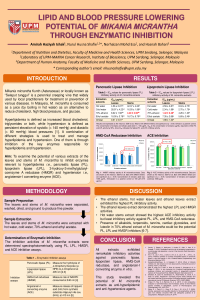
Mikania micrantha Kunth (Asteraceae) is a plant that traditionally used to reduce the risk of hyperlipidemia and hypertension. This study was aimed to examine the in vitro potential of different parts of M. micrantha (leaves and stems) extracts to inhibit enzymes relevant to hyperlipidemia i.e., pancreatic lipase (PL), lipoprotein lipase (LPL) and 3-hydroxy-3-methylglutaryl-coenzyme A reductase (HMGR), and also hypertension i.e., angiotensin-I converting enzyme (ACE). The inhibitory activities of hot water, cold water, 70% ethanol and ethyl acetate extracts of the leaves and stems of M. micrantha against the enzymes were determined spectrophotometrically using PL, LPL, HMGR, and ACE inhibition assays. The ethanol stems (ETS) extract exhibited the highest PL inhibitory activity (IC50=4.49±2.50 μg/mL) and showed no significant (p > 0.05) difference with orlistat (IC50=0.31±0.01 μg/mL). The ethanol leaves (ETL) extract showed the highest LPL (IC50=1.42±0.48 μg/mL) and HMGR inhibitory activities (50.12±3.44%). Hot water stems (HWS) showed the greatest ACE inhibition (97.47±1.19%), but not significant (p > 0.05) when compared to other extracts and captopril (98.42±0.93%). Overall, all extracts exhibited remarkable inhibitory activity against PL, LPL, HMGR, and ACE. This study demonstrated the potential of M. micrantha extracts as anti-hyperlipidemic and anti-hypertensive agents.
Keywords
Mikania micrantha
pancreatic lipase
HMG-CoA reductase
angiotensin converting enzyme
lipase inhibition
hypertension
Manuscript
Poster IECN 2020.pdf
Poster
sciforum-036819 Poster IECN 2020.pdf
POTENTIAL EFFECTS ON A COMBINATION OF ZINGER OFFICINALE, ALLIUM SATIVUM, CITRUS LEMON, HONEY, AND MALUS DOMESTICA VINEGAR (ZACA) EXTRACT IN RATS FED WITH HIGH CHOLESTEROL DIET
Duodenal infusion of Anaerobutyricum soehngenii ameliorates glycemic control and postprandial GLP-1 responses and alters the transcriptional profile of small intestine in subjects with metabolic syndrome.