Event submissions
Published

This submission belongs to the session 4. Poster of the event The 1st International Electronic Conference on Nutrients
Published date
03 Nov, 2020
Citation
Julia J. Witjes, Annefleur Koopen, Koen Wortelboer, Soumia Majait, Andrei Prodan, Evgeni Levin, Hilde Herrema, Maaike Winkelmeijer, Steven Aalvink, Jacques J.G.H.M. Bergman, Stefan R. Havik, Bolette Hartmann, Johannes H.M. Levels, Per-Olof Bergh, Manon Balvers, Diogo N. Mendes Bastos, Erik S.G. Stroes, Albert K. Groen, Marcus Henricsson, Marleen Kemper, Jens J. Holst, Fredrik Bäckhed, Willem M. de Vos, Max Nieuwdorp, Elena Rampanelli, Duodenal infusion of Anaerobutyricum soehngenii ameliorates glycemic control and postprandial GLP-1 responses and alters the transcriptional profile of small intestine in subjects with metabolic syndrome. , in Proceedings of The 1st International Electronic Conference on Nutrients, 2 November–15 November 2020, MDPI: Basel, Switzerland, doi: 10.3390/IECN2020-07173
Share
Email
Facebook
Twitter
LinkedIn
Duodenal infusion of Anaerobutyricum soehngenii ameliorates glycemic control and postprandial GLP-1 responses and alters the transcriptional profile of small intestine in subjects with metabolic syndrome.
'%3e%3cpath%20d='M12.6647%2010.9104C12.4176%2010.325%2012.0589%209.7933%2011.6088%209.34485C11.16%208.89511%2010.6283%208.53653%2010.0432%208.28891C10.038%208.28629%2010.0327%208.28498%2010.0275%208.28236C10.8437%207.69282%2011.3743%206.73252%2011.3743%205.64907C11.3743%203.85423%209.92005%202.40002%208.12522%202.40002C6.33038%202.40002%204.87618%203.85423%204.87618%205.64907C4.87618%206.73252%205.40677%207.69282%206.22296%208.28367C6.21772%208.28629%206.21248%208.2876%206.20724%208.29022C5.62031%208.53783%205.09365%208.89287%204.64167%209.34616C4.19192%209.79496%203.83334%2010.3266%203.58573%2010.9117C3.34247%2011.4846%203.21128%2012.0987%203.19925%2012.721C3.1989%2012.735%203.20135%2012.7489%203.20646%2012.7619C3.21157%2012.7749%203.21924%2012.7868%203.22901%2012.7968C3.23877%2012.8068%203.25045%2012.8148%203.26334%2012.8202C3.27623%2012.8256%203.29007%2012.8284%203.30406%2012.8284H4.09012C4.14776%2012.8284%204.19362%2012.7825%204.19493%2012.7262C4.22113%2011.7148%204.62726%2010.7676%205.34519%2010.0497C6.08802%209.30686%207.07452%208.89811%208.12522%208.89811C9.17592%208.89811%2010.1624%209.30686%2010.9052%2010.0497C11.6232%2010.7676%2012.0293%2011.7148%2012.0555%2012.7262C12.0568%2012.7839%2012.1027%2012.8284%2012.1603%2012.8284H12.9464C12.9604%2012.8284%2012.9742%2012.8256%2012.9871%2012.8202C13%2012.8148%2013.0117%2012.8068%2013.0214%2012.7968C13.0312%2012.7868%2013.0389%2012.7749%2013.044%2012.7619C13.0491%2012.7489%2013.0515%2012.735%2013.0512%2012.721C13.0381%2012.0947%2012.9084%2011.4856%2012.6647%2010.9104ZM8.12522%207.90243C7.52388%207.90243%206.95792%207.66793%206.53214%207.24215C6.10636%206.81636%205.87185%206.2504%205.87185%205.64907C5.87185%205.04773%206.10636%204.48177%206.53214%204.05599C6.95792%203.63021%207.52388%203.3957%208.12522%203.3957C8.72655%203.3957%209.29252%203.63021%209.7183%204.05599C10.1441%204.48177%2010.3786%205.04773%2010.3786%205.64907C10.3786%206.2504%2010.1441%206.81636%209.7183%207.24215C9.29252%207.66793%208.72655%207.90243%208.12522%207.90243Z'%20fill='%235D1EE1'/%3e%3c/g%3e%3c/svg%3e)
Julia J. Witjes 1
Annefleur Koopen 1
Koen Wortelboer 2
Soumia Majait 3
Andrei Prodan 2
Evgeni Levin 2
Hilde Herrema 4
Maaike Winkelmeijer 4
Steven Aalvink 5
Jacques J.G.H.M. Bergman 6
Stefan R. Havik 4
Bolette Hartmann 7
Johannes H.M. Levels 4
Per-Olof Bergh 8
Manon Balvers 4
Diogo N. Mendes Bastos 2
Erik S.G. Stroes 2
Albert K. Groen 2,4
Marcus Henricsson 8
Marleen Kemper 3

Jens J. Holst 7
Fredrik Bäckhed 8,9,10
Willem M. de Vos 5,11
Max Nieuwdorp 2,4

Elena Rampanelli 12
1. AUMC
2. Department of Vascular Medicine, Amsterdam University Medical Center, University of Amsterdam, The Netherlands
3. Department of Clinical Pharmacy, Amsterdam University Medical Center, University of Amsterdam, The Netherlands
4. Department of Experimental Vascular Medicine, Amsterdam University Medical Center, University of Amsterdam, The Netherlands
5. Laboratory of Microbiology, Wageningen University & Research, The Netherlands
6. Department of Gastroenterology, Amsterdam University Medical Center, University of Amsterdam, The Netherlands
7. Novo Nordisk Foundation Center for Basic Metabolic Research, Department of Biomedical Sciences, University of Copenhagen, Denmark
8. Wallenberg Laboratory for Cardiovascular and Metabolic Research, University of Gothenburg, Sweden
9. Region Västra Götaland, Sahlgrenska University Hospital, Department of Clinical Physiology, Gothenburg, Sweden
10. Novo Nordisk Foundation Center for Basic Metabolic Research, Faculty of Health and Medical Sciences, University of Copenhagen, Denmark
11. Human Microbiome Research Program, Faculty of Medicine, University of Helsinki, Finland
12. Amsterdam UMC
Abstract
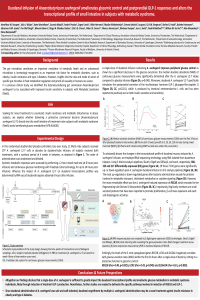
The gut microbiota constitutes an important modulator of metabolic heath and an unbalanced microbiota is increasingly recognized as an important risk factor for metabolic disorders, such as obesity, insulin resistance and type 2 diabetes. Seeking for novel treatments to counteract insulin resistance and metabolic disturbances in obese subjects, we explore whether delivering a protective commensal bacteria (Anaerobutyricum soehngenii L2-7) directly into the small intestine of treatment-naïve subjects with metabolic syndrome would ameliorate glucose metabolism (NTR NL6630).
We previously identified this butyrate-producing intestinal commensal to be associated with improved insulin sensitivity in metabolic syndrome subjects. Herein, we found that a single-dose of duodenal infusion containing A. soehngenii improved peripheral glucose control and stimulated the secretion of the hormone GLP-1, which is reported to positively act on both insulin secretion and sensitivity.
Moreover, by RNA-seq, we found that A. soehngenii-treatment triggered a prominent alteration of the duodenal transcriptome with 73 genes being differentially expressed. Among these, the expression of regenerating islet-protein 1B-encoding gene (REG1B) was the most significantly unregulated by A. soehngenii administration. Strikingly, duodenal REG1B expression negatively correlated with peripheral glucose variability, which was significantly diminished by A. soehngeniiduodenal infusion.
Altogether our findings disclose that a single-dose of A. soehngenii is sufficient to greatly impact the duodenal transcriptional profile and ameliorate glucose metabolism in metabolic syndrome individuals, likely through induction of intestinal GLP-1 production. Nonetheless, further studies are needed to delineate the specific pathways involved in induction of REG1B and GLP-1.
Notably, duodenal administration of A. soehngenii was also safe and well-tolerated.
Keywords
Anaerobutyricum soehngenii
metabolic syndrome
insulin sensitivity
insulin resistance
GLP-1
Reg1B
small intestine
Manuscript
poster Nutrients 2020 ER.pdf
Poster
poster Nutrients 2020 ER.pdf
Lipid and Blood Pressure Lowering Potential of Mikania micrantha Through Enzymatic Inhibition