Event submissions
Published

This submission belongs to the session S1. Polymer Synthesis, Modification and Self-Assembly of the event The First International Conference on “Green” Polymer Materials 2020
Published date
03 Nov, 2020
Citation
Sigita Grauželienė, Deimantė Valaitytė, Jolita Ostrauskaitė, Angels Serra, Fully Bio-Based Polymers Derived from Acrylated Epoxidized Soybean Oil by Thiol-ene Reaction, in Proceedings of The First International Conference on “Green” Polymer Materials 2020, 5 November–25 November 2020, MDPI: Basel, Switzerland, doi: 10.3390/CGPM2020-07177
Share
Email
Facebook
Twitter
LinkedIn
Fully Bio-Based Polymers Derived from Acrylated Epoxidized Soybean Oil by Thiol-ene Reaction
'%3e%3cpath%20d='M12.6647%2010.9104C12.4176%2010.325%2012.0589%209.7933%2011.6088%209.34485C11.16%208.89511%2010.6283%208.53653%2010.0432%208.28891C10.038%208.28629%2010.0327%208.28498%2010.0275%208.28236C10.8437%207.69282%2011.3743%206.73252%2011.3743%205.64907C11.3743%203.85423%209.92005%202.40002%208.12522%202.40002C6.33038%202.40002%204.87618%203.85423%204.87618%205.64907C4.87618%206.73252%205.40677%207.69282%206.22296%208.28367C6.21772%208.28629%206.21248%208.2876%206.20724%208.29022C5.62031%208.53783%205.09365%208.89287%204.64167%209.34616C4.19192%209.79496%203.83334%2010.3266%203.58573%2010.9117C3.34247%2011.4846%203.21128%2012.0987%203.19925%2012.721C3.1989%2012.735%203.20135%2012.7489%203.20646%2012.7619C3.21157%2012.7749%203.21924%2012.7868%203.22901%2012.7968C3.23877%2012.8068%203.25045%2012.8148%203.26334%2012.8202C3.27623%2012.8256%203.29007%2012.8284%203.30406%2012.8284H4.09012C4.14776%2012.8284%204.19362%2012.7825%204.19493%2012.7262C4.22113%2011.7148%204.62726%2010.7676%205.34519%2010.0497C6.08802%209.30686%207.07452%208.89811%208.12522%208.89811C9.17592%208.89811%2010.1624%209.30686%2010.9052%2010.0497C11.6232%2010.7676%2012.0293%2011.7148%2012.0555%2012.7262C12.0568%2012.7839%2012.1027%2012.8284%2012.1603%2012.8284H12.9464C12.9604%2012.8284%2012.9742%2012.8256%2012.9871%2012.8202C13%2012.8148%2013.0117%2012.8068%2013.0214%2012.7968C13.0312%2012.7868%2013.0389%2012.7749%2013.044%2012.7619C13.0491%2012.7489%2013.0515%2012.735%2013.0512%2012.721C13.0381%2012.0947%2012.9084%2011.4856%2012.6647%2010.9104ZM8.12522%207.90243C7.52388%207.90243%206.95792%207.66793%206.53214%207.24215C6.10636%206.81636%205.87185%206.2504%205.87185%205.64907C5.87185%205.04773%206.10636%204.48177%206.53214%204.05599C6.95792%203.63021%207.52388%203.3957%208.12522%203.3957C8.72655%203.3957%209.29252%203.63021%209.7183%204.05599C10.1441%204.48177%2010.3786%205.04773%2010.3786%205.64907C10.3786%206.2504%2010.1441%206.81636%209.7183%207.24215C9.29252%207.66793%208.72655%207.90243%208.12522%207.90243Z'%20fill='%235D1EE1'/%3e%3c/g%3e%3c/svg%3e)
Sigita Grauželienė 1
Deimantė Valaitytė 1
Jolita Ostrauskaitė 1

Angels Serra 2
1. Department of Polymer Chemistry and Technology, Kaunas University of Technology
2. Department of Analytical and Organic Chemistry, Universitat Rovira i Virgili
Abstract
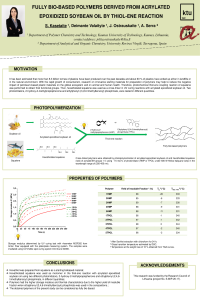
Researchers estimate that more than 8.3 billion tonnes of plastic has been produced over the past decades and about 60 % of plastic has ended up in either a landfill or the natural environment. With the rapid growth of consumerism, research on innovative starting materials for preparation of polymers may help to reduce the negative impact of petroleum-based plastic materials on the global ecosystem and on animal and human health. Therefore, photochemical thiol-ene coupling reaction of squalene was performed to obtain thiol functional groups. Then, hexathiolated squalene was used as cross-linker in UV curing reactions with acrylated epoxidized soybean oil. Two photoinitiators (2-hydroxy-2-methylpropiophenone and ethylphenyl (2,4,6-trimethylbenzoyl) phosphinate) in different quantities were tested. Rheological properties of compositions were monitored by real time photorheometry. The obtained polymers were characterized by differential scanning calorimetry and thermogravimetry. Polymers had higher rheological and thermal properties due to highest cross-linking density when ethylphenyl (2,4,6-trimethylbenzoyl) phosphinate was used in the compositions.
Acknowledgements. This research was funded by the Research Council of Lithuania (project No. S-MIP-20-17).
Keywords
thiol-ene
soybean oil
biobased polymer
Manuscript
S. Kasetaite.pdf
Poster
sciforum-037301 poster.pdf
Bio-Polymers in the World of Plasma: Effects of Cold Plasma on Seed Surface
Biodegradable Coating on Packaging Paper Made from Fibres of Invasive Plant Spieces Fallopia japonica