Event submissions
Published

This submission belongs to the session S4. Biopolymers: Design, Fabrication, Characterization and Applications of the event The First International Conference on “Green” Polymer Materials 2020
Published date
04 Nov, 2020
Citation
Migle Lebedevaite, Jolita Ostrauskaite, Photocross-Linked Bio-Based Polymers for Potential Application in Optical 3D Printing, in Proceedings of The First International Conference on “Green” Polymer Materials 2020, 5 November–25 November 2020, MDPI: Basel, Switzerland, doi: 10.3390/CGPM2020-07192
Share
Email
Facebook
Twitter
LinkedIn
Photocross-Linked Bio-Based Polymers for Potential Application in Optical 3D Printing
'%3e%3cpath%20d='M12.6647%2010.9104C12.4176%2010.325%2012.0589%209.7933%2011.6088%209.34485C11.16%208.89511%2010.6283%208.53653%2010.0432%208.28891C10.038%208.28629%2010.0327%208.28498%2010.0275%208.28236C10.8437%207.69282%2011.3743%206.73252%2011.3743%205.64907C11.3743%203.85423%209.92005%202.40002%208.12522%202.40002C6.33038%202.40002%204.87618%203.85423%204.87618%205.64907C4.87618%206.73252%205.40677%207.69282%206.22296%208.28367C6.21772%208.28629%206.21248%208.2876%206.20724%208.29022C5.62031%208.53783%205.09365%208.89287%204.64167%209.34616C4.19192%209.79496%203.83334%2010.3266%203.58573%2010.9117C3.34247%2011.4846%203.21128%2012.0987%203.19925%2012.721C3.1989%2012.735%203.20135%2012.7489%203.20646%2012.7619C3.21157%2012.7749%203.21924%2012.7868%203.22901%2012.7968C3.23877%2012.8068%203.25045%2012.8148%203.26334%2012.8202C3.27623%2012.8256%203.29007%2012.8284%203.30406%2012.8284H4.09012C4.14776%2012.8284%204.19362%2012.7825%204.19493%2012.7262C4.22113%2011.7148%204.62726%2010.7676%205.34519%2010.0497C6.08802%209.30686%207.07452%208.89811%208.12522%208.89811C9.17592%208.89811%2010.1624%209.30686%2010.9052%2010.0497C11.6232%2010.7676%2012.0293%2011.7148%2012.0555%2012.7262C12.0568%2012.7839%2012.1027%2012.8284%2012.1603%2012.8284H12.9464C12.9604%2012.8284%2012.9742%2012.8256%2012.9871%2012.8202C13%2012.8148%2013.0117%2012.8068%2013.0214%2012.7968C13.0312%2012.7868%2013.0389%2012.7749%2013.044%2012.7619C13.0491%2012.7489%2013.0515%2012.735%2013.0512%2012.721C13.0381%2012.0947%2012.9084%2011.4856%2012.6647%2010.9104ZM8.12522%207.90243C7.52388%207.90243%206.95792%207.66793%206.53214%207.24215C6.10636%206.81636%205.87185%206.2504%205.87185%205.64907C5.87185%205.04773%206.10636%204.48177%206.53214%204.05599C6.95792%203.63021%207.52388%203.3957%208.12522%203.3957C8.72655%203.3957%209.29252%203.63021%209.7183%204.05599C10.1441%204.48177%2010.3786%205.04773%2010.3786%205.64907C10.3786%206.2504%2010.1441%206.81636%209.7183%207.24215C9.29252%207.66793%208.72655%207.90243%208.12522%207.90243Z'%20fill='%235D1EE1'/%3e%3c/g%3e%3c/svg%3e)
Migle Lebedevaite 1
Jolita Ostrauskaite 2
1. PhD student
2. Professor
Abstract
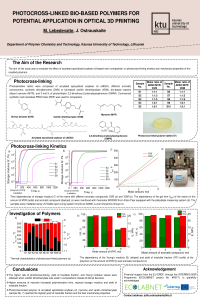
In recent years, stereolitography (SLA) or optical 3D printing, one of additive manufacturing technologies, attained a lot of interest due to the high printing accuracy and speed, simple and low raw material usage technology [1,2]. However, most resins for optical 3D printing are composed of petroleum-derived materials. Plant-based photocross-linkable materials are one of the most promising materials for polymer synthesis, which could replace petroleum-derived monomers [3].
In this study, the commercially available acrylated epoxidized soybean oil (AESO), divinylbenzene (DVB) and plant-derived reactive diluent myrcene (MYR) were photopolymerized in various ratios, and plant-derived vanillin dimethacrylate (VDM) was used as a replacement of DVB.
It was determined that photopolymerization rate and properties of the cross-linked polymers depended on the resin composition. It was observed that MYR significantly reduced not only the viscosity of the resin but also the rate of photocross linking, and impaired mechanical properties of polymers. The replacement of petroleum-derived aromatic component DVB by plant-derived VDM led to the higher rate of photocross linking, better mechanical, and thermal properties of polymers. The resin composed of only plant-derived monomers, AESO, MYR, and VDM, molar ratio 1:1:3, showed characteristics comparable to those of commercial petroleum-derived photoresins and was selected as a potential renewable photoresin for application in optical 3D printing.
Acknowledgements
Financial support from the EU ERDF, through the INTERREG BSR Programme (ECOLABNET project No. #R077), is gratefully acknowledged
References
- P Juskova, A Ollitrault, M Serra, J Viovy, L Malaquin, Chim.Acta. 1000 239-247 (2018).
- M Lebedevaite, J Ostrauskaite, E Skliutas, M Malinauskas, Polymers, 11 116 (2019)
- Lebedevaite, M., Ostrauskaite, J., Skliutas, E., & Malinauskas, M., Journal of Applied Polymer Science, 137(20) 48708 (2020)
Keywords
acrylated epoxidized soybean oil (AESO)
biopolymer
photocross-linking
Manuscript
sciforum_037187-done.pdf
Poster
sciforum-037187 poster.pdf
Recycling of Waste Rubber by the Manufacturing of Foamed Polyurethane-Based Composites—Current State and Perspectives
Green Optimization of Glutaraldehyde Vapor-Based Crosslinking on Poly(Vinyl Alcohol)/Cellulose Acetate Electrospun Mats for Applications as Chronic Wound Dressings