Event submissions
Published

This submission belongs to the session S1. Polymer Synthesis, Modification and Self-Assembly of the event The First International Conference on “Green” Polymer Materials 2020
Published date
04 Nov, 2020
Citation
Alexandra Zamboulis, Eleftheria Xanthopoulou, Lazaros Papadopoulos, Zoi Terzopoulou, Dimitrios N. Bikiaris, George Z. Papageorgiou, Synthesis and Properties of Poly(alkylene vanillate) Polyesters, A New Class of Bio-Based Polymers, in Proceedings of The First International Conference on “Green” Polymer Materials 2020, 5 November–25 November 2020, MDPI: Basel, Switzerland, doi: 10.3390/CGPM2020-07204
Share
Email
Facebook
Twitter
LinkedIn
Synthesis and Properties of Poly(alkylene vanillate) Polyesters, A New Class of Bio-Based Polymers
'%3e%3cpath%20d='M12.6647%2010.9104C12.4176%2010.325%2012.0589%209.7933%2011.6088%209.34485C11.16%208.89511%2010.6283%208.53653%2010.0432%208.28891C10.038%208.28629%2010.0327%208.28498%2010.0275%208.28236C10.8437%207.69282%2011.3743%206.73252%2011.3743%205.64907C11.3743%203.85423%209.92005%202.40002%208.12522%202.40002C6.33038%202.40002%204.87618%203.85423%204.87618%205.64907C4.87618%206.73252%205.40677%207.69282%206.22296%208.28367C6.21772%208.28629%206.21248%208.2876%206.20724%208.29022C5.62031%208.53783%205.09365%208.89287%204.64167%209.34616C4.19192%209.79496%203.83334%2010.3266%203.58573%2010.9117C3.34247%2011.4846%203.21128%2012.0987%203.19925%2012.721C3.1989%2012.735%203.20135%2012.7489%203.20646%2012.7619C3.21157%2012.7749%203.21924%2012.7868%203.22901%2012.7968C3.23877%2012.8068%203.25045%2012.8148%203.26334%2012.8202C3.27623%2012.8256%203.29007%2012.8284%203.30406%2012.8284H4.09012C4.14776%2012.8284%204.19362%2012.7825%204.19493%2012.7262C4.22113%2011.7148%204.62726%2010.7676%205.34519%2010.0497C6.08802%209.30686%207.07452%208.89811%208.12522%208.89811C9.17592%208.89811%2010.1624%209.30686%2010.9052%2010.0497C11.6232%2010.7676%2012.0293%2011.7148%2012.0555%2012.7262C12.0568%2012.7839%2012.1027%2012.8284%2012.1603%2012.8284H12.9464C12.9604%2012.8284%2012.9742%2012.8256%2012.9871%2012.8202C13%2012.8148%2013.0117%2012.8068%2013.0214%2012.7968C13.0312%2012.7868%2013.0389%2012.7749%2013.044%2012.7619C13.0491%2012.7489%2013.0515%2012.735%2013.0512%2012.721C13.0381%2012.0947%2012.9084%2011.4856%2012.6647%2010.9104ZM8.12522%207.90243C7.52388%207.90243%206.95792%207.66793%206.53214%207.24215C6.10636%206.81636%205.87185%206.2504%205.87185%205.64907C5.87185%205.04773%206.10636%204.48177%206.53214%204.05599C6.95792%203.63021%207.52388%203.3957%208.12522%203.3957C8.72655%203.3957%209.29252%203.63021%209.7183%204.05599C10.1441%204.48177%2010.3786%205.04773%2010.3786%205.64907C10.3786%206.2504%2010.1441%206.81636%209.7183%207.24215C9.29252%207.66793%208.72655%207.90243%208.12522%207.90243Z'%20fill='%235D1EE1'/%3e%3c/g%3e%3c/svg%3e)
Alexandra Zamboulis 1

Eleftheria Xanthopoulou 1

Lazaros Papadopoulos 1

Zoi Terzopoulou 1

Dimitrios N. Bikiaris 1

George Z. Papageorgiou 2
1. Department of Chemistry, Aristotle University of Thessaloniki, GR-541 24, Thessaloniki, Greece
2. Chemistry Department, University of Ioannina, P.O. Box 1186, GR-45110, Ioannina, Greece
Abstract
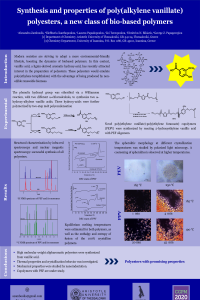
Nowadays, modern societies are striving to adopt a more environmental-friendly lifestyle. In this context, the conversion of biomass to value-added products has attracted a lot of interest both from academia and industry, and replacing monomers based on fossil resources by bio-based monomers is one of the key issues in polymer science. Lignin, among others, is a renewable feedstock, that can be used for the production of monomers for the preparation of bio-based polymers [1]. An interesting alternative bio-based building block which can be produced from lignin is vanillic acid or 4-hydroxy-3-methoxybenzoic acid [2]. In the present communication, our recent work on the synthesis of vanillic polyesters and their copolymers with poly(ethylene furanoate) will be presented [3]. Vanillic acid has been derivatized via a Williamson reaction to afford ω-hydroxyalkylene vanillic acids which were further polymerized. The thermal properties and crystallization behavior of the obtained polymers has been studied with differential scanning calorimetry, polarizing light microscopy and X-ray diffractometry. New insights, such as the enthalpy and entropy of fusion of 100% crystalline polyesters and the equilibrium melting temperature, will be presented. Additionally, the thermal stability of these polyesters has been measured by thermogravimetric analysis and the thermal decomposition mechanism has been studied by pyrolysis-gas chromatography/mass spectroscopy. Finally, the synthesis and characterization of novel poly(ethylene vanillate)-poly(ethylene furanoate) copolymers will be presented.
[1] Hillmyer, M.A. The promise of plastics from plants. Science 2017, 358, 868
[2] Fache, M.; Darroman, E.; Besse, V.; Auvergne, R.; Caillol, S.; Boutevin, B. Vanillin, a promising biobased building-block for monomer synthesis. Green Chem. 2014, 16, 1987
[3] Zamboulis, A.; Papadopoulos, L.; Terzopoulou, Z.; Bikiaris, D.N.; Patsiaoura, D.; Chrissafis, K.; Gazzano, M.; Lotti, N.; Papageorgiou, G.Z. Synthesis, Thermal Properties and Decomposition Mechanism of Poly(Ethylene Vanillate) Polyester, Polymers 2019, 11, 1672
Keywords
Vanillic acid
Bio-based polyesters
Poly(ethylene vanillate)
Thermal properties
Thermal degradation
Manuscript
Synthesis and properties of poly(alkylene vanillate) polyesters, a new class of bio-based polymers.pdf
Poster
sciforum-036121 poster.pdf
Phenothiazine-Chitosan Based Materials for Mercury Removal and Fast Naked Eye Detection
Vanillin Acrylate-Based Photocross-Linked Polymers: Synthesis and Investigation of Properties